
ESG Insights

Issue 194: Concord New Energy’s Reit speculation; Year-end goal for Indonesia-Singapore clean-electricity trade

This week in ESG: Renewable energy player still evaluating possibility of spin-off; country’s leaders mull kick-off for green electricity trade

Summarise
Kenneth Lim
Published Fri, May 15, 2026 · 07:00 PM
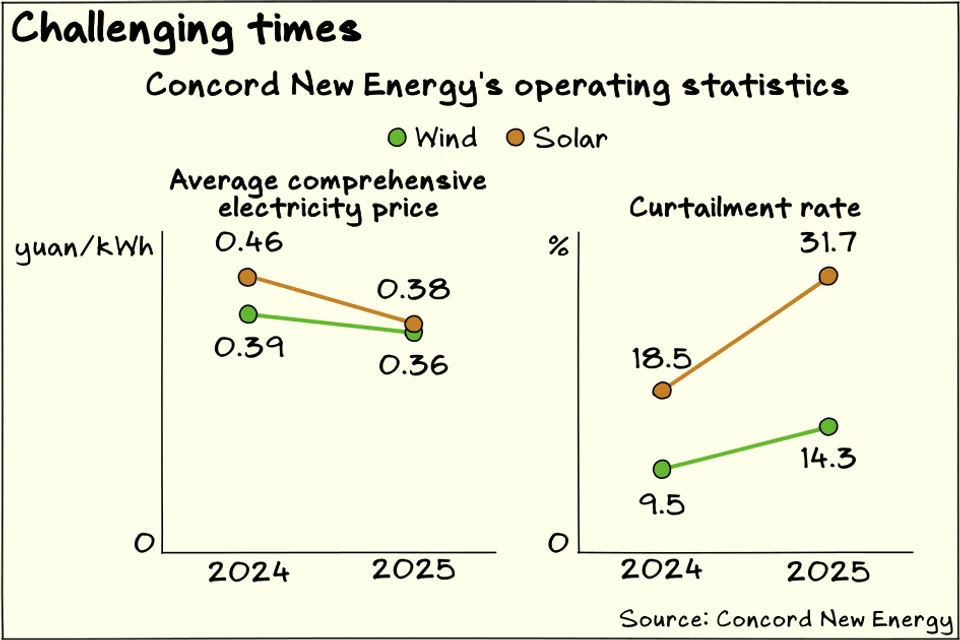
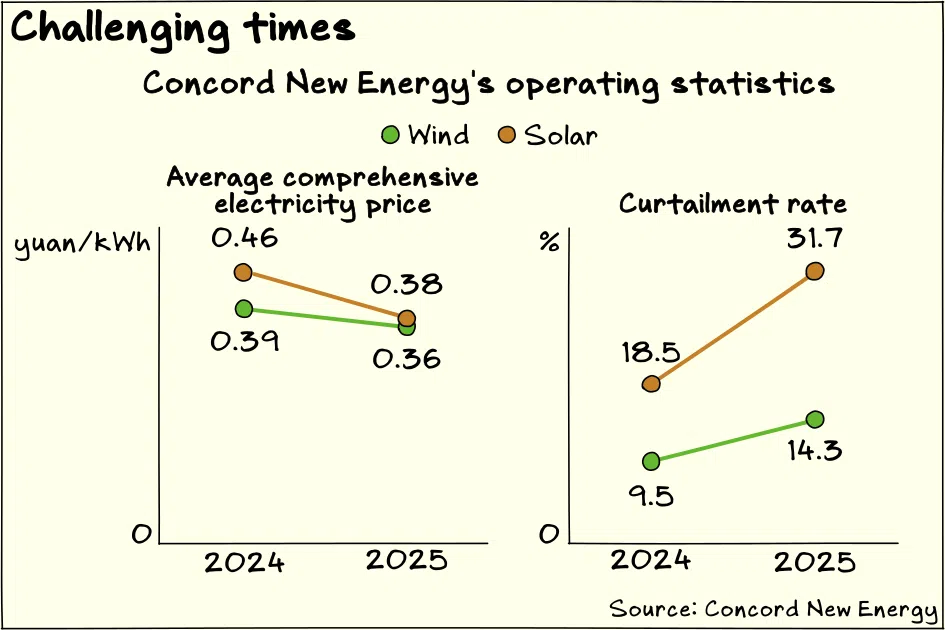
    • Concord New Energy took hits from higher curtailment rates and lower average tariffs in 2025.
    • Concord New Energy took hits from higher curtailment rates and lower average tariffs in 2025. ILLUSTRATION: KENNETH LIM

    Sustainable investing

    Concord New Energy Reit? Not so fast
    Renewables power developer Concord New Energy Group (CNE) hasn’t shut down speculation about selling a real estate investment trust (Reit), but this may not be the best time for the company to be spinning off assets.

    In fact, a friendly window of opportunity may not appear in the near future.

    That is because CNE’s assets are still mostly in China, where major structural challenges have led to high curtailment rates and lower tariff rates. CNE cannot easily come to market with any significant part of its portfolio until it builds up a stronger buffer of assets outside of China or until China’s renewables landscape improves.

    A new report asks CNE for comment on a 2025 interview in which a company executive said the company was preparing to issue Reits. In response to the latest query, CNE says it is still evaluating the possibility of doing so, with Singapore as a potential market.

    Turning that possibility into reality may be difficult.

    To begin with, CNE’s current portfolio is going through a rough patch at the moment.

    The company’s net profit attributable to shareholders fell to 139.7 million yuan (S$26.2 million) in 2025, about a fifth of the 805.1 million yuan that it earned in 2024. It was the second straight year of lower profits for CNE.

    Two major issues in the Chinese renewable energy market are weighing on CNE’s results. The first is the mandate to shift towards market-based pricing when renewable power is sold to the grid. Before 2025, a common pricing model for renewable tariffs was to fix them based on coal benchmark prices. That was great for generators of renewable energy, but municipalities would spend too much money buying too much renewable electricity and wasn’t sustainable. A new pricing model introduced in 2025 allows prices to be set at auctions and trading through contracts for differences. This works out better for buyers, but it means lower tariffs for producers, especially in markets with an oversupply of renewable energy.

    The second major issue in China is inadequate grid infrastructure that fails to balance local mismatches in supply and demand. Essentially, certain locations – especially in the northwest – have an oversupply of electricity, but the national grid is unable to transmit that surplus to other parts of the country where it can be used. The result is elevated curtailment, which refers to deliberate stoppage on electricity production, in renewables to maintain balance in the grids.

    The average comprehensive electricity price that CNE obtained in 2025 for wind assets declined 7 per cent to 0.3644 yuan per kilowatt hour (kWh). Curtailment rate, which refers to the percentage of unused capacity, rose to 14.3 per cent from 9.5 per cent.

    For solar the average price dropped 17 per cent to 0.3783 yuan per kWh as curtailment climbed to 31.7 per cent from 18.5 per cent.

    Pricing reform and curtailment means that CNE’s China portfolio isn’t just producing less electricity, it’s also getting less money from each unit of electricity produced.

    Almost all of CNE’s operating assets are in China. Capital markets are usually unwilling to pay premiums for underperforming assets. If CNE were to sell a Reit that contains properties facing the current headwinds, it probably wouldn’t get a good price for the spin-off – it would also be giving up on potential upside if and when the structural issues in China get fixed.

    CNE does have the option to keep the most problematic assets and sell the least encumbered ones instead to get a better price from the market, but doing so would leave it with a slow-growing portfolio in the near term that will hamper its ability to grow.

    A Reit doesn’t look like the optimal path at the moment, and it might not even be the right solution for a while. It’s possible that the dynamics in the Chinese market could improve, given that China has committed to a ramped up investment schedule in improving its grid infrastructure. However, infrastructure takes time, and it’s unlikely that the national effort will bring results quickly enough to meaningfully improve the outlook for CNE’s China portfolio this year.

    It’s an encouraging sign that while CNE hasn’t shut down speculation about Reits, the company hasn’t mentioned spinning off assets into a trust in its strategies for overcoming the current challenges. Instead, the company appears focussed – rightly so – on globalising its business, diversifying its customers and lowering costs, among others.

    CNE is also taking a number of steps to find new areas of growth and to diversify outside of China, and making some progress. A key example is its recent success in obtaining approval in Texas for 1 gigawatt of power capacity at its utility-scale solar and battery project there. The company is also actively pursuing data centre opportunities.

    A Reit spin-off could be a great way for CNE to demonstrate its ability to recycle capital and raise money, but the window of opportunity to do so doesn’t seem open at the moment. What’s more critical at this time is its ability to carry out its diversification strategy.

    Energy transition

    An Indonesia-to-Singapore boost to Asean Power Grid

    The stars could be aligning for a renewed push to ramp up development of the Asean Power Grid.

    Government leaders have discussed the possibility of kicking off sales of clean energy from Indonesia to Singapore by the end of the year. If that target is achieved, it could add another impetus for the Association of Southeast Asian Nations to significantly accelerate the Asean Power Grid in 2027 and beyond.

    The Asean Power Grid was formally adopted as an Asean objective in 1997, envisioned as a strategy initiative to improve the economic and energy resilience of the region. However, development of the project has been gradual, and the current target is only to connect the region’s grids by 2045.

    There’s an opportunity to move the initiative along meaningfully in the year ahead. First, the war in Iran has reinforced the rationale for building the Asean Power Grid. Supportive sentiment within Asean is at a high in the wake of the energy and supply chain disruptions caused by the Middle East conflict.

    A second potential driver arrives with Singapore assuming the rotating chairmanship of Asean in 2027. Singapore is a key stakeholder in the Asean Power Grid, if only because it will probably be a major source of demand for cross-border electricity trading. Clean-energy imports are a core pillar upon which Singapore’s climate ambitions are formed; a successful Asean Power Grid significantly helps Singapore to get closer towards its climate goals.

    A successful kick-off to Singapore imports of clean electricity from Indonesia could provide a third spark. Beyond connecting South-east Asia’s largest and wealthiest economies, it would provide a real-world model that can help to guide subsequent energy trading arrangements.

    On its own, each of those drivers might not move the needle much on the Asean Power Grid. However, when pulling together they have the potential to give a powerful kick.

    Other ESG reads



