Issue 195: Temasek to miss climate targets; Power, EVs dominate S-E Asia green economy
This week in ESG: SIA, Sembcorp emissions weigh on Temasek portfolio; Bain-Stanchart report values regional green economy at US$290 billion

Sustainable investing
Learning to live with missed climate targets
A reality check looms in the world of sustainable investing with only a few years to go before interim deadlines arrive for many companies’ climate targets.
Uneven progress on decarbonisation across geographies and industries suggests that many companies will fall short of their targets, and the market needs to become more sophisticated about discerning which misses are acceptable and which are not.
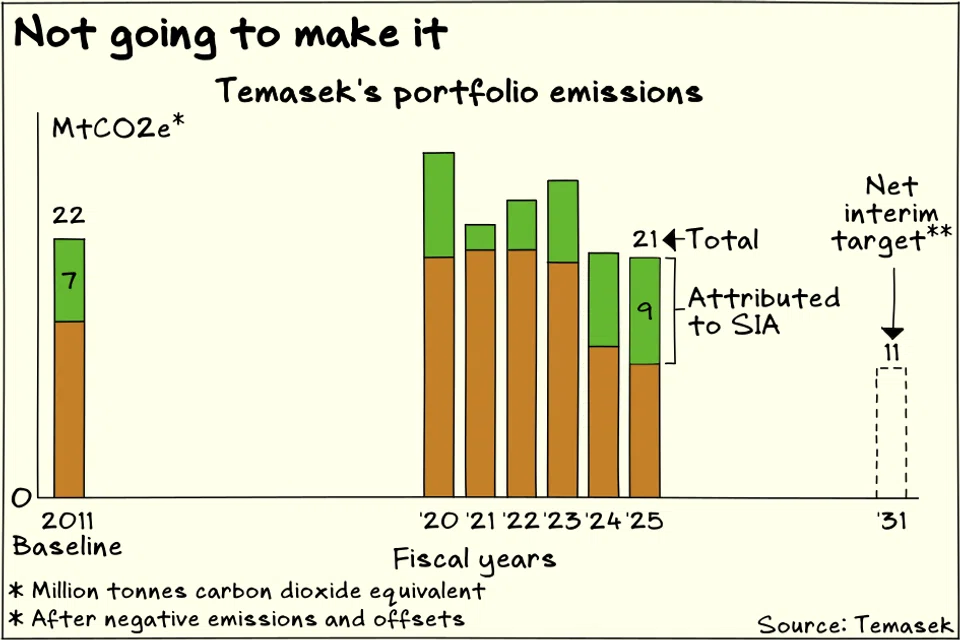
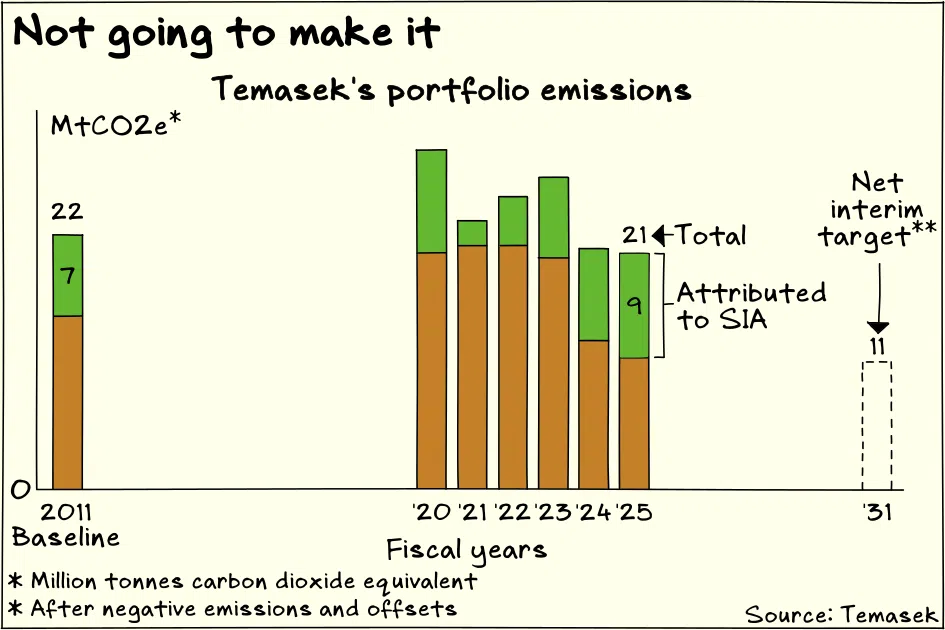
The latest miss comes from Singapore government-owned investor Temasek. Speaking at Ecosperity, the firm’s flagship sustainability conference, Temasek chief executive Dilhan Pillay says Temasek is unlikely to meet its 2030 goal to halve net portfolio emissions from 2010 levels. Temasek’s financial year ends in March, so its calendar 2010 emissions correspond to fiscal 2011, and calendar 2030 emissions to fiscal 2031.
Pillay attributes the expected shortfall to, in essence, Singapore Airlines (SIA) and Sembcorp Industries, two companies that are major contributors to Temasek’s portfolio emissions.
For SIA, decarbonisation has been particularly challenging with sustainable aviation fuel still in short supply and extremely expensive throughout the aviation sector.
At Sembcorp, growing demand for stable energy in key markets – including in Australia where a pending acquisition will add significant fossil fuel power generation assets to its mix – makes it challenging to reduce absolute emissions even as the company grows its renewable-energy assets.
Pillay explains that a number of global factors have evolved since 2019, when the firm set its climate targets. First, long-term investments are slowing due to volatile markets and higher financing costs. Second, fossil fuels remain entrenched in hard-to-abate sectors – such as steel, cement, power, aviation and shipping – with decarbonisation solutions still lacking scale or economic viability. Third, global energy demand continues to rise.
It is probable that more entities will have to join Temasek in issuing climate target warnings in the coming years.
Sembcorp has already said that it will not be able to achieve an original 2028 emissions reduction target due to the planned acquisition, and has revised its targets accordingly. Other airlines such as Air New Zealand have already had to revise their initial climate goals, and it would not be surprising if SIA were to join them.
The factors that Pillay cites are seen around the world, which means that while SIA and Sembcorp may be more prominent in Temasek’s portfolio, they are not the only companies struggling to meet their climate goals.
Announcements about misses will probably accelerate in the next few years, given that many interim climate goals are set for 2030. Market players will need to learn how to assess these misses as they arrive, because not all missed targets are bad.
In fact, markets must understand that a significant failure rate might indicate a healthy level of climate ambition among companies.
Climate targets necessarily rest on a fundamental assumption that business-as-usual is inadequate to address climate risks. Therefore, adequately ambitious targets should not be easy to achieve, otherwise success might not lead to meaningful improvement from business-as-usual.
Unreasonably punishing companies for missed targets can create perverse incentives.
For instance, companies afraid of missing targets might pick safe goals that are achievable but do not create meaningful impact. Companies might also resort to engineering disclosures and outcomes to create the illusion of progress. For example, a company could pick an unusually high-emissions year as a baseline, or manipulate ownership and contractual structures to shift problematic assets and activities out of the scope of the targets while retaining the economic benefits of those assets and activities.
It follows that failure rates should correlate with ambition levels. If the market demands high levels of ambition from companies, then it must tolerate more failures. The market just needs to figure out how to do so.
What might be some principles to guide that development?
First, the market – including investors, lenders and analysts – should recognise and value current progress, even if it does not reach early ambitions. This is not to argue that all progress is good enough. Rather, the market needs to develop ways to measure progress against a wider variety of benchmarks. For instance, a company that fails to hit its own climate goal but nevertheless decarbonises faster than its peers should be recognised as an outperformer even if it is overly ambitious.
Second, progress needs to be assessed holistically, not through only a one-dimensional lens of emissions or emissions intensity. A company’s strategy for meeting its targets should matter as well. Even if some of Temasek’s existing investments cannot decarbonise quickly enough, the missed targets could be mitigated if the firm actively engages with its portfolio companies and maintains a deliberate and significant investment tilt towards climate-aligned opportunities.
Holistic assessments must also account for short-term progress versus long-term trajectories, and for the real-world need to balance multi-faceted objectives, such as a just transition. A case in point is Sembcorp’s pending acquisition of Alinta Energy in Australia, which would raise Sembcorp’s emissions in the short term. However, Sembcorp and Temasek have noted that Alinta has a strong potential to grow its renewables business with a robust pipeline of projects, and that its fossil fuel-based generation provides essential baseload and grid stability to the communities it serves until those grids can be greened. Indeed, a more useful assessment of the deal would weigh Sembcorp’s transition plan for Alinta’s non-renewable assets instead of simply looking at emissions.
Emissions are fundamental to measuring climate impact, and there is a useful elegance to having a single metric through which all climate action can be measured. But transition progress and strategies are more complex, and emissions alone are limited in how much they can tell us about how well a company is doing in greening its business. A more complex story needs more sophisticated yardsticks, and the market needs to start developing those instruments quickly as 2030 approaches.
Sustainable finance
Green capital needs returns, too
One of the more interesting aspects of a new report on South-east Asia’s green economy is how tilted it is towards a couple of sectors.
The report, by Bain & Co and Standard Chartered, finds that about 80 per cent, or about US$31 billion, of the US$40 billion in annual green capex deployed in the region between 2021 and 2025 was spent on two sectors: power and grid, and the electric-vehicle value chain.
Chow Wan Thonh, Standard Chartered head of coverage for Singapore and Asean, says the two sectors sit at the intersection of “visible demand, policy certainty and scalable business models”.
“The concentration of investment reflects sustained policy support and deliberate market creation over time, particularly in areas like renewables and batteries,” she says.
There’s a message there for the rest of the green economy. Power and EVs are attracting most of the green investment capital because capital allocators see clear paths to returns. That’s not quite the same as addressing needs, although there are overlaps.
Take the power sector, for instance. A lot of the positive economics in renewable energy and energy storage are rooted in policy decisions. China’s energy transition policy, in particular, has helped to provide a strong and sustained demand signal that has enabled the rapid build-up of industrial capabilities and capacities in renewable power in the country. Those have led to China becoming a world-leading exporter of solar and battery products, and brought down the cost of solar and batteries around the world, including South-east Asia.
Before the current Iran war fuelled a surge of interest in energy resilience and energy security, most of the demand for solar and batteries in South-east Asia came about not because there was some inherent desire and need for solar cells and batteries. Instead, the demand grew because renewable prices fell enough to make them economically viable, and because of local policies that encouraged capital expenditures into renewables.
There are many green sectors of need that aren’t attracting investments like power and grids and electric vehicles. With global warming most likely to exceed 2 degrees Celsius above pre-industrial levels, climate adaptation and resilience are areas with huge investment requirements but where funding gaps are huge.
Policymakers, businesses and investors in these underfunded sectors have to figure out how to build routes to profitability if they want to attract investments.
Standard Chartered’s Chow says: “As a bank that works across markets and value chains, we see that the common thread is bankability—capital flows where projects can be structured, de-risked, and scaled…The implication for other green sectors is to move beyond identifying need and focus on creating investable pathways at scale.”
Other ESG reads
- Convergence of energy security and climate action is ‘fragile’: Ravi Menon
- Costs of energy transition likely to go up over short term due to Iran war, says OCBC CSO
- Temasek-backed fund under Singapore’s blended finance initiative hits US$800 million in second close
- CDL, DBS launch S$300 million green loan to advance nature-based solutions in Singapore
- IHH bags S$250 million sustainability-linked loan from DBS to promote safe use of antibiotics
TRENDING NOW
Grab CEO’s wife Chloe Tong on life with Anthony Tan and finding her purpose
Income Insurance appoints former Manulife Singapore top man as new CEO
Incidence of civil servants buying property near unannounced MRT stations ‘a concern’, but may not establish misconduct: PSD
Three ex-employees of Envy group join Ng Yu Zhi in bankruptcy