

Issue 196: AI’s complex role in sustainability; Keppel’s emissions targets
This week in ESG: AI hyperscalers now major funders of nuclear startups; Keppel well ahead on 2030 emissions goals

Sustainable investing
The greens and browns of AI
The sustainability impact of artificial intelligence (AI) brings to mind the end of Michael Jackson’s Black Or White music video, which shows a series of different people morphing into one another, along with the lyrics: “It’s black, it’s white, it’s tough for you to beat”.
Like the morphing montage, AI is a constantly evolving space of promises and threats that can be amazing for sustainability in one moment and terrible in another. But bane or boon, AI is a juggernaut that’s tough to beat, and the sustainability sector must learn how to harness it while avoiding its pitfalls.
There has been growing awareness that AI can be a beneficial force for sustainability.
In the energy sector, the biggest AI players – also known as hyperscalers – have emerged as major funding sources for advanced nuclear startups. That funding provides critical early-stage capital that would otherwise be challenging to obtain from banks or investors.
In an April report, the International Energy Agency (IEA) estimates that about 45 gigawatts (GW) of planned small modular reactor capacity has been announced to serve data centres.
In fact, AI is now driving a significant portion of low-carbon power development. IEA finds that tech companies account for about 40 per cent of all corporate renewables power purchase agreements (PPAs) signed globally in 2025.
A recent analysis by Temasek and Boston Consulting Group (BCG) estimates that deploying AI to climate and sustainability sectors could generate about US$600 billion of value annually. That number represents efficiency gains, cost reductions, and new revenue if AI is deployed at scale in areas such as industrial systems and equipment efficiency, climate risk modelling, grid storage and management, inclusive education and materials discovery.
But the hyperscalers’ investments in clean energy need to be understood within AI’s larger impact on the amount of energy it consumes and how it obtains that energy.
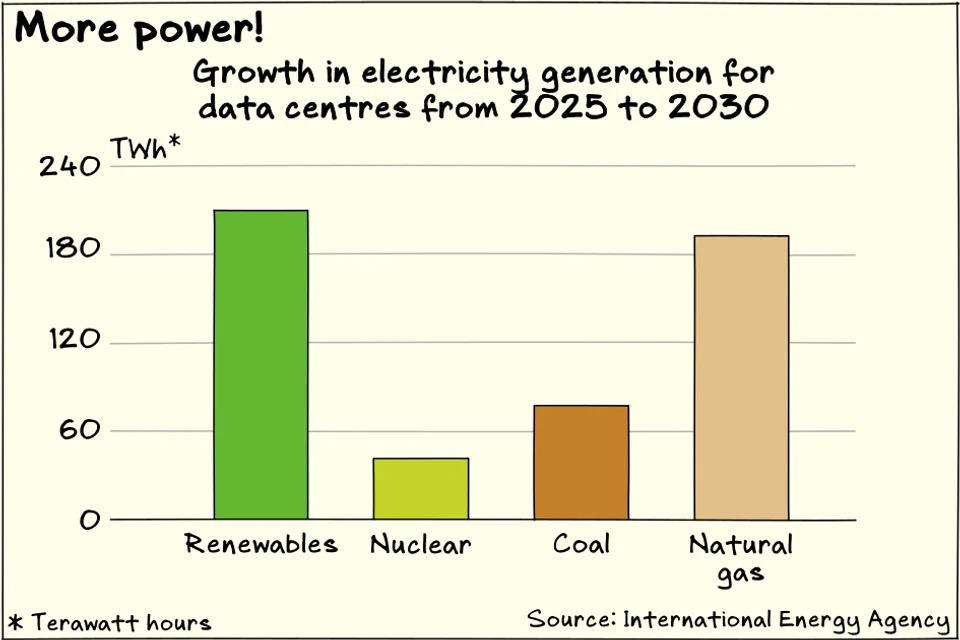
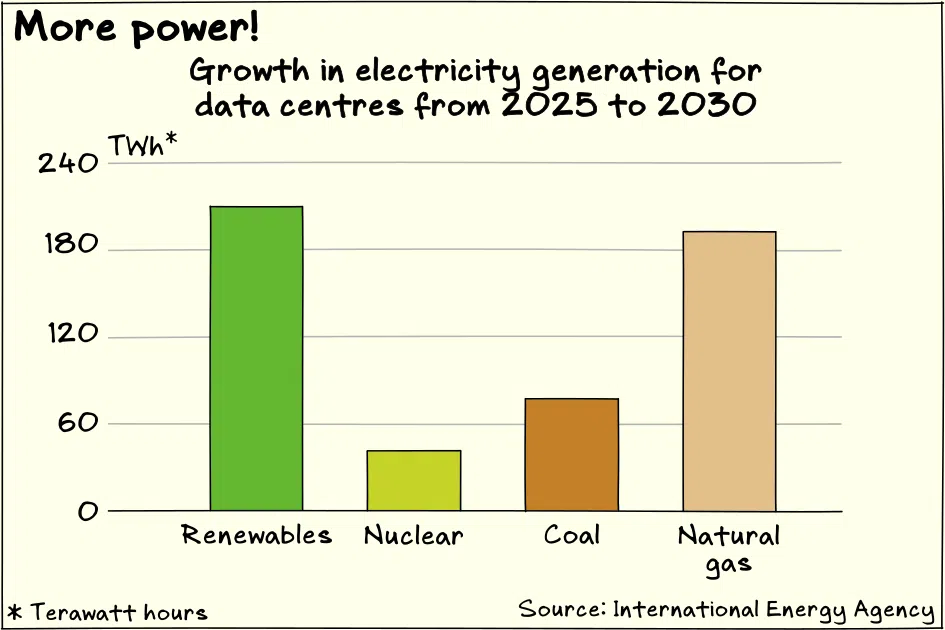
AI is a massive energy hog. Global electricity demand from data centres – which are used to train and run AI models – grew 17 per cent in 2025, IEA says. At AI-focused data centres, electricity consumption grew at an even faster 50 per cent. IEA’s base-case forecast is that data centre electricity demand will almost double to 950 terawatt hours (TWh) in 2030 from 485 (TWh) in 2025.
That huge and ballooning need for energy leads to some problematic outcomes from a sustainability perspective when renewable sources are not pursued. Data centres are contributing to a surge in demand for natural gas power plants, especially in the United States, Ireland and Malaysia. Malaysia said in 2025 that it could add 6 to 8 GW of gas-fired power by 2030 to address demand from data centres.
While natural gas power generation may have a lower carbon footprint than coal, it still produces significant amounts of greenhouse gases. Building new natural gas power plants now could lock in those emissions for the long term.
Furthermore, AI’s power needs can make it challenging for energy markets where the data centres are located to shift away from existing fossil fuel-based generation because baseload demand outpaces addition of renewables capacity.
The reality about AI is that it is here to stay. The grand vision of a general AI that is able to truly learn and reason on its own may be still a long way from reality, but within narrower fields – typically in highly constrained use cases where success and failure are easily defined and where data is robust – AI models have delivered results. There is enough success to sustain a meaningful industry even if AI never delivers on most of its promises.
Making AI work for sustainability instead of against it requires lowering the barriers for deploying AI in sustainability-aligned areas.
IEA identifies data as a key enabling aspect that should be a priority area to address. AI models rely on large amounts of high-quality data to determine solutions, and the current state of data in the energy sector is fragmented, low-quality and inaccessible, IEA says.
The agency recommends improving data sharing throughout the industry, especially across public and private domains. Data standardisation throughout the industry, regardless of jurisdiction, is also needed to facilitate the creation of large, integrated datasets that can help to relieve structural bottlenecks to wider AI deployment in the energy sector.
The energy sector can better integrate with data centres’ infrastructure, especially when it comes to energy storage hardware. Data centres with on-site renewable power need significant amounts of battery capacity to ensure stable supplies. Investing in advanced grid management technologies can help to integrate these assets with local grids, which would in turn improve those grids’ ability to tap intermittent renewable power sources.
Renewable energy stakeholders must also manage exposure risk to AI. While details of the PPAs are not typically publicly known, it is not unusual for offtake agreements in early-stage projects such as those signed with nuclear developers to be only loosely binding. If the AI industry fails to grow as expected and projects are cancelled, the nuclear and renewables sectors may be stuck with stranded assets.
It is important to understand that AI is not a silver bullet, and should not replace more conventional solutions and approaches to improving energy sustainability.
IEA reckons that AI deployment in the energy sector could save about 13.5 exajoules (EJ) by 2035. This might be significant, but IEA notes that the savings represent only about 3 per cent of today’s total energy consumption of about 450 EJ.
“While AI is an important tool for achieving energy sector goals, it cannot eliminate the need for more traditional policies and approaches to improve efficiency, accelerate the adoption of new technologies, and advance affordability and sustainability,” IEA writes.
Sustainability reporting
Time for Keppel to commit on Scope 3
Having made good progress on its initial emissions targets, it may be timely for asset manager Keppel to raise its ambitions and commit to addressing the significantly larger carbon footprint of its supply chain.
In its latest sustainability report, Keppel posts Scope 1 and 2 emissions of 21,312 tonnes of carbon dioxide equivalent (tCO2e) for 2025, which represent an 87.6 per cent reduction from a 2020 baseline. This is well ahead of its interim goal, set in 2021, of halving Scope 1 and 2 emissions by 2030. The group is also significantly ahead of schedule on its 2050 target to hit net zero on Scope 1 and 2 emissions.
The progress is commendable, and has come on the back of a robust decarbonisation strategy backed by steady execution. In 2024 and 2025, Keppel committed to S$5 billion of sustainability-linked financing. In 2025, the company spent S$108 million on innovation, including research and development into clean technology, and into green and smart buildings.
Keppel further set a target to source 50 per cent of electricity use from renewables in 2025. The company achieved 60.8 per cent of electricity from renewables in 2025, up from 40.7 per cent in 2024.
Yet for all of that progress, the emissions targets that Keppel set in 2021 address less than a per cent of the group’s total emissions impact. Scope 1 emissions refer to greenhouse gases directly produced by Keppel in its operations, such as the use of fuels and refrigerants. Scope 2 covers emissions produced from purchased heat, cooling and power.
But Keppel’s business model includes importing natural gas to Singapore and managing portfolios of assets, significant portions of which are in infrastructure and real estate. This means that the bulk of Keppel’s emissions impact falls under what is termed Scope 3, which covers emissions indirectly produced in a company’s supply chain like customers’ emissions from consumed gas or purchased construction services and office equipment. Yet Keppel’s formal emissions commitments omit Scope 3.
For 2025, Keppel reported Scope 3 emissions for categories that are relevant to the group of 6.7 million tCO2e, up 11 per cent year-on-year. The increase was primarily due to higher natural gas sales for Singapore’s electricity needs, accounting for about 83 per cent of the group’s Scope 3 emissions.
To Keppel’s credit, the group has consistently acknowledged and worked on addressing its Scope 3 impact. Its climate strategy includes plans to reduce Scope 3 emissions, with detailed approaches to its top three sources of said emissions.
Keppel’s real estate division even has an internal commitment to reduce Scope 3 emissions from purchased goods and services by 20 per cent per square metre by 2030 from its 2020 base year. However, the company has stopped short of including this as a formal commitment on the group level, and progress on that front is not reported. Keppel’s sustainability-linked financing framework also does not include Scope 3 emissions as a performance target.
Addressing climate risks and opportunities is an unavoidably long journey for companies, given evolving reporting standards and the work required to set up reporting systems. Starting with Scope 1 and 2 emissions was an appropriate approach for Keppel in light of what was feasible.
But navigating the climate transition also requires regular recalibration to ensure meaningful progress. Keppel’s largest exposure to climate risk and opportunities doesn’t lie in the narrow boundaries of Scope 1 and 2 emissions. It rests in the company’s supply chain as the operator of a nationally strategic gas supply business and the manager and operator of a vast portfolio of assets.
Taking firm pledges on Scope 3 reduction and reporting on progress provides investors and other stakeholders with vital information about how well the group is addressing those risks and opportunities.
Commitment always carries a risk of disappointment, but Keppel can take courage from its success so far on Scope 1 and 2. The group has already laid much of the foundation for taking the next step on its Scope 3 emissions, now it just has to commit.
Other ESG reads
- Preparing for climate risks helps companies weather Iran war shocks: SGX RegCo
- Geo Energy expects ‘further clarity’ on Indonesia’s plan to centralise commodity export controls
- Engie Factory Asia-Pacific is acquired by New Zealand venture capital firm Pacific Channel
- Asia insurers increasing infrastructure debt exposure as capital rules shift: Schroders
- Asia-Pacific’s energy transition demands a labour market transformation






