ESG Insights

Issue 203: Singapore reserves’ varied climate strategies ; industry urges regional energy coordination

This week in ESG: MAS on track with equity portfolio decarbonisation; Siemens Energy exec calls for regulatory alignment on energy security

Summarise
Kenneth Lim
Published Fri, Jul 17, 2026 · 07:00 PM
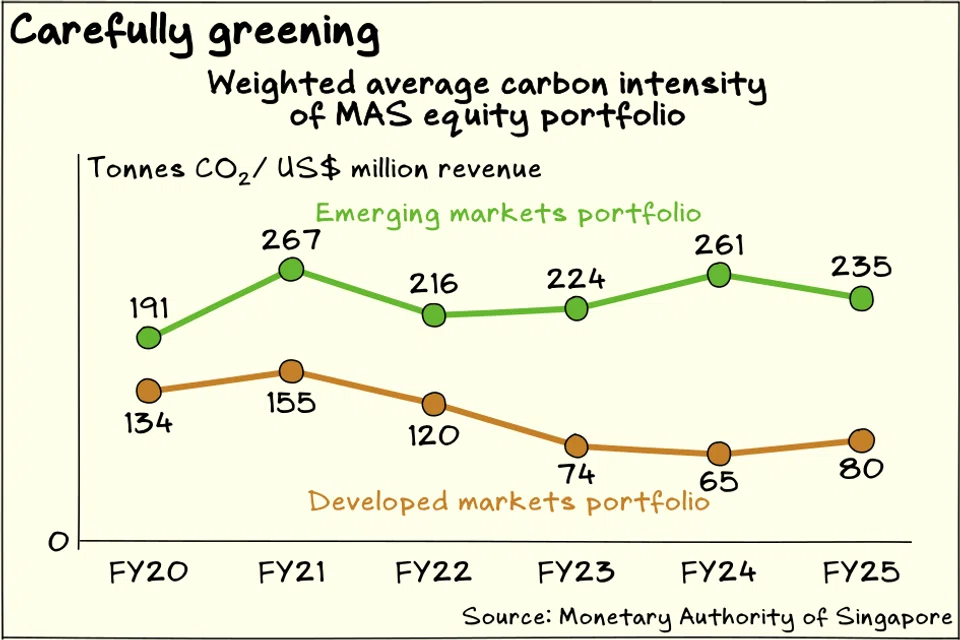
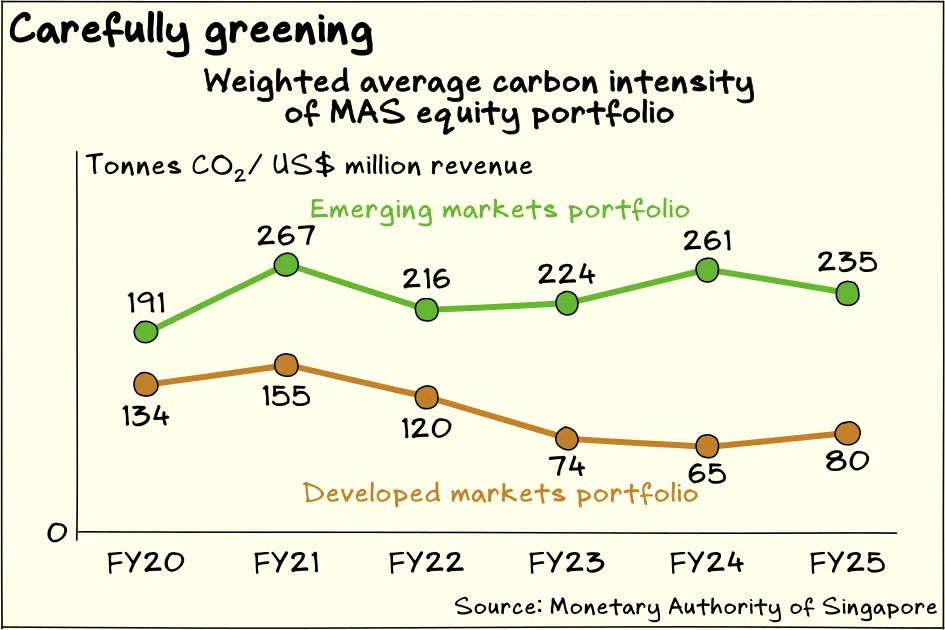
    • Led by its developed markets holdings, the Monetary Authority of Singapore is on track to halve equity portfolio emissions by 2030.
    • Led by its developed markets holdings, the Monetary Authority of Singapore is on track to halve equity portfolio emissions by 2030. ILLUSTRATION: KENNETH LIM

    Sustainable investing

    Different climate strategies within Singapore’s invested reserves
    The latest sustainability report from the Monetary Authority of Singapore (MAS) offers a glimpse into how differently managers of the country’s invested reserves address climate change.

    Crucially, the varied approaches employed by MAS, GIC and Temasek give Singapore’s reserves a diversified exposure to climate change at a broad portfolio level. That diversity could turn out to be an important form of risk management amid elevated uncertainties and fragmentation in the trajectory of climate action around the world.

    Singapore’s reserves are primarily invested through three entities. MAS, which is Singapore’s central bank and financial sector regulator, manages the official foreign reserves that are used for managing the Singapore dollar. GIC manages the government’s assets with a mandate to preserve and enhance the international purchasing power of the reserves. Temasek is an active, value-oriented equity investor with a mandate to deliver sustainable returns over the long term.

    MAS is the most conservative of the three, while Temasek is the most aggressive. Just as the three organisations have different objectives and risk appetites, they also chart their own paths in how they manage climate change.

    Different stances

    Philosophically, MAS is primarily concerned about risk when it comes to the impact of climate change on its portfolio, hence its focus on building climate resilience in its investments.

    GIC and Temasek are concerned with both the risks and opportunities from climate change. GIC explains its thesis: “We believe that companies with strong sustainability practices offer prospects of better returns over the long term, and that this relationship will strengthen over time as market externalities get priced in and are incorporated into the decisions of regulators, businesses, and consumers.”

    Temasek in its latest sustainability report states: “Our long-term success as an investor and institution is contingent on the presence of thriving businesses and economies, cohesive societies and communities, and resilient people and planet.”

    Temasek is the only one of the three to set portfolio emissions targets. MAS measures portfolio emissions and has provided guidance that it expects the carbon intensity of its equities portfolio, weighted by revenue, to reduce by up to half by fiscal 2030 from 2018 levels. However, the central bank has not committed to any emissions reduction targets for the portfolio.

    GIC has also decided against setting a portfolio emissions goal. GIC says it believes a bottom-up approach of engaging with companies to help them transition and considering companies’ circumstances are more impactful than a top-down strategy of mechanically excluding investments.

    “By focusing on real-world outcomes rather than portfolio emissions, we believe our efforts can have a greater impact in ensuring our actions contribute to lasting positive change in the real world,” GIC says.

    Varied deployment

    Not surprisingly, investment approaches can be very different when those theses are translated into portfolio strategies.

    MAS has been markedly deliberate and cautious in how it incorporates climate change into its management of the official foreign reserves. It began implementing its Climate Transition Programme in fiscal 2023 with the aim to adjust its equities benchmark in a way that will “gradually” shift the portfolio towards less carbon-intensive exposures.

    The programme currently uses two climate benchmarks – one off-the-shelf and one bespoke. MAS has only just completed a transition from passive to active management for the Climate Transition Programme, and has extended the programme to its corporate bonds portfolio.

    MAS has also committed to exclude thermal coal mining and oil sands activities from its portfolio. As at the latest reported year, MAS has reduced weighted average carbon intensity by 52 per cent in the developed markets equity portfolio and by 12 per cent in the emerging markets equity portfolio. It deems the progress as “good headway” towards the 2030 expectation.

    GIC and Temasek have integrated sustainability factors into their investment frameworks. Beyond that, each has identified investment opportunities along climate-related themes that are prioritised and receive allocations.

    However, Temasek goes a step further by using its investments to selectively pursue “positive impact”. For example, the firm deploys capital “to catalyse solutions that can enable companies to transition to a more sustainable future”, including climate financing platforms such as GenZero, Clifford Capital and Pentagreen.

    Temasek’s absolute portfolio emissions remain flat compared to 2011 levels, but are about a third below peak emissions levels from 2020. Temasek is aiming for net zero emissions by 2050.

    Diversified exposure

    Temasek recently shifted its baseline climate scenario to a “Fragmented World” situation where climate-related policies and ambitions are disparate. That unevenness makes the world more unpredictable.

    The result of the different approaches from the three managers is that, on a broad portfolio level, Singapore’s reserves have a somewhat heterogeneous exposure to climate risk and opportunities. In a world of unexpected trajectories, that diversity could provide an important hedge.

    Energy transition

    Policy hurdles to South-east Asian interconnectivity

    The market is sending an increasingly loud message in South-east Asia that policy remains the biggest hurdle to energy interconnectedness in the region.

    The latest to chime in is Siemens Energy group senior vice-president Thorbjorn Fors, who writes that while industry leaders are keen and able to answer South-east Asia’s call for greater energy security and grid resilience, they struggle to overcome persistent policy hurdles. That includes “permitting processes that vary dramatically by market, regulatory frameworks designed for national grids rather than cross-border ones, and coordination gaps that slow even well-capitalised projects to a halt”.

    “The challenge is not will or capital,” Fors writes. “It is alignment between regulatory systems that were built independently and now need to work together. From where we sit as a technology provider, the engineering is ready.”

    Fors is not the first, and will not be the last, to be frustrated by policy and regulatory problems in the region.

    Some of those problems are structural. The Association of Southeast Asian Nations (Asean) comprises 11 member states at vastly different levels of economic development. Asean’s consensus-based system means that regional coordination can only exist in the narrow spaces that exist between closely guarded national interests, which can dilute the impact and effectiveness of regional initiatives.

    A web of bilateral deals is sometimes used to overcome these issues. For example, Singapore is working with Indonesia to establish the trading of low-carbon electricity between the two countries.

    However, such webs naturally become inefficient the larger they grow, with stakeholders and capital struggling to navigate too many different parts. A truly regional approach is still the best solution for South-east Asia.

    There have been calls for South-east Asia to find and focus on mutually beneficial solutions, which is a sound approach because the equation on energy interconnectedness ultimately benefits every member of the region. But perhaps it is just as important to accept that getting to mutual benefits sometimes requires mutual sacrifices. For instance, energy exporters might have to be willing to give up some sovereignty and commit to long-term supply agreements, while importers might have to be willing to pay more for that assurance.

    The war in Iran may have served as a spark to catalyse greater political will in the region for interconnectedness. Energy security and resilience is an increasingly important pillar for stability in the region to support the rapid growth in economies, populations and electrification. The sooner that Asean can come together on this challenge, the more it will reap the gains.

    Other ESG reads