Issue 207: Al Gore’s sustainable investing claim; Qian Hu’s aquaculture expansion
This week in ESG: Former US vice-president sees no retreat in green investments; fish and aquarium equipment company starts lobster farming in Timor Leste

Sustainable investing
Shifting tides in green allocations don’t lift all boats
Former US vice-president and climate advocate Al Gore might be both right and wrong when he declares it a myth that investors are retreating from sustainable investing.
The ambiguity boils down to indications of a shift in the way that sustainable capital is being deployed. With the broad spectrum of green investing facing challenges overall, wary investors have placed greater emphasis on economic returns. Interest has therefore grown in sectors like energy infrastructure and adaptation and resilience where business models and investment returns are more resilient and predictable.
This shift signals a maturing market that is now better able to identify and reward winners. However, investors going for the easy wins may make it more difficult for areas of greatest need to attract private capital.
Gore tells The Business Times that the Iran War has sparked a desire among many countries to reduce reliance on fossil fuels, which has led to increased investments in renewable energy. Citing data from the International Energy Agency, Gore highlights that clean energy now accounts for 65 per cent of global energy investments, and has outpaced fossil fuel investments for the past 10 years.
Indeed, the hot green sectors are old news by now.
Renewables are having their day in the sun, but not because people are more interested in reducing greenhouse gas emissions. Rather, renewables are benefitting because they are seen as solutions for improving energy security. In its latest annual report, Singapore sovereign wealth fund GIC observes that “concerns over energy security and supply chain resilience are increasingly central to how countries approach energy transition”.
Growing demand for electricity from artificial intelligence and from increasing electrification – especially in transport – is also fuelling demand for renewables and electricity infrastructure solutions such as intelligent grid systems and energy storage.
GIC’s analysis suggests that investments related to the energy transition outpaced fossil fuel investments by 88 per cent in 2025. GIC also finds that global clean technology equities outperformed the MSCI All Country World Index by 45 percentage points between January 2025 and March 2026.
Adaptation and resilience opportunities are also catching the attention of investors that predict rising demand for solutions to deal with severe global warming, such as environment cooling and insurance.
But taking a step back from the hot sectors, sustainable investing as a whole is a challenging space to be in at the moment.
Global sustainable funds witnessed US$84 billion of net outflows in 2025, the first year of annual redemptions since tracking of the segment began in 2018, Morningstar has reported.
Morningstar says that some of the outflows stem from large UK institutional investors moving allocations from off-the-shelf environmental, social and governance (ESG) funds to bespoke ESG accounts in order to exercise better control over the funds. Nevertheless, the fund-rating house sees a “challenging” investment landscape in general, with net outflows in the US, UK and the rest of the world in the second half of 2025.
The sectoral growth in energy-related segments against the broader ESG pullback suggests that capital must be flowing out of certain green sectors.
One of those cooler sectors could be in carbon markets, which climate impact investor GenZero’s latest sustainability report suggests could still be struggling under the weight of uncertainties in credit integrity and policy. GenZero highlighted unclear authorisation processes, and slow and inconsistent implementation as operational hurdles for carbon credit developers and investors.
These shifts raise important questions about the impact of sustainable investing in the current investment climate.
On one hand, the current emphasis on economic viability puts sustainable investing on sounder footing. Renewable technologies like solar and batteries have emerged as feasible alternatives to fossil fuel-based energy, and that clarity catalyses investments at scale as has been happening for the past few years.
However, because the energy transition is a rapidly developing field, substantial investments, research and development remain to be done. And if investors only want to put money in the safest bets, projects where the need or impact are greatest might have a harder time finding capital.
For instance, an analysis in a 2026 report by Bain and Standard Chartered shows power and grid and electric vehicle value chain accounting for about 80 per cent of green capital expenditures deployed in South-east Asia’s six major economies. The skew suggests considerably slower activity for less popular green sectors like nature and agriculture.
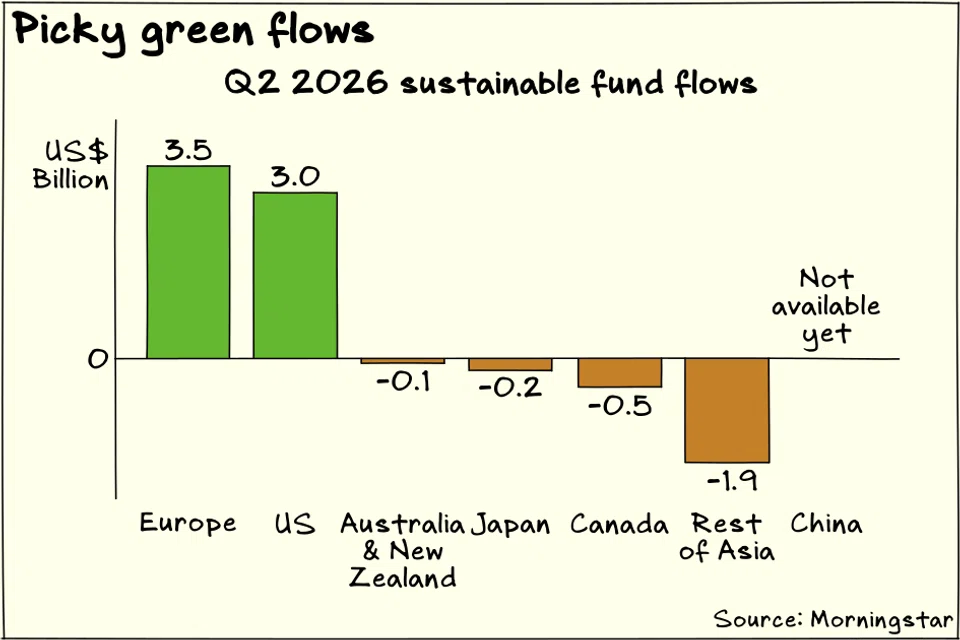
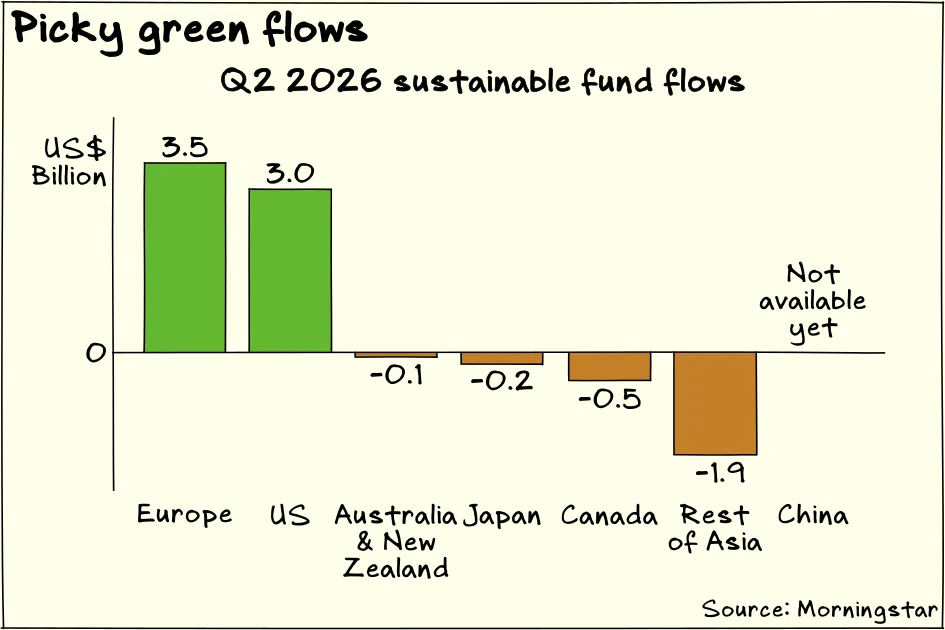
The mid-year 2026 update by Morningstar shows a divergence in fund flows between Europe and Asia ex-Japan, ex-China. While sustainable funds in Europe experienced a total US$11.7 billion of net inflows in the first and second quarters of 2026, Asia ex-Japan, ex-China saw US$3.9 billion of net outflows in two straight quarters of outflows. While quarterly numbers can be volatile for fund flows, the numbers suggest softness in developing Asia in the first half of 2026.
Gore himself is also aware of the returns-impact mismatch, saying: “Much of this surge towards the energy sources and the economy of the future is being financed largely in the rich countries, in the developed countries, and the developing countries have been denied access by the capital allocation system.”
To be clear, investors are not to blame. Investments ultimately need to deliver economic returns, and asset allocators naturally seek out the path of best risk-versus-reward. However, South-east Asia policymakers, industry bodies and businesses need to recognise the importance of creating investable and bankable solutions if they want to attract capital in today’s climate.
Sustainable investing
Qian Hu faces new risks and opportunities with Timor Leste farm
An expansion into aquaculture in the waters of Timor Leste could put Singapore-listed Qian Hu on the radar of sustainable investors.
If the ornamental fish and aquarium products company wants to make the most of that exposure, it will have to start properly measuring and auditing its impact on the host country’s ecosystem and society.
Qian Hu holds a 55 per cent stake in the newly incorporated Timor Aquahub International, a business set up to undertake sustainable lobster farming and seafood processing in the country.
Timor Aquahub managing director Roger Koh, who holds a 20 per cent stake in the joint venture, says about US$500,000 has been invested in the facility so far. The amount could double to US$1 million by the time buildout is completed by around September.
These are early days yet, but Qian Hu’s new operation could eventually create a new revenue channel with robust profit margins for the company. It could also tick a few boxes for sustainability-minded investors because the business could help to improve food security and uplift the livelihoods of people in its community in Timor Leste.
However, those same factors will also increase the company’s exposure to scrutiny from investors and civic society groups that are on the lookout for greenwashing. Qian Hu will have to ensure that its operations do not negatively impact the precious ecosystems in the waters around the facilities, and that it is not exploiting the local community.
Qian Hu’s sustainability report does not yet account for these issues, so it is something that the board and management will need to work on. Just as importantly, the company will need to figure out how to monitor and measure its impact on nature and local communities, and ensure that it audits and reports on its performance on these dimensions.
Other ESG reads
- Singapore grants approvals to import 900 MW of Malaysian solar power, including from Linggiu Reservoir facility
- Concord New Energy expects H1 profit to fall over 66% on drop in power generation
- What the reallocation of global energy capital means for Asia
- Malaysia renews 10-year energy plan, targeting savings of around US$21.5 billion
- Indonesian rubber growers bet the farm on oil palm