Issue 21: Singapore sparks its hydrogen plan; cross-border solutions bloom

In this issue: Hydrogen might be Singapore’s least-worst option for a green energy grid, while Shell explores carbon transport and storage in Singapore and Brunei.
Singapore
Preparing for the hydrogen boom
Singapore’s commitment to a 2050 target to achieve net zero emissions is igniting the development of a low-carbon hydrogen ecosystem.
Plans announced this week include exploring ammonia-based power generation, investing in hydrogen research, building up infrastructure and workforce training. The full works, in other words.
How does hydrogen fit into Singapore’s net zero plans?
For a country that doesn’t have enough land and resources to fully meet its energy needs from renewable sources such as solar and wind, Singapore will need to meet its energy requirements with two key imports: sustainable electricity that’s generated elsewhere, and low-carbon fuel that can be used to generate sustainable electricity domestically. The mix of imported sustainable electricity and low-carbon hydrogen will depend on how technology and politics develop in the years ahead.
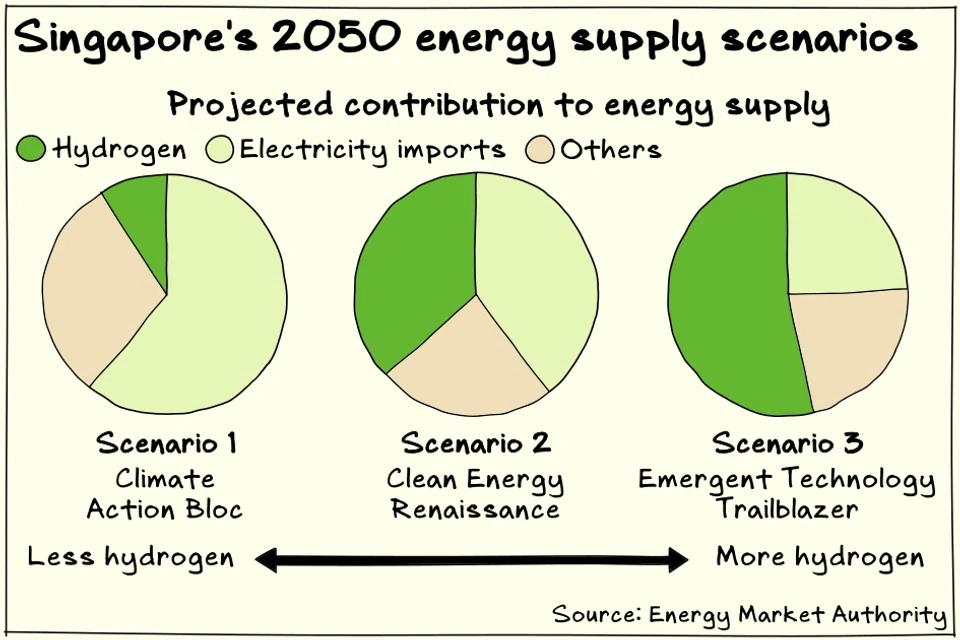
The Energy Market Authority’s Energy 2050 Committee Report lays out three scenarios, with reliance on hydrogen ranging from 10 per cent to 60 per cent of total supply.
The scenario with the least reliance on hydrogen envisions slow technological advancement in hydrogen, but a cooperative stance between countries that makes electricity imports the mainstay of Singapore’s energy supply in 2050.
The scenario with the most reliance on hydrogen paints a picture of a fragmented world in which sustainable electricity imports are insignificant, and Singapore has to import low-carbon fuel to generate sustainable electricity within its own borders.
In between those two scenarios is one in which technology and geopolitics are both climate-progressive, and Singapore is able to achieve a balanced mix of energy sources.
Hydrogen is the least-worst option for Singapore as an alternative to renewable energy and electricity imports. Unlike nuclear energy, which comes with related pollution and geopolitical complications, hydrogen is relatively trouble-free. It is no coincidence that 26 countries have published low-carbon hydrogen strategies, and more than 20 have announced the intention to develop those strategies, according to the International Energy Agency’s 2022 Global Hydrogen Review.
Perhaps the biggest problem with hydrogen at the moment is that “green” hydrogen, which is hydrogen produced through the electrolysis of water using sustainable energy sources, is prohibitively expensive. S&P Global Ratings estimated in 2020 that low-carbon hydrogen prices would have to fall by more than 50 per cent to be viable.
Hope for feasible prices rests on a few possibilities: One, that the cost of electrolysis will fall significantly with research and development. Two, that “blue” hydrogen, which is hydrogen extracted from natural gas, will become green enough with advances in carbon capture, utilisation and storage technologies. Three, that transportation and storage will be more efficient – especially if hydrogen systems use existing infrastructure for natural gas. Finally, that economies of scale will emerge as more countries commit to hydrogen and help to grow global marketplaces for hydrogen.
When and how much Singapore relies on hydrogen will depend on four signposts:
- Global investment levels in developing hydrogen
- The emergence of modes and standards for hydrogen storage and transportation
- Global production capacity
- Global shipping capacity
Other Singapore stories
OCBC joins Net-Zero Banking Alliance, to announce targets by H1 2023
Keppel Infrastructure to explore green ammonia and renewable energy opportunities with Greenko
South-east Asia
Solutions across borders
Decarbonisation is everyone’s problem, even if everyone’s problem is different. While the challenges of getting to net zero can be vastly different depending on where you are, on a global level those challenges are all connected.
Multinational and cross-border developments should, therefore, increase as countries and companies progress on their decarbonisation journeys.
Shell Eastern Petroleum this week said it had signed a memorandum of understanding with Brunei Shell Petroleum to explore carbon transport and storage options in Brunei and Singapore.
Meanwhile, a World Bank-backed carbon credit data-sharing platform is set to go live in December with the aim of helping to facilitate Article 6 of the Paris Agreement. The latter lays out principles that address the double claiming of carbon credits by governments and buyers in cross-border transactions. The Climate Action Data Trust, which also has the support of the International Emissions Trading Association, will be domiciled in Singapore.
Other South-east Asia reads
Supporting the decarbonisation transition of South-east Asia’s SMEs
Impact fund for sustainable transport startups raises over 100m euros in first close
Good reads
Carbon impact on global equity benchmark could be 0-14% of earnings: GIC