

Issue 213: Singapore public-sector green bond issuance nears limit; companies lag on physical climate risk assessment
This week in ESG: Singapore public-sector green debt hits S$31 billion; MSCI finds detailed climate risk disclosures lacking

Sustainable finance
Keeping the Singapore green bond train going
The Singapore government may need to lift its guidance on public-sector green bond issuance, or it might have to slow the pace at which it sells environmentally friendly debt in the next few years.
The Singapore public sector has issued S$25.8 billion of green bonds as at end-March 2026, based on numbers released in the latest edition of the annual Singapore Green Bond Report. This includes sovereign green bonds issued by the Monetary Authority of Singapore as well as green notes issued by statutory boards.
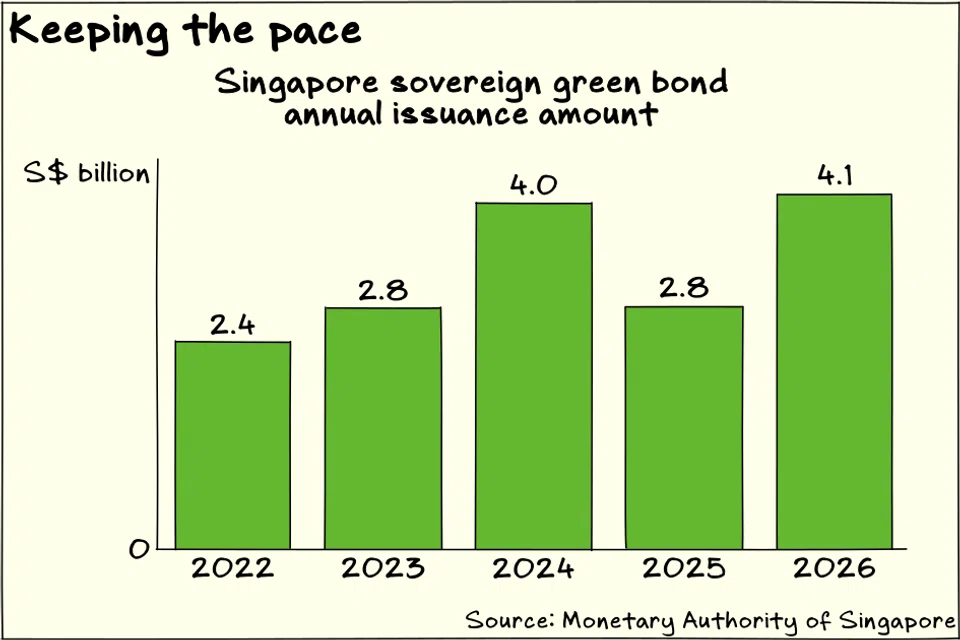
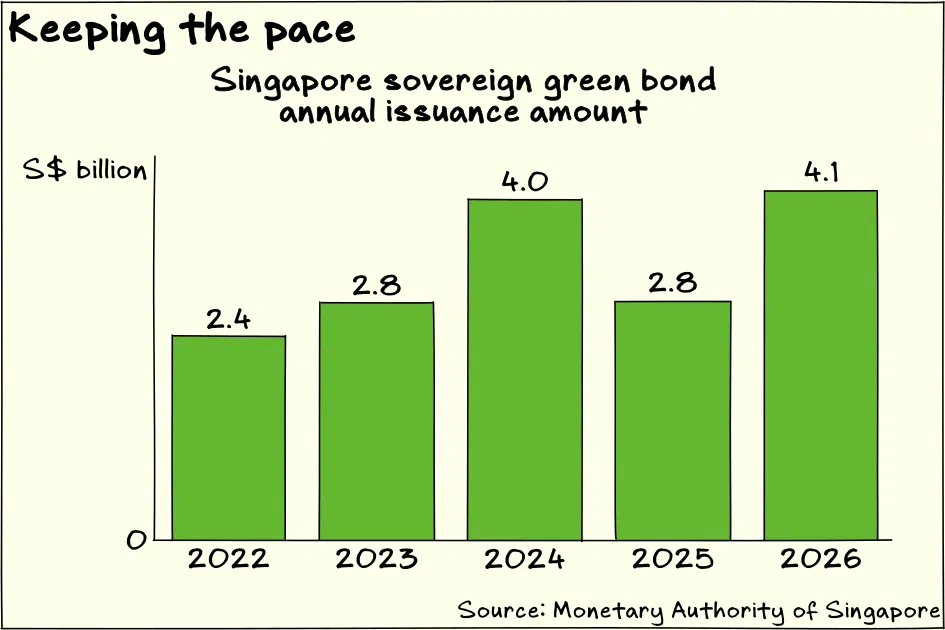
Since April 1, the Singapore government has issued another S$4.1 billion of sovereign green bonds – a S$1.5 billion re-open of 30-year bonds issued on April 1 and a S$2.6 billion syndicated sale of new 20-year bonds issued on Aug 3 – while the Housing Development Board sold S$1.115 billion of five-year notes in May.
That brings the total issued public-sector green debt amount to just over S$31 billion. The Singapore government has committed to issuing “up to” S$35 billion of green bonds by 2030.
That guidance leaves about S$4 billion of borrowing room in the next few years, which works out to an average of about S$1 billion to S$1.3 billion a year depending on whether “by 2030” includes 2030. Annual issuance at those amounts would be considerably below the roughly S$5 billion to S$7 billion pace of green issuance by the public sector between 2021 and 2026.
For sovereign debt, annual issuance between 2022 and 2026 averaged about S$3.2 billion.
The Singapore government could seek to raise the limit to keep the public-sector green bond programmes going, for a few reasons.
The first is that the green bonds have been generally well-received by the market, with every issuance oversubscribed and priced aggressively, which means that the public sector has been able to finance its projects at a relatively low cost. The latest green bond offering was the 20-year sovereign deal that priced in July to yield 2.4 per cent, about 15 basis points tighter than initial guidance.
The second reason is that the public-sector bonds help to establish a benchmark yield curve for the corporate green bond market, which is important to support Singapore’s status as a regional green finance hub. Regular issuance is needed to maintain that benchmark yield curve. For instance, the first 50-year green bond due 2072 was issued in 2022, and with each passing year it becomes less representative of 50-year yields.
A third reason is that the sovereign green bonds play a role in allocating fiscal costs for long-term infrastructure projects to better align cost and usage. The green bonds – technically Green Singapore Government Securities (Infrastructure) bonds – fall under a fiscal budget rule that allows the Singapore government to recognise their cost when the projects that they fund become operational. The current green bonds are allocated for the Jurong Region and Cross Island rail lines, so the development costs for these lines will be mainly borne by fiscal budgets after those lines open.
If Singapore were to raise its guidance on green bond issuance, an average annual ballpark might be a more useful way to give the market a heads up than a cumulative cap. This would allow public-sector green bond issuance to maintain a predictable pace that funds public-sector projects as well as supports the development of the green finance market.
However, fiscal considerations need to be addressed. An ongoing debt policy would need careful review to ensure that it is aligned with Singapore’s disciplined fiscal approach. One solution might be to separate statutory boards’ green debt from sovereign green debt in the issuance guidelines, since statutory board and sovereign debt financing are fiscally distinct.
Sustainability reporting
Staying ahead of physical risk
It’s one thing to acknowledge that you’re exposed to risk, and another to actually do something about it.
A new MSCI study finds that while most companies in Singapore and across the world declare that they face physical climate-related risk, only a fraction provide details about how those risks could affect their business. With physical climate shocks becoming more frequent and severe, companies might want to put more effort into managing that exposure.
Of 540 Singapore companies analysed for the study, 98 per cent mentioned physical climate risk in their annual or sustainability reports. However, only 26 per cent of the companies provided detailed disclosures about such risk. Globally, 81 per cent of assessed companies mentioned physical climate risk, but only 27 per cent explained that risk in detail.
The study defines “detailed” disclosure as identifying one or more physical hazards, and explaining the hazards’ past, present or potential impact on business through pathways such as asset damage, business disruption, costs or supply-chain effects. Merely mentioning extreme weather, natural disasters or physical climate risks without specifying hazards and impact pathways does not qualify as detailed.
The large gap between generic mentions and detailed disclosures raises concerns. One possibility is that companies are merely going through the motions of highlighting climate risk without following through to analyse and manage that risk. It is also possible that companies are addressing those risks but not disclosing them in their annual or sustainability reports.
Companies are either paying lip service to climate risk or failing to give investors adequate information about risk management. Neither possibility is desirable.
MSCI’s analysis of US disclosures shows that almost 6 per cent of US companies – or one in every 17 – disclosed physical climate-related shocks between 2023 and 2025. While it might be tempting to interpret those numbers as an indication that most companies have not been subject to physical climate shocks over the past two years, doing so would be foolish.
The analysis also shows that in the early 2000s, fewer than one per cent of US companies – or only one in every 105 – encountered climate-related shocks. Moreover, MSCI looks at companies that have disclosed both physical climate risks and detailed physical risk disclosures, and finds that almost three-quarters of such companies began detailed disclosures only after encountering a shock event. Those findings suggest that material climate-related events are increasingly frequent, and that companies tend to underestimate their vulnerability to such events.
Indeed, the fact is that physical climate risk is becoming more frequent and severe. Research by Aon shows growing global economic losses from natural disasters, with the 2020s annual average of US$388 billion higher than the 21st-century average of US$336 billion. Furthermore, the number of billion-dollar events has been steadily climbing over the years, hitting a high of 71 events in 2023. Wildfires, flooding and severe convective storms, in particular, are growing perils.
While the overall trend of climate-related risk is upwards, actual risk can vary significantly from market to market, sector to sector and company to company. A real estate developer with fixed assets has a very different intersection with climate risk than an offshore and marine engineering business.
That’s why companies need to go beyond a generic declaration about physical climate risk. If the risk is important enough to acknowledge, it should be important enough to manage. And if a company is going to go through the trouble of assessing and addressing physical climate risk, then it should disclose those efforts accordingly. Disclosure not only allows investors to better understand the company’s climate-related risk strategy, it also signals to the market that the company is better prepared for unexpected shocks.
Straits Times Index (STI) component companies are already required to report on climate-related physical risks under Singapore’s listing and accounting rules. Large, non-STI listed companies will have to start doing so for fiscal 2028 onwards, followed by all other listed companies for fiscal 2030 onwards.
Singapore’s listed companies still have some breathing room, but the regulatory trajectory is clear, and now is the time to begin building the capacity to manage physical climate risk.
Other ESG reads
- Malaysia’s Securities Commission to ask listed firms for El Nino plans, eyes closer Middle East ties
- Indonesian tycoon creates coal mining giant with 30% Bayan stake deal
- Hong Kong weighs tougher climate finance disclosures for banks
- EU to require data centres to disclose energy and water efficiency
- Climate action needs a reset. COP31 offers a crucial window for that
TRENDING NOW

Grab CEO’s wife Chloe Tong on life with Anthony Tan and finding her purpose

He built the Vingroup empire. Now South-east Asia’s richest man is handing some key roles to his sons

HDB reviewing ‘jumbo’ flat scheme after Telok Blangah unit listed for sale at S$2.18m

What role can Japan play in Asean’s future?

