

Issue 215: Coal’s role in South-east Asian energy security; Singapore’s electricity import woes
This week in ESG: International Energy Agency sees regional coal demand growing 4.4 per cent annually; Wood Mackenzie expects Singapore to miss import goal

Energy transition
Beware the overly narrow view of energy security
The reframing of the renewable energy transition as a matter of security instead of a climate priority has been a mixed bag for climate action.
On one hand, the security impetus has fuelled a desire among many countries to diversify away from oil and gas towards more renewable sources of energy. However, the pursuit of energy security has also rekindled the lifespan for coal, especially in countries like Indonesia or Vietnam where domestic coal resources exist.
An important lesson lies beneath that dynamic: The energy transition cannot be tackled as a one-dimensional problem, or it will fall short. Just as the climate change movement has learnt that the energy transition cannot happen at the expense of energy resilience and security, the pursuit of secure energy must be undertaken with the understanding that global warming is ultimately destabilising. Coal and fossil fuel policies should not close a window but leave the door open.
That dissonance between the climate-first and security-first approaches in the energy transition is apparent in the International Energy Agency’s (IEA) Asean Energy Security Review, which projects that while renewables will capture a larger share of electricity generation in South-east Asia in the next five years, coal and gas generation will continue to grow as well.
The review’s projections trace from a fundamental expectation of growing energy needs in the region. For instance, electricity demand in South-east Asia is expected to grow at an average of 5.4 per cent every year from 2026 to 2030 on the back of growing demand for cooling, data centres and industry.
The security question as addressed by the review is how to “ensure the uninterrupted availability of energy at affordable prices, while maintaining the flexibility and resilience needed to manage shocks and longer-term stresses”.
The review’s recommendations are centred on three key strategies: Diversify energy supply sources and routes, make greater use of domestically available energy resources, and accelerate electrification alongside efficiency improvements.
Renewables tick many boxes. For example, the review describes South-east Asia’s solar supply chain self-sufficiency as “among the world’s most secure” with existing manufacturing capacity able to supply projected regional demand across solar modules, cells and wafers.
Looking ahead, the review expects wind generation in South-east Asia to grow by about 26 per cent annually from 2026 to 2030, while solar generation could grow by about 23 per cent a year over the same period. Together, solar and wind’s share of the region’s electricity mix will increase to 11 per cent by 2030 from about 5 per cent in 2025.
The security challenge for greater adoption of renewables in the region has less to do with generation capacity and more with improving grid and storage infrastructure to handle the inherent variability of solar and wind generation.
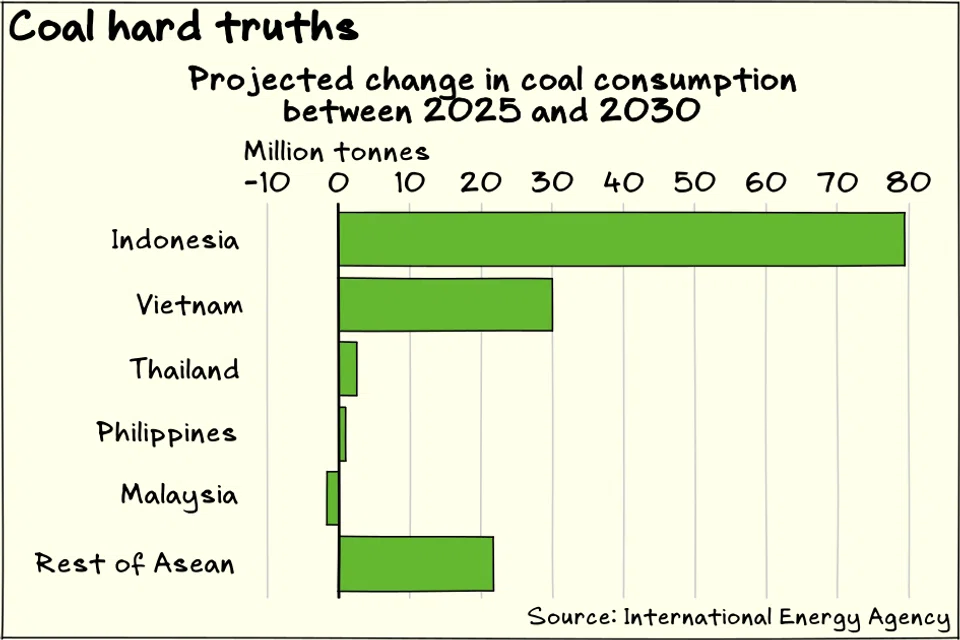
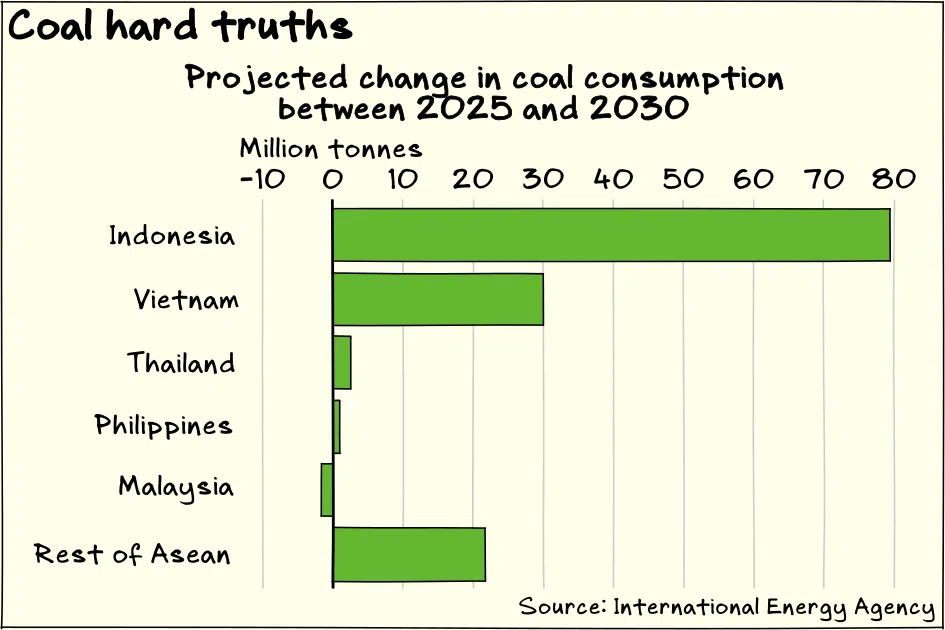
But renewables are not the only source of energy that is growing. The review projects that coal demand in the region will grow by about 4.4 per cent annually through 2030, the fastest pace globally. Indonesia, the world’s largest coal exporter, accounts for more than 56 per cent of the growth, with Vietnam and the Philippines also growing coal generation in the coming years.
The reason is simple: Self-reliance is the key to energy security. If you’re a coal-producing country like Indonesia or Vietnam, the logical thing to do for energy security is to continue to use coal.
Coal is also a cheap and energy-dense fuel. The widespread use of captive coal plants – off-grid coal generators – for industrial uses in Indonesia also makes coal difficult to replace without significant costs to communities and economies.
“Indonesia has committed to reach net zero by 2060 or earlier,” the review notes. “This presents some challenges as coal is expected to remain important for both the power and industrial sectors, particularly for nickel processing. Coal is also an important provider of jobs, as well as state revenues through taxes and royalties. Some regions in Indonesia, such as East and South Kalimantan, are among the most coal-dependent regions in the world.”
Nevertheless, the review highlights the risks of continued dependence on coal without plans to transition to greener alternatives.
For example, continued reliance on captive coal in nickel production “may raise future transition costs, complicate net zero pathways and create export risks if importing Asean member states apply stricter sustainability standards to nickel supply chains”.
There is a danger in taking too narrow a view when framing the energy transition as a security issue.
There is no doubt that sufficient and reliable energy is essential for countries, especially in fast-growing South-east Asia. But policymakers and businesses must take a more holistic approach to energy security.
First, policies need to consider long-term security alongside short-term needs. Coal and natural gas may keep the lights on for now, but are these solutions that would still make sense a few decades from now?
Second, climate change needs to be recognised as a security concern as well. The planet-scale impact of climate change – weather catastrophes and agricultural losses, for instance – has the potential to cause tremendous disruptions to social and economic systems. Lights at night are important, but so is food at mealtimes. The impact is also widespread across many vectors – for example, higher temperatures can reduce the efficiency of solar panels.
The shift in the energy transition conversation to one dominated by energy security has helped to highlight the benefits of renewable energy beyond being greener. But it is important to ensure that the new paradigm does not devolve into short-sighted actions concerned only with geopolitics. Just because a war in the Middle East is highly consequential at the moment does not mean that climate change has lessened or that climate needs are no longer pressing.
Energy transition
Time to sharpen Singapore’s energy transition strategy
It seems increasingly likely that Singapore will miss its interim climate goals as a major energy import strategy struggles to progress quickly enough.
Singapore is likely to miss its target of importing about 6 gigawatts (GW) of low-carbon electricity by 2035, says research firm Wood Mackenzie. As a result, green electricity imports will probably account for only about 15 per cent of the electricity mix by 2035, about half of the targeted one-third contribution.
Wood Mackenzie’s projection is based on the fact that although Singapore has approved 9.25 GW of import projects, none of that capacity has begun construction. The analysis identifies a few key hurdles that hold back progress: “Export permit frameworks, project bankability, cross-border transmission financing, and the lack of a complete market mechanism that allows Singapore buyers to claim the carbon value of imported electricity.”
The challenge for Singapore is that none of these hurdles are fully within its control. For example, Wood Mackenzie notes that Vietnam still has no legal mechanism for a foreign developer to develop generation and to export it through a dedicated undersea cable. Cambodia lacks an export regulatory framework and surplus generation, with blackouts a regular occurrence. The firm does not expect exports from either country by 2035.
Singapore has pledged, under the terms of the Paris climate agreement, to reduce greenhouse gas emissions to 60 million tonnes of carbon dioxide equivalent (MtCO2e) by 2030 after peaking earlier. By 2035, the country aims to reduce emissions further to between 45 and 50 MtCO2e.
Singapore’s emissions remain on an upward trajectory. Singapore reported national emissions of 55.5 MtCO2e for 2023. The country’s total electricity generation in 2023 was 57.4 terawatt hours (TWh). In 2025, generation increased about 5 per cent to 60.4 TWh. Singapore’s grid emissions factor declined only about half of that between 2023 and 2024.
Electricity demand is also growing faster than initially expected. In a September call for bids to develop additional gas-fired generation by 2031 and 2032, the Energy Market Authority revised its earlier outlook for peak demand. The official projection is now for peak demand to increase at a compound annual growth rate of 2.9 to 6.5 per cent from 2025 to 2034, higher than the initial forecast of 2.4 to 4.8 per cent.
Singapore will probably have to revise its climate targets to better align them with current circumstances, but the more important task is to review the climate strategy to find ways to hasten progress on the country’s energy transition.
Energy imports seem unavoidable for resource-starved Singapore, so Singapore needs to sharpen its plan to overcome the hurdles to progress. Those hurdles were not all apparent when Singapore’s Energy 2050 Committee first formalised imports as a key pillar of the energy transition in 2022, but now they are. Reviewing the climate goals present an opportunity to be more focused about addressing these roadblocks.
The green-alternatives pillar can also be better focused on pathways that are more promising. Green hydrogen may not be as likely as once thought with viable scale still elusive. Nuclear looks increasingly like the most feasible way to lower domestic generation emissions. The geothermal pathway is still very nascent, but it could be worth accelerating research so that its feasibility can be determined sooner.
Other ESG reads
- Related story 1
- Related story 2
TRENDING NOW

Mooted COE changes will solve category issues, but higher premiums likely: observers

Grab CEO’s wife Chloe Tong on life with Anthony Tan and finding her purpose

Once staunchly pro-China, Malaysian Chinese businesses are now distancing themselves from Beijing
Cliff Tan has 7 million followers and a 4-month waitlist. Why won’t he expand his business?

