Issue 217: Time to face palm oil’s transboundary problem
This week in ESG: Singapore issues haze notices to palm oil companies

Sustainability policy
The Transboundary Haze Pollution Act isn’t working. Now what?
A severe season of the haze in Singapore and Malaysia inevitably brings on watery eyes, scratchy throats and angry fists pounding about the injustice of fires in Indonesia spreading harmful air pollution to neighbouring countries.
Tears and coughs are easily treated, but cross-border pollution is tougher to remedy. As Singapore pursues “every legal and regulatory lever”, tougher requirements on traceability backed by economic consequences should be explored.
The haze is mainly caused by fires lit by palm oil farmers in Indonesia who are seeking to clear the land at little cost.
Singapore’s existing regime for addressing the haze is embodied in the Transboundary Haze Pollution Act (THPA). During the last severe haze episode in 2015, Singapore issued legal notices under the THPA against six companies. Two of those cases have been closed, while four remain under investigation.
This round, Singapore has issued notices against 10 companies, ordering them to take preventive measures against the fires creating the haze and to submit action plans on those measures. Three of the companies were also issued notices in 2015. It’s clear that the THPA is ineffective.
The THPA route suffers from a number of challenges.
One of the biggest is that the THPA requires the Singapore government to establish fault, but does not provide the means to do so. Singapore Minister for Sustainability and the Environment Grace Fu has mentioned the work required to determine who might be responsible, including having to analyse satellite imagery and meteorological data, and integrating information from various sources.
Official plantation information as well as enforcement action also requires the cooperation of the Indonesian government, a diplomatically sensitive channel that complicates Singapore’s ability to obtain the outcomes it requires.
The result is that closing a case is almost impossible unless many cards fall into the right place. That is why most of the cases from the 2015 round are still open, and why three from the current round are repeat cases.
It also explains public uncertainty about how to respond. A Greenpeace report has identified Singapore-listed First Resources and Bumitama Agri as entities with concession areas with fires that contribute to the haze. The companies have – not surprisingly – declared their innocence and pledged cooperation with investigators. But without clear data, investors and other stakeholders are caught in a he-said, she-said bind.
A better path forward may be to address the information gap by making it the responsibility of palm oil companies to account for their supply chain.
Taking a page from the European Union Deforestation Regulation (EUDR), Singapore and Malaysia could mandate full supply chain transparency for imported palm oil and palm oil products. That should include plantation boundaries, even for fresh fruit bunches that mills obtain from third-party dealers, who in turn aggregate them from smallholders.
It’s a requirement that benefits both public and private interests. A palm oil company’s supply chain disclosures – audited – should make it fairly easy for stakeholders to verify whether the company is responsible for any haze-causing fires, and for the company to refute erroneous allegations.
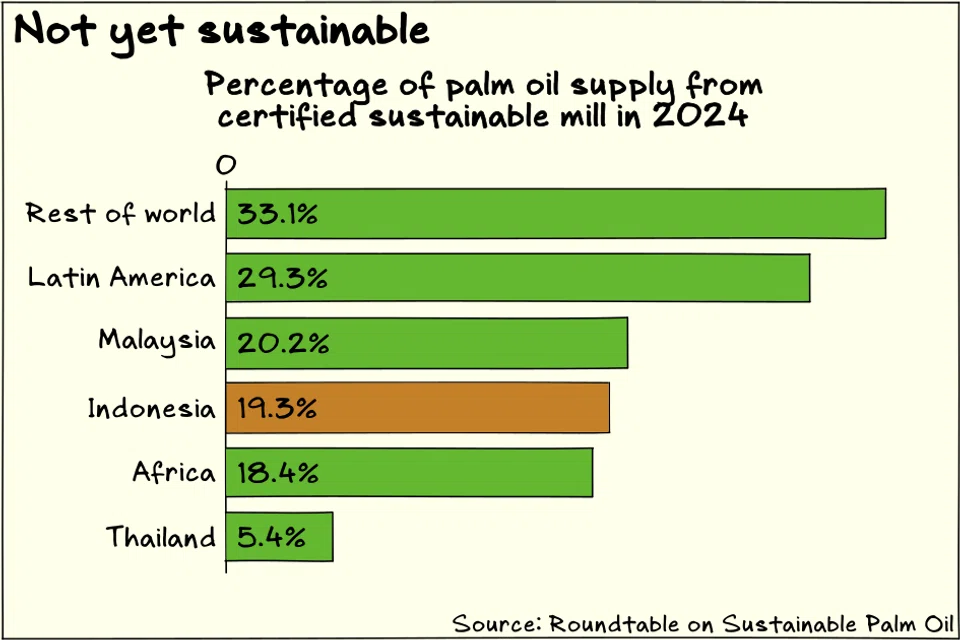
Such traceability is possible, even if costly and inconvenient. The Roundtable on Sustainable Palm Oil (RSPO), an industry body, reports that only 19 per cent of Indonesia’s palm oil production is certified as sustainable. But in Latin America almost 30 per cent of production is certified sustainable, raising the prospect that Indonesia could be a laggard on this front. There is still a long way to go, but the industry needs a strong nudge to accelerate progress.
Singapore and Malaysia must also be willing to impose economic consequences – tariffs on non-compliant imports, for instance – for not providing traceability. These penalties could lead to higher prices for consumers, but that should be weighed against the costs of the haze. Some estimates – based on assessments by researchers at Nanyang Technological University – place the cost of this year’s haze north of S$3 billion.
The rules should not be burdened by the question of who is responsible for starting a fire, and focus instead on preventing and putting out fires. Just because a company did not start the fire should not absolve it of responsibility to put out the fire once it has made its way onto the property. It is well known by now that the peat vegetation on which oil palm is cultivated is prone to fires and that fires can migrate underground to show up in one plantation even if it started in another. Big palm oil companies and their supply chains should have no excuse to have inadequate fire prevention and protection measures and tools in place, regardless of where a fire originates.
The principle behind these changes would be to shift the balance of obligations and responsibilities. Instead of the current system where palm oil companies are granted access to the market by default, a more effective system should make them earn that access.
Other ESG reads
- Asia Pulp & Paper, tied to haze-linked suppliers, given temporary restrictions by SEC
- Fewer than one in 20 Singapore-listed firms disclose external board evaluations: study
- Malaysia Budget 2027: Key sector winners and laggards amid wage hikes
- UN sees higher global warming, even in best-case scenario
- Protect people, not prices: How Asean+3 can build resilience to energy shocks