

Issue 219: Singapore sharpens haze law; South-east Asia’s blended sweet spots
This week in ESG: Singapore Parliament amends Transboundary Haze Pollution Act; Convergence, International Energy Agency highlight solar, battery opportunities

Environmental policy
Haze law’s new teeth must bite
On paper, changes to Singapore’s transboundary haze law sharpen the teeth of the Transboundary Haze Pollution Act (THPA). But the threat of getting bitten will not improve behaviour in the palm oil industry until authorities demonstrate that they can hold companies and individuals accountable for causing this year’s haze.
Singapore Minister for Sustainability and the Environment Grace Fu told Parliament on Wednesday (Nov 4) that the THPA amendments are aimed at giving the country “better ways to obtain and verify information, trace complex corporate relationships, and impose meaningful consequences on errant entities, even where criminal prosecution proves difficult”.
The changes are a welcome move in the right direction to sharpen the THPA.
For instance, one change will empower the director-general of environmental protection to direct entities suspected of links to haze pollution to appoint approved expert private-sector assessors at their own expense. These assessors will establish relevant facts, leaving it to the authorities to decide on enforcement and the courts to determine liability.
This means palm oil players could now be subject to what is effectively a mandatory audit as long as they are under suspicion for liability in haze pollution. While the current regime’s teeth will bite only when authorities can establish liability – which has proven to be extremely challenging given the complexities of investigating and prosecuting a foreign entity – the new rules significantly lower the barrier for palm oil players to face enforcement action. Furthermore, the imposition of external investigators makes it easier for liability – if it exists – to be discovered.
The new rules also allow the government to target supply chains connected to liable entities. The Singapore government will be able to restrict business dealings with designated entities and individuals that have been convicted under the haze law on penalty of fines. Entities with relevant connections to activities associated with burning, such as large forestry and agriculture companies, may also be ordered to ensure that their supply chains do not involve entities that cause such fires.
A palm oil player is therefore potentially on the hook for its whole supply chain. That risk will also get transferred to its suppliers, financiers and insurers, and therefore raise the cost of doing business for the palm oil company.
One other important change tightens the definition of responsible behaviour within the Act. The original Act gave an accused three defences: If a fire was due to natural disaster or an act of war, if the fire was caused by another party without the accused entity’s knowledge, or if the accused took reasonable steps to prevent and put out the fire. The amendments combine the latter two, such that an accused will have to prove not just that the fire was caused by another party without its knowledge, but that the accused also took reasonable preventive and firefighting measures. A new civil penalty framework will make it easier for the authorities to mete out punishment when liability is determined.
In sum, the amendments to the haze law will probably make it substantially easier for authorities to obtain information about a palm oil player’s connections to haze-causing fires, and then to go after an entity when liability is determined.
That threat is important. If suspicion is enough to expose the company to an external assessment, and if liability leads to actual economic costs, palm oil companies will make the calculus that it is better to play by the rules, and to be transparent enough that suppliers, customers, financiers, insurers and investors are sufficiently assured to do business without demanding a risk premium.
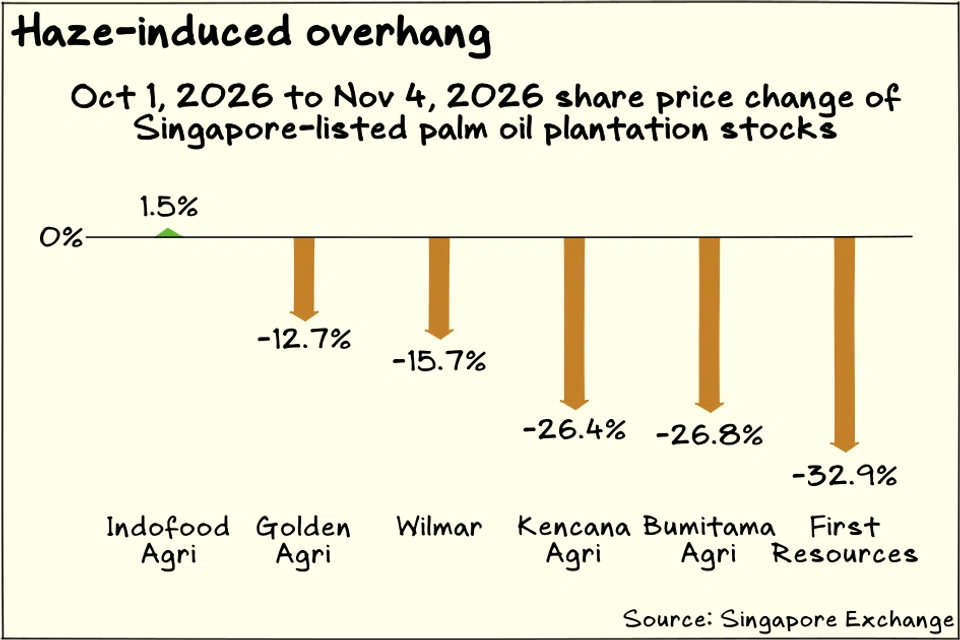
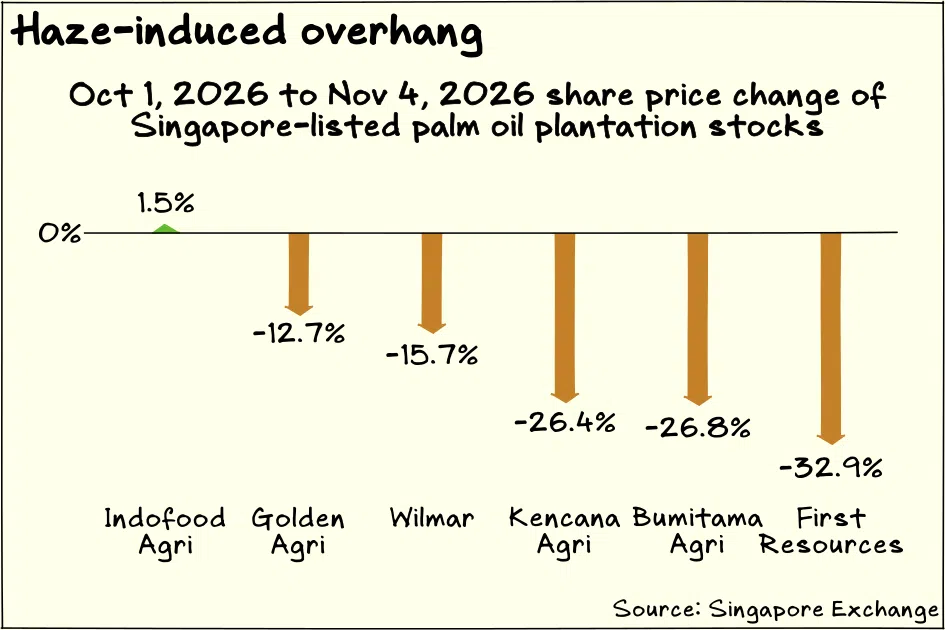
The share prices of Singapore-listed palm oil companies have mostly fallen sharply since the haze began and Singapore began to toughen its stance. But markets have short memories, and when this haze season eventually blows over and demand for palm oil continues to grow, and the industry’s own sustainability body comes up with stronger standards that everyone claims to be following, palm oil prices will recover and so will share prices, and burning practices will continue until the next major haze episode triggers a new round of indignance.
To bring about actual change, the regulatory threat must be real and durable. Getting there will require this round of assessments to lead to meaningful sanctions against those responsible for the haze. Otherwise we will be back where we started, with a set of laws that do not work.
It remains to be seen whether the THPA amendments will be enough. Much hinges on the extent to which the assessors can connect the fires responsible for the haze to the people and entities ultimately responsible for those fires. It will not be an easy task. If liability exists, those liable are highly incentivised to ensure that they can claim they are not related to those who caused the fires, that the fires occurred without their knowledge, and that they took reasonable preventive and fire control measures. It is a cat and mouse game, and the mouse is typically a very good player.
But until the cat can catch a mouse, the mice will have little reason to fear its teeth.
Sustainable finance
Batteries, solar offer blended pathways in South-east Asia
Blended finance can seem like a miraculous financial solution that turns on the faucets of capital for unbankable projects.
However, what makes blended finance “blended” – the use of concessional capital to mobilise private capital within a single investment – also imposes constraints that limit use cases for the solution. Deals must deliver impact and financial “additionality” – financing can be obtained only with the help of non-commercial capital – to satisfy concessional funders, as well as profits to satisfy private investors.
A new report by blended finance group Convergence and the International Energy Agency explores how to best apply blended finance in South-east Asia, particularly Indonesia, the Philippines and Vietnam.
In Indonesia, rooftop solar and decentralised energy solutions could be the sweet spot where scale and risk mitigation are most needed. Credit guarantees by concessional financiers can reduce lender exposure to borrower or project-level risks, thereby enabling longer tenors or lower collateral requirements for aggregating larger projects.
In Vietnam, battery storage and offshore wind are nascent sectors where blended finance can catalyse early deployment and establish scalable financing structures.
The report notes that blended finance cannot remove all financing hurdles, and that policy, regulatory and system-level reforms must also take place.
“Bankability rests on clear contractual arrangements, predictable remuneration frameworks, and transparent procurement procedures, which remain incomplete” in the markets examined in the report. Physical readiness, including transmission and distribution networks and port infrastructure for battery storage and offshore wind, are key for unlocking investments in those sectors as well. Furthermore, counterparty exposure limits and limited long-term currency hedging hinder finance availability.
“Blended finance can cushion the effects of these constraints where they translate into identifiable project-level risks, but it cannot resolve them,” the report states. “Sustained mobilisation of private capital depends on durable policy reforms, credible market frameworks, improved power system readiness, and deeper domestic financing capacities.”
Other ESG reads
- Singapore’s data centre operator STT GDC eyes US$2.4 billion loan, adds to AI debt binge
- Singapore to ratify Asean haze coordination centre agreement ‘in the next few days’: Grace Fu
- ‘Energy nationalism’ in Asean: Businesses face risks, but can’t ignore the opportunities
- Markets are pushing electrification. Governments must push harder
- Stronger governance code, listing rules need backing of a robust culture of stewardship
TRENDING NOW

Analysts cut DBS target price on lower 2027 earnings, but see buying opportunity after share price slide

China Investment Corp, PGIM’s 50% stake in Nex mall up for sale; asking about S$1.2 billion

Nvidia CEO Jensen Huang drops from world’s top 10 richest after chips sell-off
OCBC wealth clients turn defensive amid market volatility as Q3 profit rises 3%

