

Issue 24: How to pay for hydrogen, and what is JETP?

In this issue: Singapore’s bet on hydrogen is likely to come with significant costs, while Indonesia clinches a US$20 billion deal to phase out its coal plants.
Singapore
Managing the hydrogen cost
Who’s willing to pay two to three times their current electricity bill to ensure that the energy source is sustainable?
That’s the future Singapore could be facing as it transitions from fossil fuels to low-carbon hydrogen for power in order to achieve its goal of net zero emissions by 2050.
The uncomfortable reality of hydrogen is that while it can be a very effective substitute for fossil fuels, it is also substantially more expensive at the moment. That’s because hydrogen is more expensive to produce, store and transport. Specifically for Singapore, a hydrogen-heavy energy profile will mean a heavy dependence on imported hydrogen – since Singapore does not have the capacity to produce “green” hydrogen from renewable energy sources.
Hope that economies of scale and technological developments will eventually bring the cost of hydrogen lower is predicated on progress that is still scant.
There is also a risk of underestimating future demand for hydrogen, given it is one of the best candidates at the moment as a transportable low-carbon alternative. Hydrogen and hydrogen carriers such as ammonia are noticeably present in many of the scenarios used to plan net-zero transitions, and not all these scenarios account for how many other scenarios want to use hydrogen too.
There are a few implications:
- Inflation: Be prepared for higher costs, especially for the poorer segments of the world. The cost of decarbonisation is a massively regressive tax that disproportionately weighs on the poor. Some tough policy decisions are going to be made. To keep the wealth gap from getting out of control, Singapore will have to fund fiscal transfers to help offset the impact of hydrogen among the less privileged sections of the population. But this will put a strain on national coffers, which are already stretched by rising healthcare and cost-of-living demands. That’s just on a domestic level. On the international stage, the same issue of inequity confronts divisions between developed and developing nations.
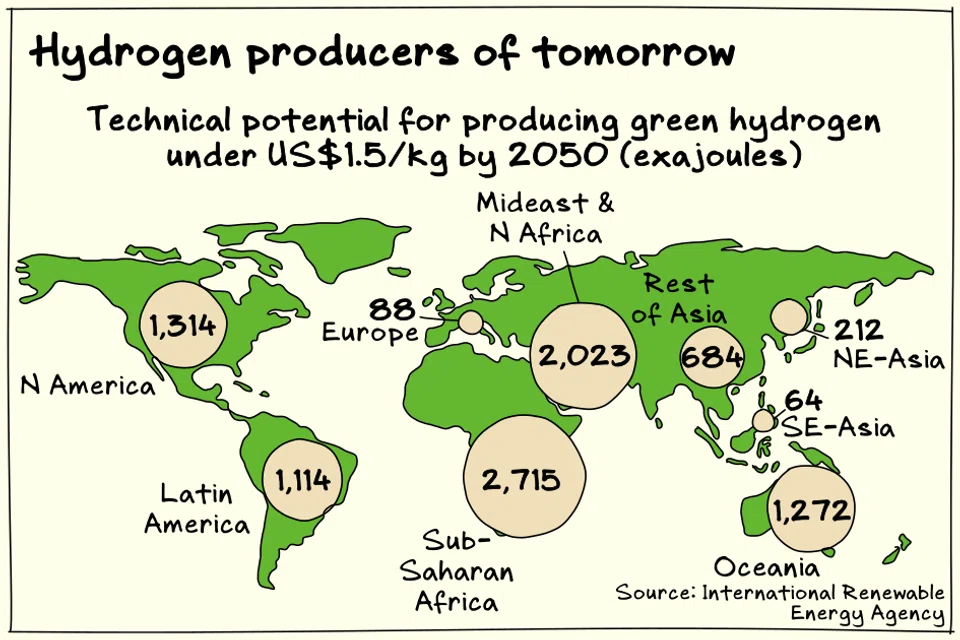
- Changes in global centres of power: Singapore anticipates significant imports of hydrogen from Australia, which has made hydrogen production and export a key national priority. In fact, a study by the International Renewable Energy Agency found that countries and regions such as Australia and sub-Saharan Africa could stand to play significant roles in a global hydrogen ecosystem as production and transport nodes.
Other Singapore reads
Singapore boards need to strengthen corporate governance practices
Directors’ independence, interest alignment remain concerns for listed trusts: governance index
South-east Asia
JETP taking off
Expect to see the letters JETP more often. They stand for “Just Energy Transition Partnership”, a programme that has generated quite a bit of excitement in the transition finance space.
The United States, Japan, Canada and six European countries have pledged to raise US$20 billion to help Indonesia transition away from coal in an agreement made on the sidelines of the G20 meeting in Bali.
The Indonesia JETP initiative is modelled after the first JETP created about a year ago at the 26th United Nations Climate Change Conference (COP26), between South Africa and an international partners group comprising France, Germany, the United Kingdom, US and the European Union. The South African JETP aimed to raise US$8.5 billion in three to five years for decarbonisation efforts.
Much has been said about the need to scale up transition finance, which refers to funding the green transformation of brown economies and entities. While the need for transition finance is high, the amount of transactions and money actually going into transition work has not grown quickly enough to drive change at a pace that will allow many developing countries, including those in South-east Asia, to hit key climate objectives.
JETP has fuelled some optimism because of hopes it can help resolve some of that scaling problem.
First, the programmes are organised between governments with national coordination within the recipient countries. The high-level involvement can help open up catalytic capital, to attract more private-sector financing for transition, as well as create a pipeline of projects in line with the projects’ objectives.
The size of the partnerships also makes it potentially viable to templatise or standardise frameworks and contracts, lowering the time and cost of finding, assessing and funding new projects.
There is talk of JETP programmes being implemented in more countries, including an US$11 billion version in Vietnam. Outside of South-east Asia, India and Senegal are also understood to be exploring similar initiatives.
Other South-east Asia reads
Asian fund managers lag global peers in ESG due diligence on deals: poll
Good reads
Climate policies ‘often out of sync’ with 2030 targets: FTSE Russell






