Issue 33: So long, Sun Cable; Wilmar’s sustainability-linked loan

In this issue: Financial troubles at Australia-Singapore solar power cable, while agricultural group Wilmar obtains a US$200 million sustainability-linked trade facility.
Singapore
Sun Cable’s collapse
Should Singapore adjust its plans for renewable electricity imports to reduce expectations of supply from Australia?
Sun Cable, an Australian company that had been trying to build a 4,200 kilometre undersea transmission cable from Darwin to Singapore, has filed for bankruptcy protection. A key shareholder said this week that it is no longer viable to export renewable electricity to Singapore. Instead, Australia should export green hydrogen to the island nation, the shareholder said.
Singapore’s electricity market regulator, the Energy Market Authority, has said that Sun Cable’s collapse doesn’t present a setback to the country’s plans to import 4 gigawatts of renewable electricity by 2035, representing about 30 per cent of total electrical supply. That is mainly because Singapore has yet to award contracts for that 4 GW of renewable imports; an ongoing request for proposal (RFP) is only due to wrap up in December this year.
While Sun Cable – which was planning to transmit 1.75 GW of solar-produced electricity through its Australia-Asia PowerLink project – was among the parties that expressed interest in the RFP, EMA said it has received more than 20 proposals that together have the capacity to supply more than the required 4 GW. So even if Sun Cable were not in the picture, it appears that EMA should still be able to hit its target.
But it seems likely that how EMA hits its target may have changed, even if EMA isn’t discussing it. Sun Cable was a high-profile project, and EMA’s future plans include Australia as a potential supplier of renewable power. In EMA’s landmark 2050 long-term planning report, one of the scenarios envisioned that “by 2035, Singapore had interconnectors with multiple countries, including Australia, Vietnam, Laos, Malaysia, Indonesia, and Thailand.”
But Sun Cable’s collapse has raised new questions about whether importing renewable electricity from Australia makes commercial sense.
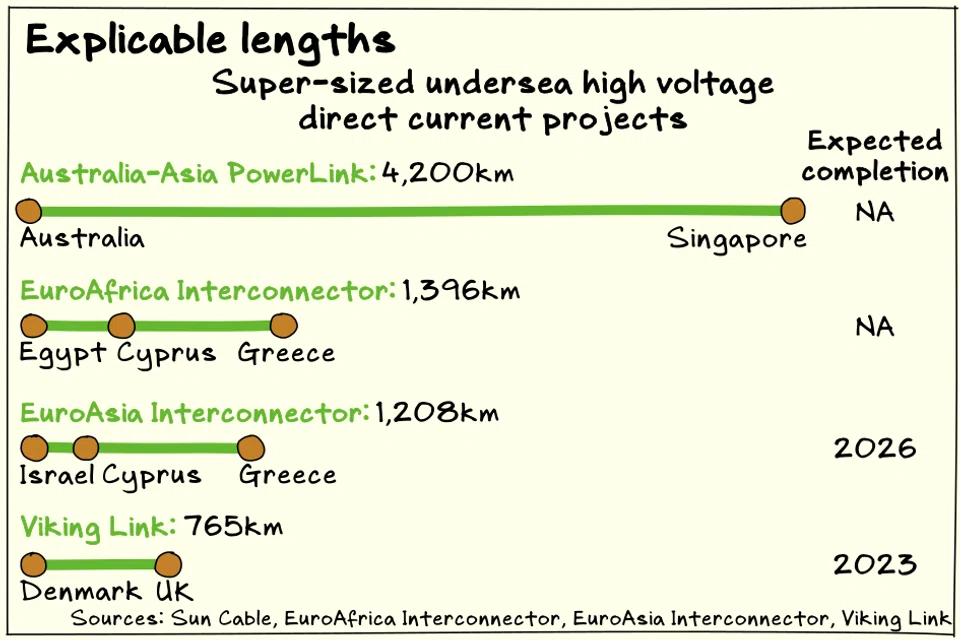
The biggest challenge for importing electricity from Australia is the distance. At 4,200km, the Sun Cable project when built would have been almost six times the current world longest undersea electrical cable, the 720km North Sea link between Norway and the United Kingdom.
With distance comes cost, and that immediately puts Sun Cable at a competitive disadvantage to electricity imported from Singapore’s South-east Asian neighbours. The cost disparity would have been even greater with a regional interconnected grid in South-east Asia.
But higher cost can be overcome if demand sufficiently surpasses supply. For investors, however, the Sun Cable project’s A$30 billion (S$28 billion) price tag was enormous, and could have required ascetic levels of patience to recover.
Some back-of-the-envelope calculations show why. The current regulated electricity tariff is 31.27 Singapore cents per kilowatt hour. Based on Singapore’s consumption of 53.5 terawatt hours of electricity in 2021, electricity suppliers can collect roughly S$16.7 billion from consumers a year at that price. Assuming Sun Cable’s share of electricity sales matches its 14 per cent share of capacity, that would mean it could collect about S$2.4 billion at that price. But that’s just revenue, and if we take a profit margin of 20 per cent, that means Sun Cable could expect to retain about S$480 million per year. At that rate, it would take the company and investors about 58 years to make back S$28 billion.
To recoup its capital faster, Sun Cable would need to charge more, but that would make it less competitive.
Of course, these are very crude approximations. Actual average electrical takings don’t match the regulated tariff, which only affects the retail market, for instance, and future rates will probably be higher than they are now. Sun Cable’s actual share of the market and profit margin are pure speculation, too.
Notwithstanding all of those challenges, it might be too early to call for the demise of Australia-sourced renewable electricity in Singapore. Other long-range electricity transmission projects, like the EuroAsia and EuroAfrica Interconnector projects, are still progressing, and can provide enough confidence to keep the Sun Cable project going if they do well enough.
Decisions on national electricity are also not completely commercial, and Singapore might have a strategic interest in maintaining a source of renewable electricity from Australia.
For what it’s worth, the pivot to green hydrogen isn’t straightforward either. Green hydrogen has its own set of economic challenges, which is why we still aren’t shipping huge amounts of hydrogen or ammonia across the seas today.
Other Singapore reads
StarHub named world’s most sustainable telco on Global 100 list
Patrizia, Mitsui sustainable infrastructure fund raises US$110m at first close
South-east Asia
Wilmar links a trade facility
Wilmar International has obtained a US$200 million sustainability-linked trade finance facility from Standard Chartered.
The facility has a margin ratchet mechanism that will move according to the agribusiness group’s annual performance internal key performance indicators (KPIs) and external benchmarking standards. Companies typically do not disclose the coupons and KPIs on their sustainability-linked loans, so there is no publicly available information about that aspect of this deal.
Unlike green or social bonds and loans, which can only be used for qualifying green or social purposes, sustainability-linked debt does not constrain the borrower’s use of proceeds. Instead, borrowers agree to certain KPIs, and the interest that they pay on the debt is subsequently adjusted based on how well they perform on those targets.
Sustainability-linked debt has been growing in popularity because they’re seen as a way to finance the transition of non-green companies towards more sustainable outcomes. An oil and gas company that can’t qualify for green bonds can raise money through a sustainability-linked bond to transform its business and reduce its carbon footprint, for instance.
That popularity, especially among lenders, used to result in “greeniums”, or pricing premiums that favoured the borrowers. That greenium, however, has been narrowing on a global scale, and could even be gone, according to Goldman Sachs analysts. The analysts cited scepticism about the impact of sustainability-linked debt, which can inflict negligible penalties for missing targets and be difficult to enforce.
Other South-east Asia reads
Banks need to start managing nature-related risks: WWF-Singapore
US climate envoy Kerry outlines carbon offset initiative for developing nations
Good reads
The World Economic Forum is taking place in Davos, Switzerland, and BT News Editor Joan Ng is covering it live. Given how much sustainability and ESG principles have entrenched themselves in the mainstream, it’s no surprise that we’re seeing significant discussion about sustainability.
Integrate ESG reporting and accounting to align unlisted businesses, say corporate figures at Davos