Issue 4: Governance reloaded; Khazanah won’t let go
 Add BT as a preferred source
DeeperDive is a beta AI feature. Refer to full articles for the facts.
Singapore
Rethinking the governance code
Professor Mak Yuen Teen, Singapore’s eminent corporate governance scholar, asks some important questions about how to improve the nation’s Code of Corporate Governance.
A lot of focus these days is on the environmental and social pillars of ESG, but governance could well be the most important column when it comes to companies. After all, a company with poor leadership won’t be able to achieve much on environmental and social issues.
Prof Mak highlights a few issues to consider, including directors’ obligations on environmental and social issues; the incorporation of wider stakeholders’ interests into board composition; pay equity across the company; employee share ownership; addressing company groups; and a more heterogeneous but targeted Code.
One fundamental question raised is whether the “comply-or-explain” regime works. Prof Mak argues that it doesn’t in Singapore, because there isn’t enough vigilant enforcement from regulators, sponsors and private investors. As a result, too many miscreants face little consequence for non-compliance.
Regimes that adopt comply-or-explain have justified it as a flexible approach that avoids the ills of the more prescriptive frameworks. In a prescriptive regime, companies have to comply even if the rules don’t make sense for them. With comply-or-explain, companies can explain non-compliance and let the market decide if the reasons are good enough.
Navigate Asia in
a new global order
Get the insights delivered to your inbox.
Comply-or-explain is particularly useful when the rules are relatively new, such as with sustainability reporting, and the market and regulator need breathing room to figure out where thresholds and boundaries belong. Over time, however, it’s common to see some rules become prescribed, such as with climate-related reporting in Singapore, as circumstances change.
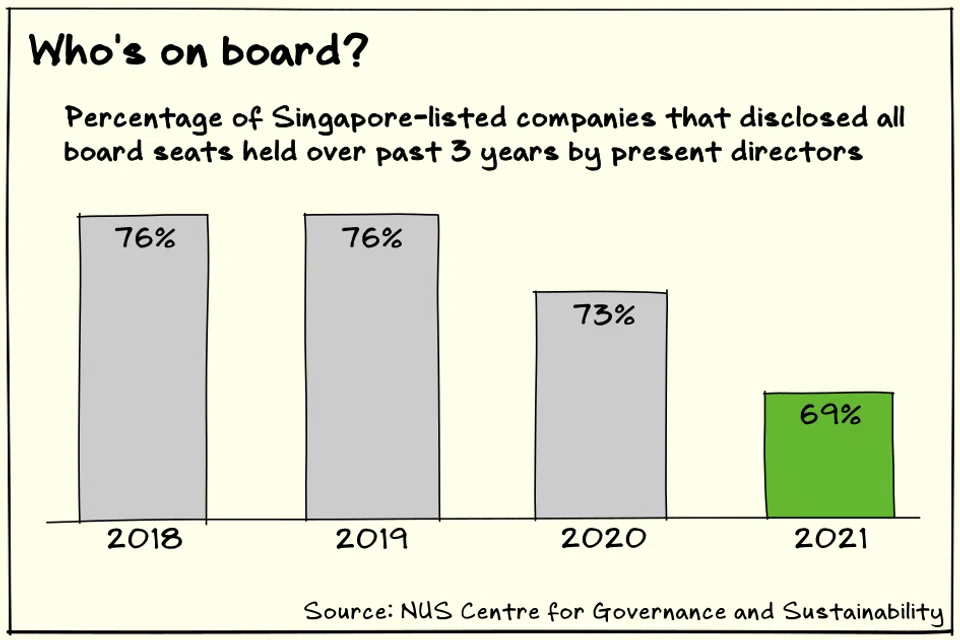
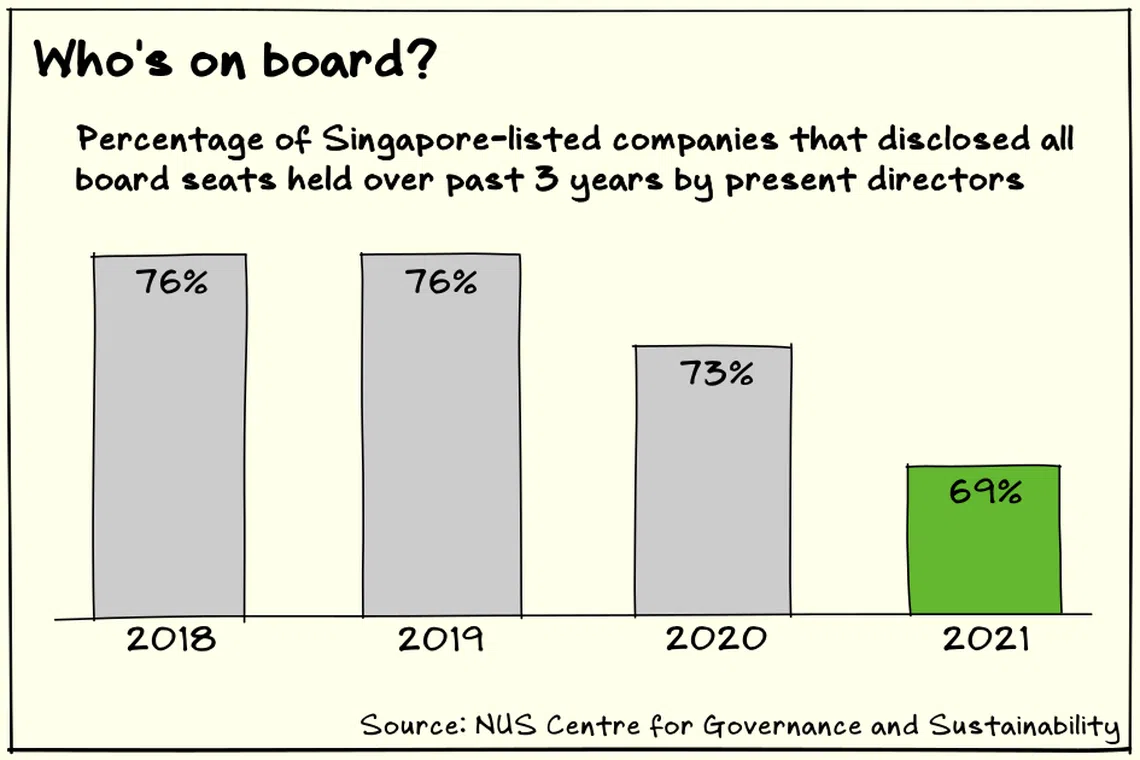
Notwithstanding the fact that the quality of corporate governance disclosures has been improving in Singapore, there is definitely room to tighten up. The percentage of companies disclosing present and historical board seats held by directors is declining, for instance. Are there genuinely good reasons for companies not to disclose such information that would outweigh the benefits of the market having that information? When more than a quarter of the market isn’t doing something, it might be a good idea to take a hard look at the rule and ditch it, change it or enforce it.
Advocates would also argue that prescriptive approaches are not necessarily blunt tools. Prof Mak, for example, has proposed taxonomies that apply different rules to different companies based on risk.
SEE ALSO





The last time the Code had a major revision, mandatory sustainability reporting had just kicked in for Singapore-listed companies, the global economy was chugging along and nobody had heard of Covid-19.
That was 2018. The world is very different in 2022, of course. Regulation is a game of constant calibration, and an update of the Code might not be a bad idea in our post-pandemic, climate changing world.
Other Singapore reads
- Premiums for EVs still relatively high as insurers struggle to price risk
- A generation gap in ESG investing in Singapore
South-east Asia
Khazanah’s ambivalence
Khazanah Nasional, Malaysia’s sovereign wealth fund, had committed to a rather ambitious set of sustainability targets. It remains to be seen whether it can stick to those commitments.
Khazanah managing director Amirul Feisal Wan Zahir told the Financial Times that the fund would not divest state companies that are dependent on fossil fuels. And for portfolio companies that do not meet the goal of 30 per cent female board members and senior leaders, Khazanah will “put them to task” instead.
It’s not hard to understand why there is considerable scepticism about commitments and targets, especially from this part of the world. It would be super if Khazanah could pull it off, but the truth is that it is extremely challenging. After all, Khazanah can’t just sell national power company Tenaga Nasional because of its dependence on coal.
Other South-east Asia reads
- The sustainability shift rewriting rules in the payments industry
- Amundi pushes for higher standards in ‘Say on Climate’ AGM resolutions
Other good reads
The ESG data gap
Only 1 in 10 Indonesia-listed companies has obtained an ESG score, according to Indonesia Stock Exchange’s director of business development Hasan Fawzi.
Mr Hasan would like more companies to get scored, but he’s also realistic, so he is only focusing on the 80 biggest companies on his exchange for now.
“Not all of our investors are trying to get the small, micro-cap companies,” he says.
He’s right, but his point raises an interesting question: Why do the small companies care about sustainability reporting?
Most funds that have integrated ESG into their investment frameworks are honestly not going to bother with the long tail of a stock exchange. And the retail investors who are speculating in these stocks aren’t trading on ESG principles either. It’s not as if these stocks are affected by the quality of their sustainability disclosures.
There would be demand for some ESG accounting from banks and the supply chain, but typically these could be satisfied without the cost and trouble of full-fledged sustainability reports.
So if you’re a small company on a South-east Asian exchange, and you know that there isn’t really anyone scrutinising your sustainability report, it’s going to be pretty tempting to head over to the nearest paint store, buy the biggest bucket of green paint you can get your hands on, and greenwash the heck out of your disclosures, right?
A lot is resting on assurance to save us all.
- Companies weak in ESG more likely to be hit with scandals and lose market value: Moody’s
- Corporate net-zero goals don’t add up to a net-zero planet
Decoding Asia newsletter: your guide to navigating Asia in a new global order. Sign up here to get Decoding Asia newsletter. Delivered to your inbox. Free.
Copyright SPH Media. All rights reserved.