ESG Insights

Issue 40: Gender diversity without quotas; SP Group takes shine on Vietnam solar

Kenneth Lim
Published Fri, Sep 15, 2023 · 03:01 PM
    • Women’s participation on the boards of Singapore’s 100 largest companies has climbed steadily over the past decade without the use of mandatory quotas.
    • Women’s participation on the boards of Singapore’s 100 largest companies has climbed steadily over the past decade without the use of mandatory quotas. ILLUSTRATION: KENNETH LIM

    In this issue: Singapore’s women participation on board progresses the hard way, while SP Group adds 100 megawatts to its Vietnam solar portfolio.

    Singapore

    The no-quota approach to women on boards

    The latest board diversity numbers in Singapore are encouraging, showing continued progress in women’s participation as directors of the country’s largest listed companies.


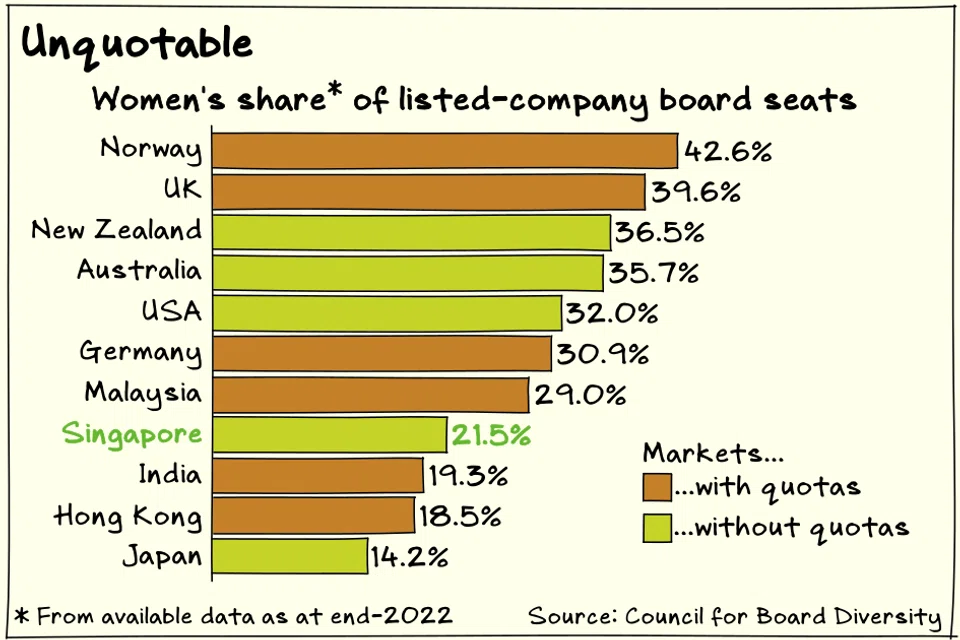
    Women held 21.5 per cent of board positions on the 100 largest Singapore-listed companies as at end-2022, according to data compiled by the Council for Board Diversity. That was a 1.4 percentage point improvement from the 18.9 per cent share at the end of 2021.

    It’s notable that the progress has come without the use of the “Q word”: quotas. In fact, the Council’s website explicitly lays out a no-quota stance:

    “We are interested in board diversity, including gender, for the benefits that it brings. Meeting the numbers does not guarantee that benefits follow… Where organisations willingly embrace board diversity, more effort is likely to be invested in making the arrangement work well than if numbers were met for compliance without enthusiasm.”

    No forcing it

    In the early years of the Council – before 2015, when it was first known as the Diversity Task Force and later the Diversity Action Committee – quotas were the source of many lively discussions.

    There was strong support for quotas from some corners, mostly because quotas are effective in raising the numbers. Norway was the first to impose a quota for women participation on the corporate boards of listed companies – 40 per cent in 2005. That Norway’s listed companies managed to comply was a telling sign that gender gaps in boardrooms stemmed more from unwillingness than from inability to change. It is also worth mentioning that women participation on the boards of private companies has not progressed as quickly in Norway – prompting lawmakers to pursue a similar quota for large, unlisted companies.

    But there has also been scepticism about whether quotas will drive real change, or simply create the illusion of progress. In Norway, for example, there was a “golden skirt” phenomenon: a small number of women filled many board seats. In India, one analysis suggested companies were letting women into boardrooms; but only to fill unimportant positions.

    Among the strongest opponents of quotas in Singapore are women. For many of them, getting the numbers via a quota would be an empty achievement that would deny women the legitimacy of succeeding on their own merits.

    Quotas never garnered enough support in Singapore.

    But it was also clear that letting the market move at its own pace would not move the needle quickly enough. There has therefore been a steady ratcheting of regulatory pressure aimed at improving board diversity.

    Rules on who rules

    In keeping with the principle to not impose quotas, regulations have focused not so much on getting women appointed to board seats but on creating opportunities for women to be considered. For instance, revisions in 2018 to the Singapore Code of Corporate Governance specified gender as a diversity aspect that boards should consider in their composition. Just as importantly, the Code stated companies should disclose their policies and progress on board diversity. Companies were free to aim as high – or as low – as they wished, but simply making diversity a part of the Code was enough of a nudge to get many to confront the issue.

    Another major regulatory factor was the push to impose term limits on independent directors. The nine-year cap has been steadily strengthened over the years, and from 2024 onwards all directors who have served more than nine years on the board of a Singapore-listed company will be considered non-independent. While this rule was primarily driven by the desire to improve the independence of directors, its side benefit is that it will support regular renewal in the boards. Each time a new director has to be found, there is an opportunity for a woman to be in the running.

    Principle and execution have mostly been in alignment in Singapore’s case, and the progress among the largest listed companies is the proof of the pudding.

    The approach hasn’t been as effective outside the large companies, though. Among Singapore-listed companies that do not fall within the largest 100, women’s participation on boards was just 12.8 per cent in 2022. That is far behind the 21.5 per cent share in the 100 largest companies, and an improvement of less than 1 percentage point per year since 2013. At this rate, it will be another 12 years or so for the non-top 100 companies to reach a 20 per cent share.

    The other Q word: quality

    Given that pace, should a quota be considered for these smaller companies?

    As long as the board diversity movement in Singapore remains driven by the benefits that diversity brings to the organisation, quotas will probably not work.

    That’s because corporate governance doesn’t appear to be a priority for many of the smaller listed companies. In the 2022 edition of the Singapore Governance and Transparency Index, almost six in 10 of the 489 assessed companies failed to achieve a passing score. 

    Take the hypothetical example of a boardroom that exists only to rubber-stamp the controlling shareholder’s decisions. Would this board become more independent just because it needs to add a couple of women? What is more likely to happen is that the board will simply find a couple of women who are relatives of the controlling shareholder and emplace them.

    A quota may raise the numbers for these companies, but that progress might be meaningless.

    To hasten the process, Singapore policymakers and regulators need to continue wielding their rulebooks to drive continuous improvements in diversity policies, stakeholder engagements and disclosures.

    Watchdogs and advocacy groups must also become more sophisticated in how they assess gender diversity in the context of corporate governance. The Council’s twice-a-year statistics have been helpful in tracking progress, but they are still very basic metrics that do not shed light on whether women’s participation on boards are carried out in the right spirit. The data might need to be supplemented with analysis about whether companies’ diversity policies are rigorous; whether stakeholders are engaged and accounted for in determining the skills and experiences that are important for the board; whether board candidates are identified through a sufficiently independent process and so on. What is measured gets noticed.

    It might be worth waiting for quality progress, but only if quality truly exists.

    Other Singapore reads

    Calls for gender diversity in Singapore’s corporate leadership to evolve past box ticking

    UOB’s loan to a coal-miner’s subsidiary spotlights complexities of defining the just transition

    South-east Asia

    SP Group eyes Vietnam solar

    Expect to see considerably more activity from energy utilities company SP Group in the Vietnam solar space.

    SP Group announced this week that it has bought two solar farms in the South-east Asian country with a combined peak capacity of 100 megawatts-peak. The acquisition price was not disclosed.

    The deal will almost double SP Group’s solar capacity in the South-east Asian country to almost 250 MW. The company has set a target of 1.5 gigawatts of utility-scale and rooftop solar projects in Vietnam by 2025.

    SP Group began developing rooftop solar projects in Vietnam in 2021. Given that there are only about two years left to reach its target and it is only one-sixth of the way there, SP Group will need to step up its growth in this market considerably.

    That growth could include more acquisitions. Vietnam, already one of the more aggressive developers of solar power in the region, added 17.6 GW of solar capacity in 2021, according to a report by the US Department of Commerce’s International Trade Administration. If SP Group were to rely entirely on new projects to meet the rest of its target, it would have to capture about 3 to 4 per cent of the new-capacity market. Strategic investments might be faster, albeit riskier.

    Other South-east Asia reads

    Ant gets Asia’s biggest ESG-linked loan in US$6.5 billion deal

    Malaysia needs to invest US$375 billion in renewables to reach 2050 climate goals

    Good reads

    ‘Dirty’ resources sector needs decarbonisation, not divestment

    UN takes step towards new way of tracking greenhouse gases