Issue 5: Singtel’s emissions; Asean issuers chug along

In this issue: Singtel cuts it close with its 2025 emissions target, while ESG issuance and funds continue apace in Asia.
Singapore
Singtel’s emissions ambitions
Could sustainable finance be a risk for the issuer?
Singtel just published its latest sustainability report, including its first report aligned with recommendations of the Task Force for Climate-Related Financial Disclosures (TCFD).
The new report notably contains updated numbers on Singtel’s greenhouse gas emissions. These matter for Singtel, because the telco issued US$100 million of 5-year 3.56 per cent digital sustainability-linked bonds in April under its Olives sustainable financing programme.
The cost of financing for sustainability-linked bonds is dependent on an issuer’s ability to achieve certain sustainability targets. In Singtel’s case, it faces a 2025 deadline to cut its absolute Scope 1 and 2 greenhouse gas emissions by 25 per cent from 2015 levels. If it fails to do so in time, Singtel will need to make additional investments of at least 0.25 per cent of the outstanding principal amount into defined green efforts.
Based on the initial principal amount, that would come to US$250,000 – raising Singtel’s interest cost on the bond by 12.5 basis points annually for the last 2 years of the bond’s tenure.
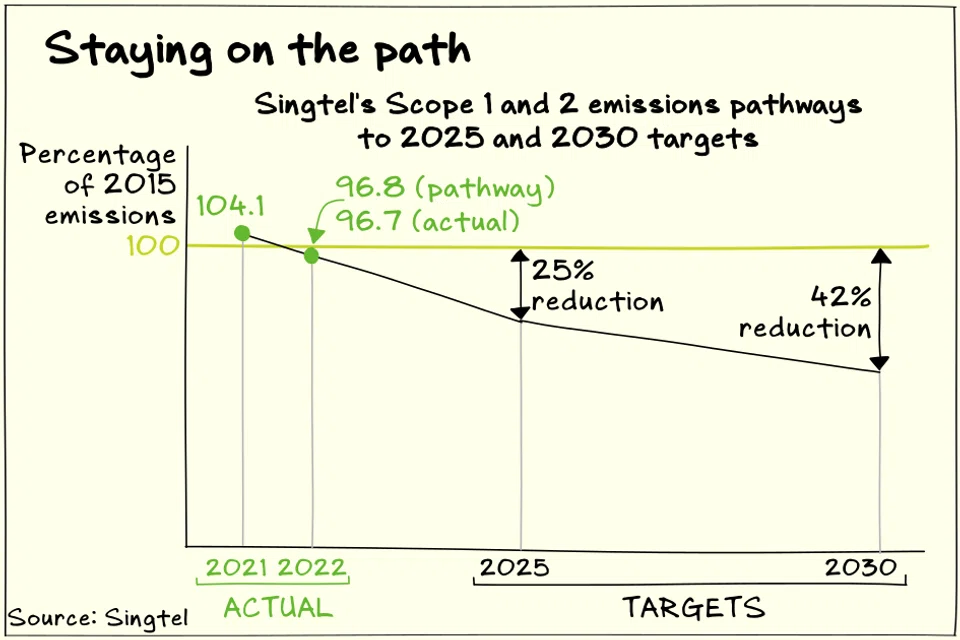
So how is Singtel doing with respect to those targets? Going by the latest numbers, Singtel is on track but cutting things close! Singtel needs to cut its Scope 1 and 2 emissions by 25 per cent from the 2015 baseline, but emissions in 2021 were actually 4.1 per cent above the baseline. Assuming a straight-line reduction in emissions, Singtel needed to lower 2022 Scope 1 and 2 emissions to 96.8 per cent of baseline to stay on track. It managed to get to 96.7 per cent, which is good. But the easiest cuts are usually the first to go, which means the remaining excess emissions will be harder for Singtel to reduce. It’s nail-biting stuff!
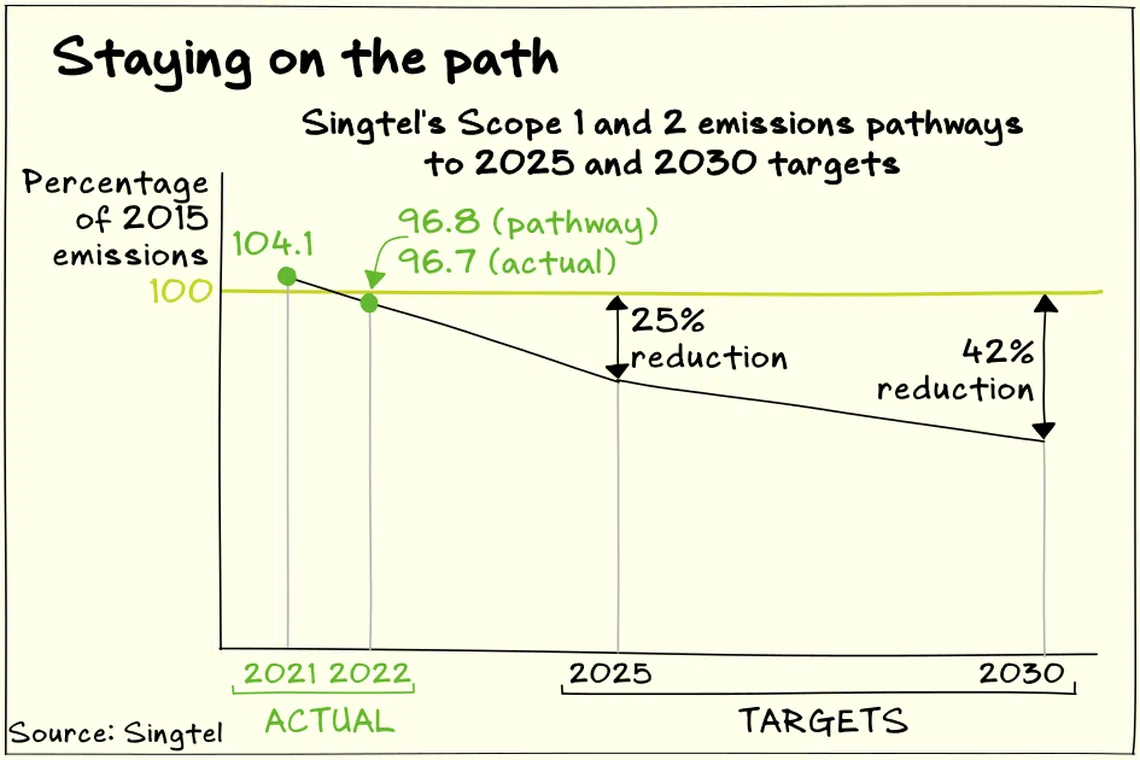
To be fair, a US$250,000 penalty is negligible for Singtel. The company reported S$15.3 billion of revenue in fiscal 2022 (that’s a whole other debate on how KPI’s are set for sustainability-linked bonds). And cutting Scope 1 and 2 emissions by 8.1 per cent per year for the next 3 years is not out of this world.
But if Singtel misses the target, it will probably have to pay more the next time it wants to issue a sustainability-linked bond – so there’s a real incentive to make it.
Interestingly, a significant source of emissions and energy usage for Singtel comes from data centres. Data centres are among the fastest-growing users of cooling in Singapore, according to a recent report by WWF-Singapore and Carbon Trust that looked at decarbonising cooling in the country. The report estimated that data centres alone used about 2.6 per cent of Singapore’s total electricity consumption in 2019 for cooling. For both comfort and necessity, cooling has been an under-appreciated aspect of Singapore’s attraction as a metropolitan hub in the region. The nation won’t get to a sustainable footing without addressing the clean cooling challenge.
Other Singapore reads
- Taking Singapore forward as a regional green hydrogen hub
- Singapore and Malaysia to deepen cooperation in digital and green economies
South-east Asia
ESG issuers keep on keeping on
For all the (very often legitimate) griping about the quality and consistency of ESG-themed products in the market, issuers and fund managers are still bringing offerings to market.
In Indonesia, Bank Rakyat Indonesia is in the midst of pricing up to 5 trillion Indonesian rupiah of green bonds. Nomura in Malaysia has launched its first ESG syariah fund.
While ESG-related investments might be underperforming at the moment, and capital flows support anecdotes of investors pulling back, the recent corrections seem more reflective of increased investor scepticism about the consistency and quality of what’s in the market. That’s healthy in the long term.
Why that confidence in underlying demand? ESG-related risks and consequences are manifesting at a can’t-be-ignored pace. The “non-financial” risks are becoming very tangible. It’s hard to be an investor in this climate and not be concerned.
Take Malaysia’s glove makers, for example. In a world altered by a pandemic, these should be the best of times for the glove makers. Instead, they find themselves mired in controversy over their labour practices.
Intertwined government and politics are also part of the scenery. Net zero commitments are sprouting everywhere, but good luck hitting those targets if renewable energy is unavailable. Researcher Quah Say Jye has a nice analysis of Indonesia’s green-energy export ban here.
Other South-east Asia reads
- South-east Asia could emerge as clean energy heavyweight in global race to decarbonise
- Is the road to net-zero paved with errors?
Other good reads
Bloomberg has a nice story about trying to live green in China. One of the most frustrating parts of trying to lead a sustainable lifestyle in developing regions, including South-east Asia, is the lack of good supply chain information. Want to eat only sustainable seafood? Good luck with that!