ESG Insights

Issue 68: MAS champions carbon credits for retiring coal plants early; S-E Asia’s urgent adaptation needs

Kenneth Lim
Published Fri, Sep 29, 2023 · 07:00 PM
    • The proposed transition credits could help investors of coal-fired plants to recover lost value if the plants are retired early.
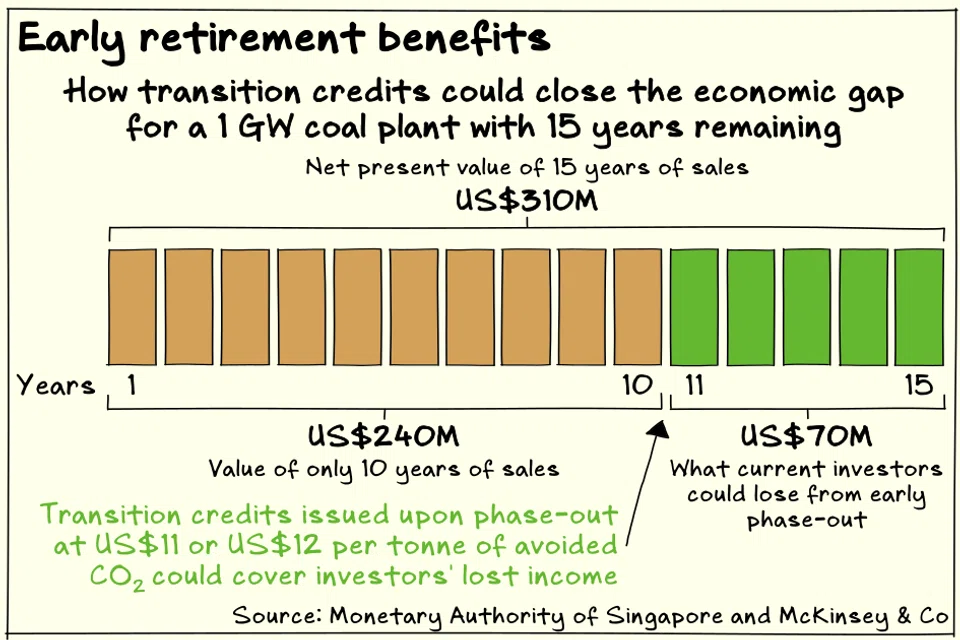
    • The proposed transition credits could help investors of coal-fired plants to recover lost value if the plants are retired early. ILLUSTRATION: KENNETH LIM

    In this issue: The search begins for pilot testing transition credits, while experts urge action on flood, drought and heat risks

    Singapore

    Using credits to make whole coal investors

    Singapore has put its weight behind carbon credits for coal phase-out projects and is seeking a pilot project to test the idea.

    In a working paper released on Sep 26, the Monetary Authority of Singapore (MAS) and McKinsey & Co laid out a possible framework to enable the issuance of carbon credits – which the financial regulator has termed “transition credits” – for emissions avoided when a coal-fired power plant is retired early and replaced by a lower-emission alternative.

    Imagine you’re an investor in one of the 2,000 or so coal plants in the region. The coal plant is still relatively young (South-east Asia has one of the youngest fleets of coal plants in the world), and you’ve got a power purchase agreement with the government to provide electricity for another 15 years. You’ve spent considerable sums of money building this plant, and that purchase agreement is how you’re going to make back your investment. Asking you to retire your plant five years early would be asking you to take a loss, so there’s no way you’re going to do that.

    But what if you didn’t have to lose money? You could potentially recover the lost income if you could sell credits for the emissions avoided by retiring the plant early, and those credits attract a high-enough price.

    That’s the idea behind transition credits. A model offered by MAS and McKinsey estimated that a 1 Gigawatt coal plant in Indonesia with 15 years to go on a power purchase agreement has a net present value of about US$310 million. Retiring the plant five years early would reduce that value to about US$240 million, leaving an “economic gap” of about US$70 million that represents how much investors would lose from phasing out the coal plant.

    If the coal plant was replaced with renewable energy, selling credits for the avoided emissions could be enough to cover that gap if the credits were priced at about US$11 to US$12 per tonne of avoided emissions, based on the model.

    For humanity, too, of course!

    In his Foreword, MAS managing director Ravi Menon described the need from a climate action perspective to accelerate coal phase-outs. However, Singapore’s interest in creating an additional financing mechanism for coal phase-outs may also lie on two strategic fronts.

    First, the coal phase-out and transition segment of the sustainable finance market has been paralysed partly because of difficulties in closing these gaps and partly because the amount of capital provided is vastly below what is needed.

    Remember the early days of Google when they were building and giving away great online tools such as Maps and Gmail, all for free? The company’s argument at the time was that the more people use the Internet, the more they’ll need a search engine and the more data Google will have, so anything that grew the Internet was good for Google. As the region’s financial hub, Singapore has kind of the same approach. The more vibrant the sustainable finance scene in South-east Asia, the more Singapore stands to gain.

    Singapore’s interest also stems from the fact that the country and its businesses need high-quality carbon credits. Singapore’s carbon tax regime will allow large emitters to partially offset their emissions. Singapore itself – and its major industries such as aviation and maritime – will likely need to lean on credits to achieve their net zero targets. Finally, Singapore Inc has ambitions to be a regional and global player in voluntary carbon markets through Climate Impact X, the carbon exchange supported by DBS Bank, Singapore Exchange, Standard Chartered and Temasek. All of those require a robust supply of good-quality credits.

    Wildcards

    Whether transition credits will take off may come down to a few factors.

    The first is the level of support among regional governments not simply for transition credits but for coal phase-out as well. One of the key principles of high-quality credits is that the emissions reduction should be sufficiently “permanent”. One proposed safeguard for permanence is that the host jurisdiction, in which the coal plant to be retired sits, must commit to having no new coal plants beyond what is already planned. This sounds great on paper; but in practice, it might be challenging to enforce. The strength of the host jurisdiction’s commitment ultimately rests on the government of the day; and in developing countries, political risks are high on the list of “What can screw things up?”.

    The paper also deliberately takes a neutral approach toward standards and methodologies, acknowledging that there are independent efforts on those fronts from the Coal to Clean Credit Initiative, Gold Standard, the US Energy Transition Accelerator and the World Bank. The MAS framework is meant to work with any methodology.

    Too many competing standards and methodologies can hinder getting a critical mass of projects and credits to create a viable asset class. One potential source of friction lies with the question of what is considered to be an acceptable replacement source of energy for coal. One side of the debate argues that lower-emitting alternatives, such as natural gas or co-firing, should be allowed because not every part of the world is physically or economically able to support renewables at this time. The other side argues that allowing non-renewable, lower-emitting replacements locks in new sources of emissions that will eventually create new but similar phase-out challenges as coal.

    This can be a delicate matter with existential implications. Standards that are too harsh may not attract enough phase-out projects. Those that are too lenient will not attract enough capital from wary investors. The wrong calibration could make or break coal phase-out.

    Timing it right

    One complication with transition credits is that they can be issued only when the phase-out begins, while the projects themselves might start much earlier. This means that the capital available from credits might become available only after it’s actually needed.

    One possible solution offered is to do a ramped phase-out, in which lower-emitting sources gradually replace coal. This would allow some credits to be issued earlier than in a situation where all the coal assets are decommissioned at a single point in time. However, this would still mean that most of the benefits from credits are skewed towards the end of the project.

    An innovation that received special mention in the paper was advanced market commitments (AMCs), as currently seen through Frontier. Frontier, which was started by Silicon Valley stalwarts such as Google and Meta, takes a page from vaccine development economics. The way it works is that Frontier’s members commit to an annual budget for buying carbon credits. Frontier then assesses carbon credit suppliers on behalf of the members and cuts deals to purchase credits that meet its standards. For credits in the future, Frontier might undertake offtake contracts to purchase at an agreed price upon delivery.

    That mechanism provides some capital, but more important is the certainty for producers of carbon credits, which can help to reduce the risks inherent in long-term projects.

    Testing it

    MAS has put out a call for partners to help test the idea and is looking to launch one or more pilot projects. The “data and experience” from these projects will then be used to refine the concept with the goal of rolling out large-scale implementation.

    Other Singapore reads

    South-east Asia

    Governments critical in growing adaptation investments

    What’s the best way to allocate resources for climate action? Do you put money into mitigation efforts to try to stop global warming, or do you spend it on adaptation measures to protect against the loss and damage of higher global temperatures?

    Naturally, one of the biggest factors is urgency. Not putting out a fire when the house is already burning is a sure way to lose your home.

    Funding for climate adaptation – addressing the risks of loss and damage from climate change – has long been overshadowed by the resources going into climate mitigation, which tries to slow or reverse climate change. Part of the reason is that climate change operates on a relatively long time scale, so the impact of catastrophically high temperatures hasn’t become very apparent.

    But it’s becoming harder and harder to prevent the fire from starting. The synthesis report of the Paris Agreement’s Global Stocktake made it clear that loss and damage from climate change are already happening, and adaptation investments are sorely needed.

    In South-east Asia, experts have identified floods, droughts and chronic heat as the most pressing areas for adaptation spending. Swiss Re estimates that Asia has suffered the most flood-related losses over the past decade, with annual flood-related economic losses of almost US$30 billion between 2011 and 2020.

    Governments play a critical role in helping to prioritise areas of need as well as in establishing the right combinations of rules, incentives and penalties to grow and sustain investment in adaptation projects. As Neha Bhatia, ESG and sustainable finance partner at environmental consultancy ERM, tells The Business Times reporters Janice Lim and Wong Pei Ting, governments must “start thinking holistically around climate risk and opportunities, and start embedding it into every single policy and plan that they have”.

    Other South-east Asia reads

    Other good reads