

Issue 69: Dealing with Singapore’s coming carbon tax windfall; nudging private capital towards climate adaptation

In this issue: A national climate trust fund could enable the optimal use of carbon tax revenue, while experts urge stronger participation from businesses and investors in addressing climate loss and damage.
Singapore
Whatchu gonna do with all that funds?
Singapore has published the eligibility criteria for carbon credits that companies may use from 2024 onwards to offset up to 5 per cent of their taxable emissions.
By the end of the year, the government will release a list of credits and methodologies that meet the criteria of its International Carbon Credit framework.
Driving all that fuss about carbon credits is anticipation for the large and imminent jump in Singapore’s carbon tax rate. Singapore is set to collect a considerable amount of additional carbon tax revenue in the coming decade, but constitutional rules may impose constraints on how that revenue is utilised to address climate change. Holding those collections within a long-term climate trust fund could provide important fiscal flexibility to support Singapore’s decarbonisation journey.
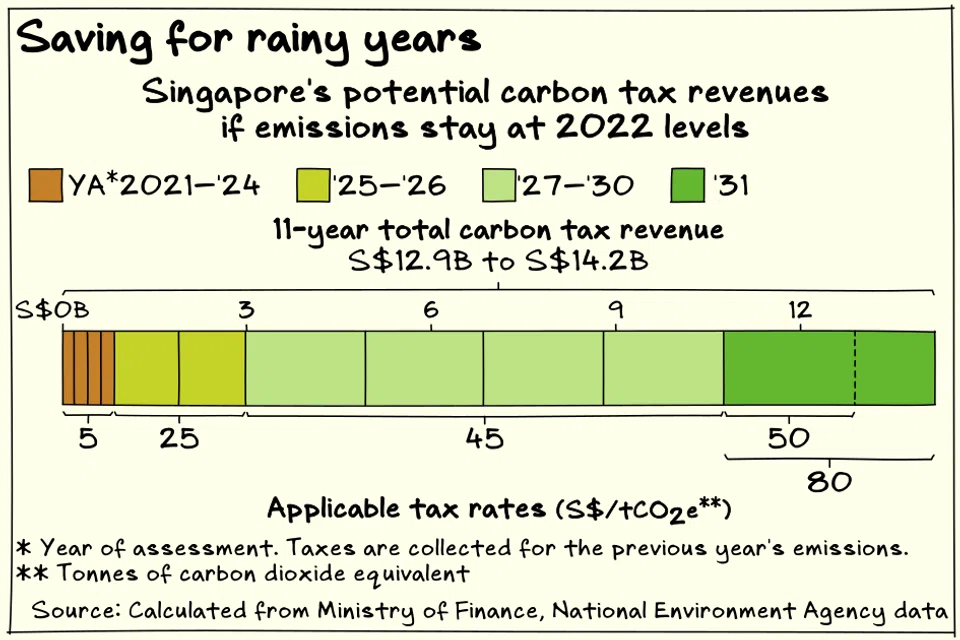
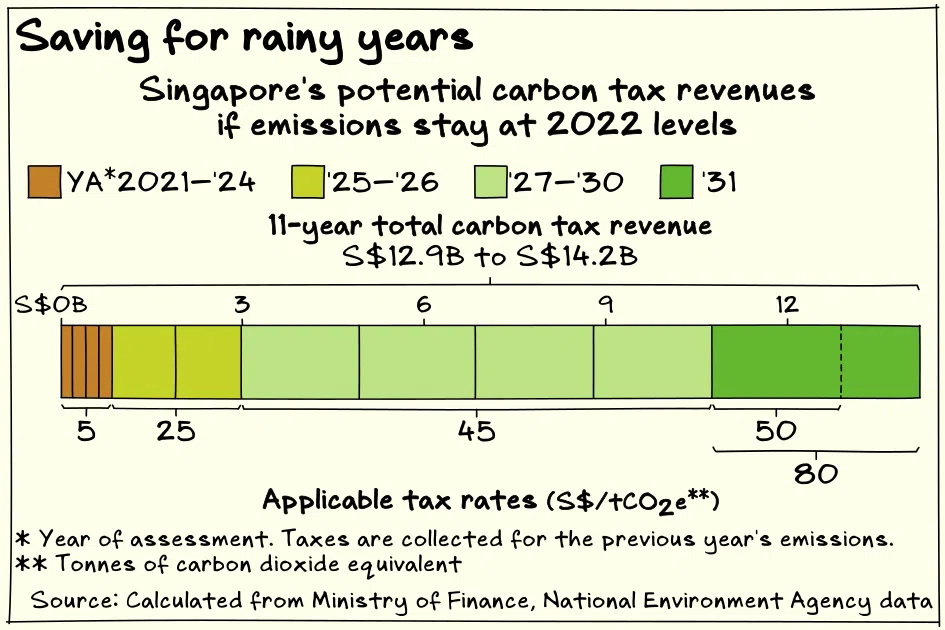
Come 2024, Singapore’s carbon tax, which covers about 80 per cent of emissions in the country, will increase to S$25 per tonne of carbon dioxide equivalent, which is five times the current rate of S$5 per tonne.
The hike means that carbon tax revenue in 2025 – the first year in which tax collections will reflect the new tax rate – could also be five times what it is now. The current Singapore Budget projects S$215.2 million of carbon tax revenue for the year ending Mar 31, 2024, which means carbon tax revenue could contribute more than S$1 billion to the Budget in 2025.
The carbon tax rate is scheduled to further increase to S$45 per tonne in 2026, which means annual takings from this levy could jump again to almost S$2 billion in 2027. By 2030, Singapore is aiming for a carbon tax of between S$50 and S$80 per tonne of emissions. At that point, annual carbon tax collections could be between S$2 billion and S$4 billion – assuming Singapore achieves its goal of post-peak annual total emissions of 60 megatonnes by 2030.
In a somewhat conservative estimate – assuming emissions are frozen at current levels and that only one more hike occurs in 2030 – total carbon tax revenue from 2021 to 2031 could be about S$12.9 billion if the final tax rate is S$50 per tonne and about S$14.2 billion if the final rate is S$80 per tonne.
The carbon tax kills two birds with one stone for Singapore. The first act of avicide is through the internalising of the cost of emissions in the Singapore economy. In other words, people and companies can no longer produce greenhouse gases and let the rest of society bear the cost. In the words of the National Climate Change Secretariat (NCCS), it is “an effective economic signal to steer producers and consumers away from carbon-intensive goods and services, hold businesses accountable for their emissions, and enhance the business case for the development of low-carbon solutions”.
The second feathered fatality is that the carbon tax helps Singapore fund the cost of decarbonisation. In explaining the carbon tax, NCCS says: “The government does not expect to derive additional revenue from the carbon tax increase in this decade. The revenue will be used to support decarbonisation efforts and the transition to a green economy, and cushion the impact on businesses and households.”
The plan to use carbon tax revenues to “support decarbonisation efforts and the transition to a green economy” could run into a constitutional complication. Singapore’s Constitution prohibits each term of Parliament from running a cumulative Budget deficit over the term. Any surplus at the end of the term is then placed in the reserves, where it is locked up and may only be used under exceptional circumstances.
This means any surplus carbon tax collected by the current government will no longer be available to subsequent governments.
There is a way around this, and that is to transfer the carbon tax collections into a climate trust fund every year. It’s a Budget device the government often uses to ensure the continuity of well-defined, long-term programmes. For instance, in 2015 Singapore set aside S$3 billion to seed the Changi Development Fund to support airport expansion across the years. When it was announced in 2014, the Pioneer Generation Package for the elderly was supported by an S$8 billion Pioneer Generation Fund.
These funds last for as long as needed, and money placed in these funds can be disbursed as required. This means that if there is a surplus of carbon tax collections when the prevailing government comes to the end of its term, the surplus can remain accessible to the next government for its climate-related needs.
Why bother? Why not just spend the carbon tax money as it comes in, and leave surpluses to be locked in the reserves?
For a start, decarbonisation is probably going to be a highly expensive endeavour and a long-term journey. Those circumstances make fiscal wiggle room extremely valuable. Having money stashed in a long-term fund insulates decarbonisation efforts from the year-to-year uncertainties of the Budget cycle; greening won’t have to pause to accommodate the crisis of the day.
A well-endowed fund also gives the government of the day the ability to optimise the timing of spending to match needs. Take Singapore’s energy transition, for instance. It’s still too early to identify which low-carbon energy solutions will eventually replace fossil fuels for Singapore, so current investments into fossil fuel alternatives are rightly measured and cautious. As greater clarity emerges, however, it might be important to step up development spending on the winning solutions. A long-term fund allows those decisions to be made wisely.
Other Singapore reads
- UOB sets up sustainability advisory panel with trio of members
- Singapore to formulate alternative-fuel standards by 2025
South-east Asia
Getting private capital involved in adaptation
Experts are stressing the importance of getting private capital involved in helping to fund climate adaptation in Asia. One of the key arguments being made is that climate-related loss and damage pose risks to businesses, therefore investing in climate adaptation protects the bottom line.
It’s an argument that perhaps needs to be more forcefully made. With overall adaptation spending already seriously lagging what scientists believe to be needed, the Climate Policy Initiative says private contribution to adaptation measures stands at only 2 per cent of total adaptation spending.
Financial institutions, including banks and insurers, have more widespread exposure to adaptation risks than companies in most other sectors, and can therefore play a more active role in helping to nudge private-sector capital towards addressing adaptation needs. The cost of incentivising adaptation investments – be it preferential insurance premiums or loan interest rates – can be a perfectly rational price to pay to reduce risk.
Other South-east Asia reads
- Asia renewables are a bright spot on the M&A horizon
- Hong Kong tycoon’s energy empire ramps up green jet fuel push
Other good reads
- BP’s US$4.1 billion bet on renewable natural gas gets underway
- Climate change-related droughts dent progress on energy emissions: report
TRENDING NOW

Britain’s mansion tax shows the difficulty of targeting wealth

Once staunchly pro-China, Malaysian Chinese businesses are now distancing themselves from Beijing

The only common thing in S-E Asia is that we all eat rice: Cisco’s Asean president

Singapore data centre operator DayOne opts for US IPO at likely US$20 billion valuation

