Issue 75: SIA’s green fuel goal needs costlier carbon; outcomes matter at COP28

In this issue: Singapore Airlines’ transition to sustainable aviation fuel could face headwinds without a meaningful global price on carbon, while BCG experts identify energy transition and water as key issues at the coming climate conference.
Singapore
Lifting sustainable aviation fuel through carbon pricing
As Singapore Airlines (SIA) begins its transition towards sustainable aviation fuels (SAF), carbon pricing will be a key factor in the carrier’s ability to remain competitive while staying green.
SIA and its budget arm Scoot said on Tuesday (Nov 14) that they are aiming to use sustainable aviation fuels (SAF) for 5 per cent of their fuel requirements by 2030. While 5 per cent may not seem much, it is only a start; SIA has set itself a 2050 target to achieve net zero emissions, which means it will need to transition to a much higher SAF share in its fuel consumption.
SAF remains far too expensive, and supply is far too limited, to completely replace conventional jet fuel at the moment. Global production of SAF in 2022 was 0.24 million tonnes, based on data compiled by the International Air Transport Association. That was five times what it was in 2020, but still less than 0.1 per cent of the 254 million tonnes of jet fuel produced that year.
In terms of cost, one tonne of SAF cost US$2,437 in 2022 – 2.2 times the US$1,094 cost for conventional fuel (although there is significant regional variance).
SIA did not provide estimates of how a fuel mix that is 5 per cent SAF might affect its costs. For the six months ended September, SIA’s net fuel cost was S$2.3 billion. This was about 30 per cent of total expenditure.
If SAF net fuel cost was 2.2 times that of conventional fuel, and SIA had replaced 5 per cent of its fuel with SAF during that period, total net fuel cost could have increased about 6 per cent to about S$2.4 billion for those six months.
Total expenditure would have increased just under 2 per cent to S$7.7 billion from S$7.6 billion. Assuming no changes to ticket prices and revenue, operating profit would have declined by 9 per cent to S$1.4 billion from S$1.6 billion.
The good news for SIA is that the 14 airlines that form the Association of Asia-Pacific Airlines – including SIA – have also adopted the 5 per cent by 2030 target. Cathay Pacific, which is part of the Association, has set itself an even more ambitious target of 10 per cent SAF by 2030.
This lowers the risk that one of these regional carriers will be able to undercut its rivals.
SIA will probably be able to pass on some of the cost to customers, but it still needs the cost gap between SAF and conventional fuels to narrow much more.
SIA was serving 74 destinations around the world, and it has many more competitors outside of those other 13 regional airlines in the Association. Without a smaller cost gap, airlines that use more SAF will be at a significant competitive disadvantage.
The cost gap also hinders adoption of SAF, which makes it harder for the SAF market to develop enough scale to bring costs down.
The key metric here is the cost gap, not just the cost itself. If the cost of SAF goes down, but the price of conventional fuel falls even more, airlines will still find it more economical to stick with the conventional option.
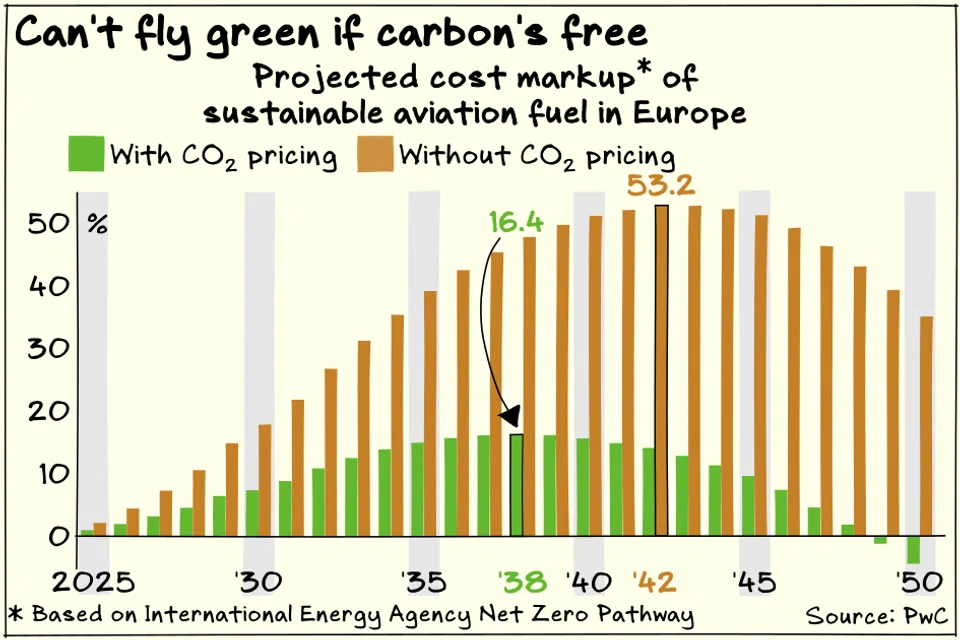
A PwC study that looked at the European market found the projected cost overhead for SAF over conventional fuels was highly dependent on carbon prices.
Assuming the price of carbon reaches US$160 per tonne in 2050, PwC estimates SAF will hit a peak gap of 16.4 per cent over conventional fuels based on the International Energy Agency’s Net Zero Pathway. If there is no carbon pricing, however, the SAF overhead will hit a peak of 53.2 per cent.
“The sensitivity analysis shows that omitting the CO2 price has the largest impact among our analyses on the cost markup created by SAF,” PwC said. “This supports the importance of a (preferably global) CO2 price to make climate-friendly alternatives to fossil fuels more competitive.”
It remains to be seen whether a US$160 per tonne global carbon price by 2050 is realistic. In South-east Asia, carbon pricing is still nascent; when carbon is being priced, it is often too cheap.
Indonesia recently launched carbon emissions trading, and the initial credits were trading at S$6.16 per tonne. Singapore currently taxes carbon at S$5 per tonne. That will go up to S$25 next year, then S$45 two years later; with a goal of S$50 to $80 by 2030.
Without meaningful carbon pricing to narrow the gap between SAF and conventional fuels, airlines trying to lower their emissions will be flying into a headwind.
SIA chief executive Goh Choon Phong put it succinctly in a statement accompanying the announcement of the SAF target. On the challenge of getting to net zero, he said: “We cannot do this alone.”
Other Singapore reads
- To diversify boards, avoid ‘cookie-cutter’ approach to hiring, says SGX RegCo CEO
- Sentosa island on track to meet its clean-energy goal
South-east Asia
Getting actual progress critical at COP28
Coal, water and financing are the key issues for South-east Asia in the upcoming United Nations Climate Change Conference (COP28), say experts from consulting firm BCG.
Indeed, none of those issues are new or surprising. South-east Asia ranks among the world’s most coal-dependent regions with one of the youngest stocks of coal-fired power plants.
The region is also an agricultural centre that is exposed to rising temperatures and sea levels that make clean water a priority. Mitigating and adapting to climate change is expensive, and South-east Asia’s needs are high.
What might be needed most at COP28 for the region isn’t merely loftier targets and well-intentioned commitments, but a focus on actions and actual outcomes.
The Just Energy Transition Partnership (JETP) programmes to support the phasing out of coal in Indonesia and Vietnam are the regional poster children for grand plans with little progress.
Indonesia’s recently released consultation on a Comprehensive Investment and Policy Plan for its US$20 billion JETP programme has been criticised for not being ambitious enough. Indonesian officials, however, have taken issue with the costs of financing that it might be facing with JETP.
Granted, big schemes that involve many stakeholders, especially governments, are necessarily complex and cannot be rushed. It’s better to wait for the turkey to cook thoroughly than to serve an undercooked bird. Still, it’s imperative to move beyond talking about the wonderful feast ahead and start to actually prepare it.
The Synthesis Report for the Global Stocktake – the first comprehensive progress review of the 2015 Paris Agreement – tells us that the world needs to do more, and that it is running out of time to do it. The stakes keep getting higher.
Other South-east Asia reads
- Climate Impact X keeps scandal-hit carbon projects in flagship contract
- World Bank’s IFC names country manager for Singapore, Malaysia and Brunei
Other good reads
- China, US to launch working group on joint climate action
- Indonesia’s Pertamina, Chevron agree to share data to develop carbon storage facility
TRENDING NOW
‘My grandfather’s legacy’: Sherman Kwek lays out three-year plan for CDL to drive returns
He built the Vingroup empire. Now South-east Asia’s richest man is handing some key roles to his sons
Canada is upping oil flows to Asia, but South-east Asia’s refineries aren’t ready to handle them yet
What role can Japan play in Asean’s future?