

Issue 8: MAS goes blending; dealing with standards

In this issue: Dive into the Monetary Authority of Singapore’s sustainability and sustainable finance announcements, while Morgan Stanley’s Tim Chan discusses the need for reporting standards to converge.
Singapore
MAS wants to unlock blended finance
There’s a lot to unpack from the Monetary Authority of Singapore’s (MAS) latest round of announcements, timed to coincide with the financial regulator and central bank’s sustainability report.
Some takeaways:
- MAS to promote blended finance: MAS managing director Ravi Menon says MAS will host a blended finance conference in October to develop financing solutions in the region. Blended finance typically relies on capital from the public sector to catalyse private sector participation.
- MAS keen to develop transition finance: Most activities at the moment are not green. Some “brown” or “amber” activities are required, and cutting all these activities from financing can lead to negative outcomes. Long-haul passenger aviation, for example, does not have a clear path for sufficient decarbonisation; but targeted financing can help airlines reduce their emissions. Transition finance is about providing financing to help brown turn green. Transition financing has been slow to pick up, however. Menon notes that only US$4.4 billion of transition bonds were issued globally in 2021, less than 1 per cent of the US$800 billion raised for green- and sustainable-labelled bonds issued in the same period.
- New guidelines for retail ESG funds’ disclosures to take effect in 2023: Details about investment strategies, metrics and criteria will be required for funds with ESG-related labels; fund names will also be tested for appropriateness.
- MAS tallies physical currency’s emissions bill: Outsourced currency operations accounted for more than half of MAS’ total carbon emissions in the year ended March 2022, although that share was partly due to a drop in air travel during Covid-19. Reducing demand for physical currency, including during the Lunar New Year, is on the cards.
- MAS to improve climate resilience of its portfolio: As part of the transition of its portfolio, MAS will exclude investments in companies that derive more than 10 per cent of revenue from thermal coal mining and oil sands activities.
A proper discussion could easily generate a hefty book chapter for each of those points, and reflects the priority that MAS has placed on sustainability. On sustainable finance, particularly, MAS is flipping over every stone it can find.
We’ll stick to blended finance for this edition.
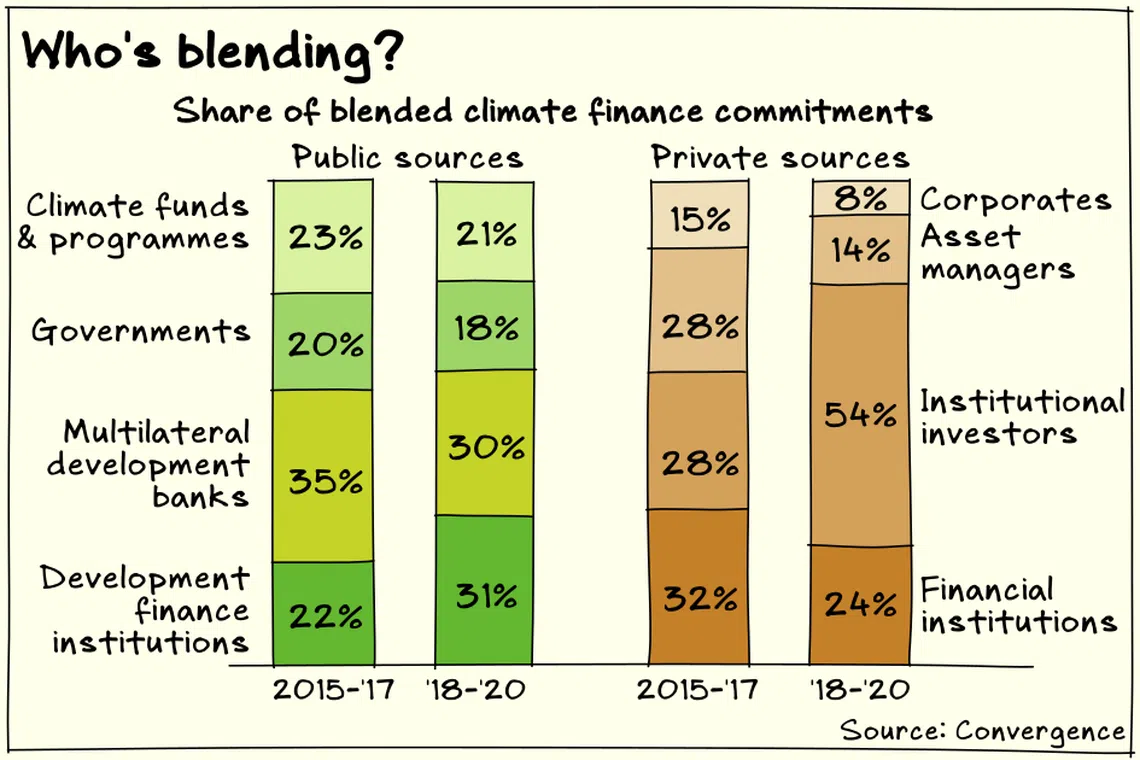
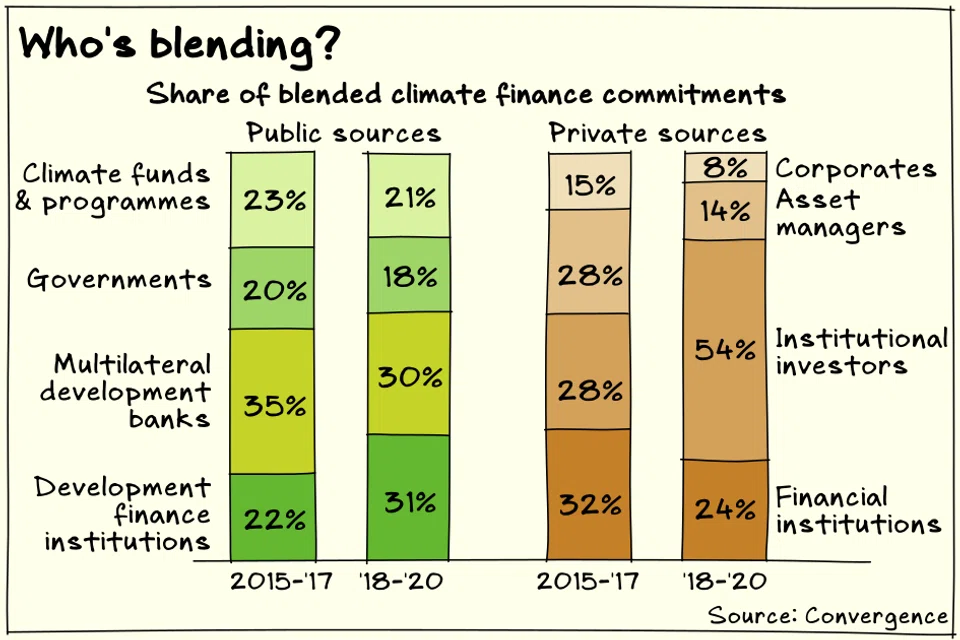
Addressing climate change is costly, and therefore lucrative – to the tune of about US$1 trillion in economic opportunities by 2030 in South-east Asia, by at least one analysis. Yet, only about US$15 billion — just over 1 per cent — has been invested since 2020.
These climate-related activities are needed because governments and companies in the region are already making commitments to decarbonise, so something must be getting in the way of money getting to them. There are in fact many somethings in the way, including:
- High risk of project changes: Poor planning, political fickleness and corruption could significantly alter the outcomes of projects.
- Life-cycle gaps: Long-term infrastructure projects are often riskiest at the start, but that is also where capital is most needed to get things started.
- Currency risk: Foreign investors need to hedge their currency exposure when funding local projects, and the lack of low-cost hedging options can create too large a gap between project and funding.
Blended financing tries to close these gaps by using strategic public capital to mitigate risk. Funding from development finance institutions, multilateral development banks, government programmes or philanthropies can provide guarantees so private investors are less exposed to the issuer’s poorer creditworthiness.
It all seems great in theory, but deals can be complicated and difficult to scale. Nevertheless, the need is great and the prize is shiny. As the region’s current financial hub, Singapore stands to gain if it can help overcome some of these obstacles.
Other Singapore reads
- Sustainability on the verge of becoming ‘very economically impactful’: GIC group CIO
- DBS CEO Gupta ponders if bankers should ‘play God’ around ESG
South-east Asia
Too many standards
Morgan Stanley’s Tim Chan, who heads the bank’s sustainability research for Asia-Pacific excluding Japan, astutely observes that the focus on ESG reporting has shifted from raising reporting rates to improving reporting quality.
But he also points out that global standards are abundant and inconsistent, making compliance challenging for businesses that operate internationally.
A lot of hope is being placed on the IFRS Foundation’s International Sustainability Standards Board (ISSB), which will lay down the rules for accountants and thereby finally provide a globally accepted baseline for reporting. The first set of standards from ISSB could arrive as early as the end of this year, but the overall process could take years. In the meantime, the climate crisis continues to worsen while different jurisdictions continue to chart their own paths.
A company that’s trying to stay in compliance across a number of jurisdictions is going to be worried about inadvertent breaches. Unfortunately, there is a tried and true solution to ensure compliance all the time: Boilerplates. If you find a way to say something by being sufficiently vague and aggressively hedged, you’re just going to keep doing it that way – so you never get in trouble. We might see convergence in ESG reporting after all, just not the kind we were hoping for. Be careful what you wish for?
Other South-east Asia reads
- BNP Paribas guns for growth in wealth management and sustainable investments
- State-run oil giants will make or break the energy transition
Other good reads
TRENDING NOW

Simba admits exceeding spectrum limits amid failed M1 deal; full-year profits surge 277%

He built the Vingroup empire. Now South-east Asia’s richest man is handing some key roles to his sons
What’s on the agenda when Xi and Trump meet in Washington

Ex-execs of CW Group, Allied Tech charged with offences linked to lawyer’s S$76 million misappropriation

