

Issue 9: Green promises; sustainable debt issuance slowdown

In this issue: Singapore issues its first sovereign green bonds, while ESG debt issuance falls in the Asia-Pacific.
Singapore
Green bonds and green defaults
After a considerable amount of buzz, Singapore’s first sovereign green bonds are finally here.
The 50-year bonds are notable not just because they are the first issued by the Singapore government to carry a “green” label, but because of their long maturities. The longest tenor on Singapore government bonds before this was 30 years. The new issue extends the yield curve in the Singapore dollar bond market, which could facilitate pricing of longer-term debt.
For the most part, though, the new bonds follow green bond conventions, including a curious norm: Green bonds rarely carry any protection against a “green default”.
Bondholders usually enjoy protection against a covenant breach or default. One of the perks of being a bondholder is that when a borrower breaks the rules, the bondholders get to ask for their money back. For example, if the borrower misses an interest payment, bondholders might be able to force the borrower to redeem the bonds early.
But what if a green bond is no longer green? What if, just for the sake of illustration, the Singapore government changes its mind about rail projects and green financing after the green bonds have already been issued? Would the green bondholders be able to ask for their money back?
The answer, for most green bonds, is no, because the documentation for green bonds don’t usually consider these changes to be breaches of the borrower’s obligations. Here is what the documentation for the Singapore green bonds says:
“While it is the intention of the Government to apply the proceeds of any Green SGS (Infrastructure) in accordance with the Singapore Green Bond Framework and to report on the use of proceeds for such Eligible Green Expenditures (as described in the Singapore Green Bond Framework), there is no contractual obligation to do so. In particular, the terms of the Green SGS (Infrastructure) do not require (i) compliance with the intended use of proceeds, or (ii) the Report issued in connection with the Singapore Green Bond Framework not to be withdrawn.”
This isn’t new. This kind of language is par for the course when it comes to green bonds. The entire premise of the green label is that the proceeds of the bond will be used for green purposes, and yet the bond documents explicitly say there is no obligation for the borrower to use the proceeds in such a manner. What is somewhat amazing is that the market lets borrowers get away with it.
Green defaults are not harmless, by the way. In 2016 and 2017, the Mexico City Airport Trust sold US$6 billion of green bonds to build a new airport. But in 2018, a new government decided not to go through with the project. The green airport bonds quickly tanked. When the bonds lost their green status, investors whose mandates did not allow them to hold the bonds were forced to realise huge losses. Mexico eventually bought back the green bonds at a fraction of the original principal amount.
The market and industry response was to tighten disclosure and monitoring of projects and disbursements in green bonds, but not to bind borrowers to permitted uses of proceeds. In other words, bondholders will know sooner if the borrower is breaking its promise. But they still won’t be able to do anything about it since it turns out there was never a promise to begin with.
A report by Baker McKenzie suggested this quirk of the green bond market could be a legacy of a desire in the nascent phases of market development to encourage market growth and to remain non-confrontational. But the fact remains that bondholders have no recourse in a green default.
This norm is unlikely to shift for a while, partly because demand for green bonds is still strong. Climate Bonds Initiative looked at a number of green, social and sustainability bonds issued in 2021, and found about two-thirds priced at “greeniums” – meaning investors were willing to pay more for them than non-green comparables.
Other than the Mexico City Airport case, the market has also not seen many major green defaults – which allows the market to continue ignoring the risk.
As the green bond market continues to mature and grow, however, green defaults will probably become more common; and with that, the impetus for change might increase as well.
Other Singapore stories
- SGX RegCo will consider costs, benefits for ESG disclosure requirements: chairman
- Singapore firms blame lack of budget, talent for sustainability struggles: report
South-east Asia
Sustainable debt slowdown
Singapore is issuing its green bonds under relatively unfriendly circumstances for new bond issues. Central banks have been raising interest rates aggressively to battle inflation, and expectations are for rates to go even higher in the coming months. Investors in such markets demand higher yields, which makes it more expensive for borrowers.
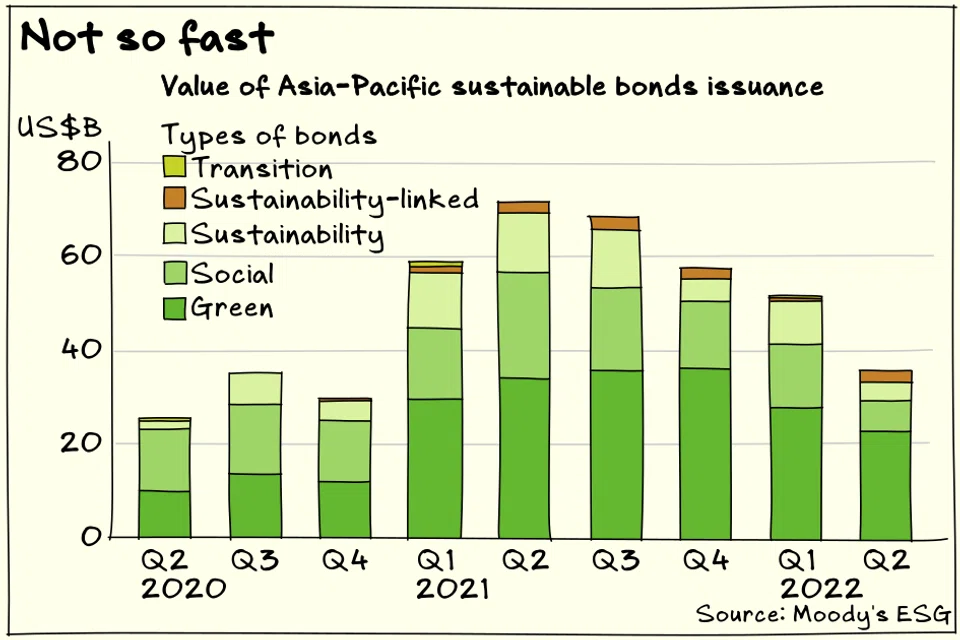
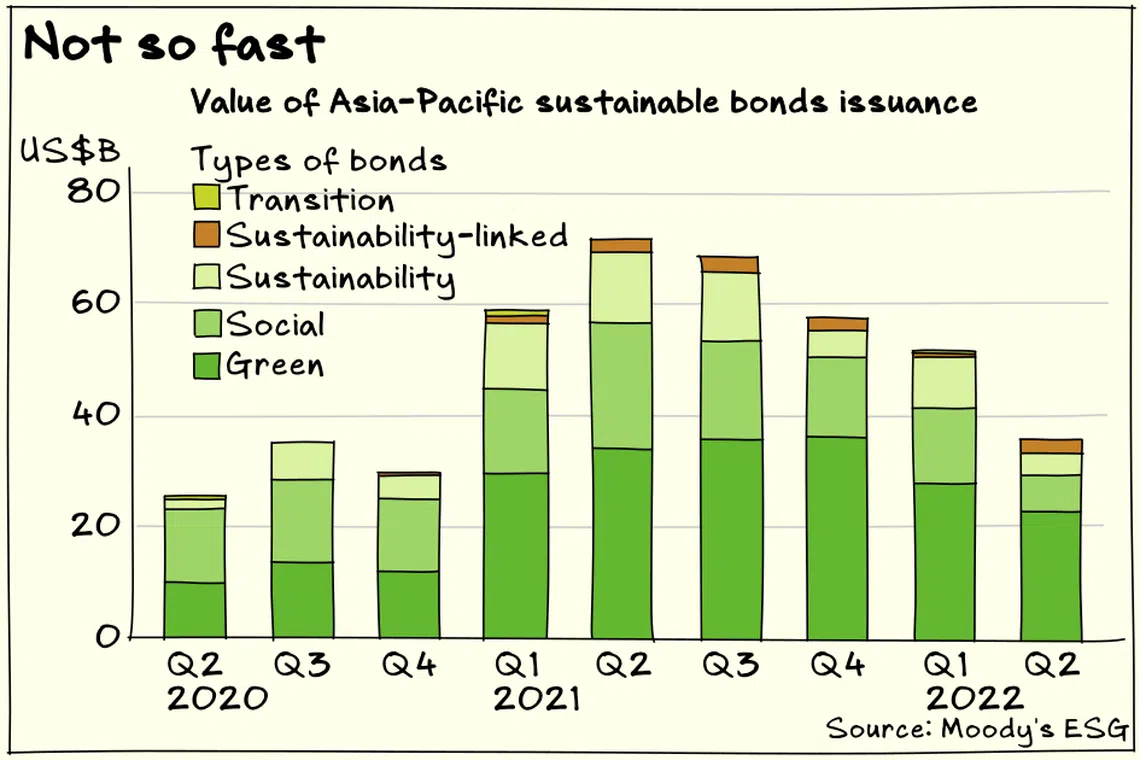
Moody’s ESG found that issuance of green, social, sustainable and sustainability-linked bonds in Asia-Pacific fell 48 per cent year on year in the first half of 2022 to US$86 billion. There was a relatively bright spot in the issuance of sustainability-linked bonds (SLBs), however, where issuance was flat year on year but up 20 per cent from the last quarter of 2021.
SLBs contain contingent structures that penalise or reward the borrower depending on whether sustainability-related performance targets are met. For instance, Singtel in April issued US$100 million of 5-year sustainability-linked bonds. The telco will have to make additional investments into green efforts equivalent to a 25-basis-point increase in its interest payment if its emissions are insufficiently lowered by 2025. Such structures make sustainability-linked bonds more directly accountable for impact.
A major reason for the popularity of SLBs is that proceeds can be used for general corporate purposes. That gives borrowers much more flexibility in how they will use the money they’ve raised. With green bonds, the use of proceeds is more constrained. Investors, meanwhile, have the convenience of dealing with neatly defined impact metrics, as well as certainty that the borrower will be held accountable for not delivering on impact.
There are pitfalls associated with SLB’s, however. As described by law firm McMillan, these could involve targets that are not ambitious or that are defined to provide loopholes; penalties that are not large enough; structures that provide loopholes; and late disclosures.
Other South-east Asia reads
- Techies take on South-east Asia’s food waste problem
- Malaysian firms that ignore ESG could go the way of dinosaurs: panellists






