The art of the deal 2.0: why pragmatism is defining the new US-China trade order

For Singapore and the wider South-east Asian region, this is a double-edged sword
Summarise
    • US President Donald Trump needs economic wins to bring back an electorate weary of global instability.
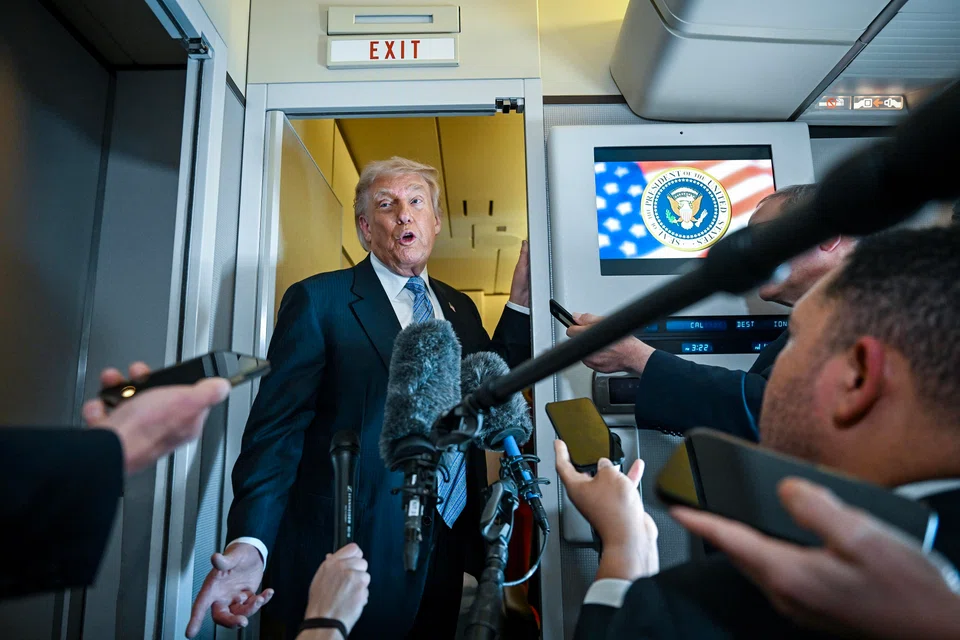
    • US President Donald Trump needs economic wins to bring back an electorate weary of global instability. PHOTO: NYTIMES
    Published Mon, May 18, 2026 · 07:00 AM

    THE red carpet laid out at Beijing Capital International Airport for US President Donald Trump on May 14 carried a weight far heavier than mere diplomatic protocol.

    As Trump stepped onto Chinese soil for the first time in nearly a decade, the global community watched a fundamentally different kind of statecraft unfold.

    In years past, the US’ objective at such summits was to try to transform China’s state-led economic system – a grand, often ideological battle to rewrite the rules of global trade.


    Today, that ambition has been replaced by “protectionist pragmatism”. The focus has shifted from trying to change a system to a simpler, more immediate goal: securing high-profile, transactional victories that can be measured in billions of dollars and bring quick industrial relief for the American heartland.

    This shift is best understood through the emergence of a strategy that prioritises immediate corporate wins over long-term structural overhaul.

    This is a move away from the scorched-earth decoupling rhetoric that defined the early 2020s towards a model of managed co-existence.

    Accompanying the US president is a delegation of corporate titans, including Nvidia’s Jensen Huang, Tesla’s Elon Musk, Apple’s Tim Cook and Boeing’s Kelly Ortberg, to name a few.

    Their presence serves as a shield for American interests, suggesting that while the two nations remain fierce rivals, they are too deeply intertwined to pursue total separation.

    Instead, the administration is focusing on a specific list of demands centred on high-visibility sectors like aerospace, energy and agriculture – what has become known as the “5 Bs”: Boeing, beans, beef, a “Board of Trade” and a “Board of Investment”.

    The domestic imperative: why these deals matter

    At the heart of this visit is a drive to secure massive purchase orders for American goods. For Trump, a multi-billion dollar Boeing order or a multi-year commitment for US liquefied natural gas is more effective political currency than a technical agreement on intellectual property rights that takes years to litigate in international courts.

    With the US military currently entangled in the Iran conflict and domestic approval ratings bruised by the resulting economic volatility and high energy prices, Trump needs economic wins to bring back an electorate weary of global instability.

    Securing record-breaking quotas for agricultural exports such as soybeans and beef serves this domestic purpose perfectly. By locking in Chinese buyers, the administration provides a floor for American commodity prices, insulating the US farm belt from the shocks of the Iran conflict.

    This is not about changing how China does business, but about ensuring that a larger share of Chinese spending flows directly back to the US.

    It is, in essence, the “art of the deal” applied on a scale suited to superpowers, where the metric of success is the trade balance rather than trying to change China’s economic philosophy.

    Furthermore, this transactional approach is a direct response to the domestic legislative climate in the US. Following the February 2026 Supreme Court ruling that limited the executive branch’s ability to unilaterally impose emergency tariffs without specific congressional approval, Trump has been forced to find alternative levers of power.

    If he cannot easily tax Chinese imports at the border, he must instead demand that Beijing “voluntarily” purchase American exports. This pivot from “tariffs as a weapon” to “purchases as a peace offering” defines the current summit.

    Geopolitical arbitrage: the Iran-Taiwan nexus

    However, the pragmatism of 2026 is born of necessity. China today is far more confident and assertive than it was during Trump’s first presidency.

    Beijing has demonstrated its leverage by positioning itself as a potential mediator in the Middle East, subtly suggesting that it could use its influence with Teheran – as Iran’s primary oil customer – to help reopen the Strait of Hormuz.

    For Washington, the reopening of this critical waterway would immediately lower global energy prices and benefit Trump’s domestic standing.

    This geopolitical arbitrage means that every trade concession the US seeks is being weighed against security concessions elsewhere.

    Beijing is signalling that help on Iran might be contingent on the US cooling its relations with Taiwan, specifically regarding the delivery of advanced defence systems authorised last year.

    The business world must realise that in 2026, trade is no longer an isolated silo; it is a bargaining chip in a much larger game of global security.

    For investors, the takeaway is that a “peace deal” on trade may actually be a “peace deal” on energy prices, bought at the cost of long-term strategic posture in the South China Sea.

    Implications for Singapore and Asean

    For Singapore and the wider South-east Asian region, this “protectionist pragmatism” is a double-edged sword.

    On one hand, a stable US-China trade relationship reduces the risk of a global recession. Singapore, as a primary trade and financial hub, thrives when the giants are talking rather than fighting.

    The “China+1” strategy, which has seen manufacturing move to Indonesia, Malaysia and Vietnam, will likely continue, but the nature of the shift may change.

    ​If Trump secures deals that preserve Chinese production in exchange for market access, the pressure for supply chain migration may ease. This would compel South-east Asian nations to compete on innovation and infrastructure rather than serving merely as tariff havens.

    South-east Asia has long benefited from a rules-based, multilateral trade order. However, the move towards a “Board of Trade” model – a bilateral safety valve for the US and China – implies a more managed world where smaller nations might find themselves squeezed by the “Big Two”.

    As Washington and Beijing move towards a “G2” model of direct bargaining, Asean nations must ensure they are not just spectators to deals being made over their heads.

    For Singapore, the opportunity lies in becoming the high-trust administrator of this new order. If trade is to be “managed” through boards and committees, someone must provide the neutral ground, the legal expertise and the financial clearinghouse for these massive transactions.

    Singapore’s role as a diplomatic conduit remains vital. In an era where the US-China relationship is defined by “transactional peace”, Singapore serves as an ideal host for the backroom negotiations that make these deals possible.

    Furthermore, as the US seeks to diversify its energy and food security away from volatile regions, Singaporean firms involved in agritech and green energy logistics stand to gain.

    The “5 Bs” strategy creates a surge in the movement of commodities across the Pacific, and Singapore’s maritime and logistical advantage makes it the natural beneficiary of increased transpacific throughput.

    If the world is moving towards a system of “managed rivalry”, the need for a sophisticated, non-aligned financial and legal hub has never been greater. Singapore is not just watching the deal; it is the platform upon which the deal can be executed.

    Both writers are from Penta Group. Thomas Kwan is managing director for Hong Kong while Shawn Balakrishnan is partner.