

Assertive Biden launches campaign
Seeking re-election amid floundering approval ratings, the US president is out to consolidate his base, and woo Nikki Haley’s voters
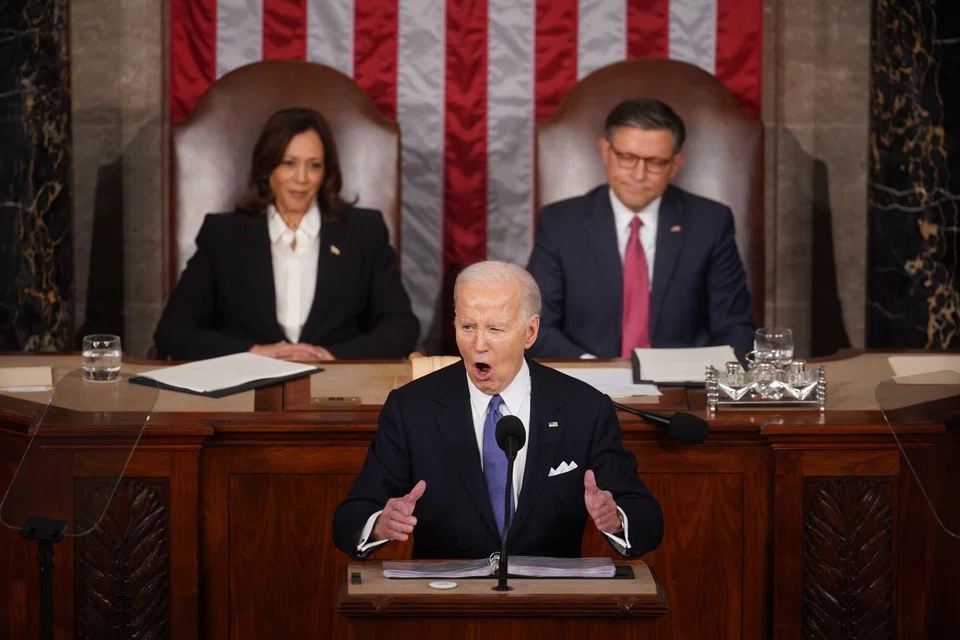
ON THE eve of the State of the Union (SOTU) address last Thursday (Mar 7) evening, some pundits speculated that US President Joe Biden, 81, with his approval rating now languishing below 40 per cent, would announce that he was withdrawing from the race and allowing other Democrats to face the Republican presidential candidate, former president Donald Trump, in November.
After all, Biden is facing huge problems that undercut his chances of getting re-elected, including doubts about his physical and mental fitness for office, looming fears over the country’s immigration crisis at the southern border, and continuing gloom about inflation despite falling prices.
Even the majority of Democrats tell pollsters that they want to see another candidate running for the presidency this year.
Overall, the major media have released public opinion surveys with similar findings: Trump was leading the incumbent president by between two and five points nationwide, with the inclusion of independent third-party candidates in the race expanding the Republican candidate’s margin.
Four years ago, Biden prevailed in six of the seven swing states. Now, according to polling averages, Trump leads by 7.7 percentage points in Nevada, 6.5 points in Georgia, 5.7 points in North Carolina, 5.5 points in Arizona, and 3.6 points in Michigan, and maintains an edge of one point in Wisconsin.
The reality is that Biden is facing a stunningly close race against a divisive predecessor across the nation – one with very high negative ratings who is saddled with 92 criminal charges.
Indeed, the consensus in Washington in the aftermath of last week’s Super Tuesday contests was that if the presidential election were held on the following Wednesday, Biden would have lost.
That was the kind of bad news that confronted Biden last Thursday, before he entered the House of Representatives to deliver the SOTU. And that may explain why the notion of the president deciding not to run for re-election may have made sense to some observers.
But that did not happen. Instead, Biden – who recognised that the SOTU would be the most important speech of his political career – used the most prominent platform of this election year to deliver a fiery speech that gratified Democrats, and confounded Republicans. The speech helped transform him from an ageing has-been politician into a vigorous statesman who still has more than 240 days to demonstrate that he could win the race.
Projecting a feisty spirit, and showing energy and focus, the president (who was ready for the back-and-forth from the Republicans on the floor, and almost seemed to welcome it) sounded defiant and exhibited his stamina. He probably helped to quell rising Democratic fears about his age and mental sharpness. Whether that would also help change public perception is another issue.
But then Biden’s major challenge may be the need to energise his political base in the Democratic Party and ensure that the majority of those who had voted for him four years ago would show up again at the ballot box and endorse him in November.
After all, according to a poll by The New York Times and Siena, close to 97 per cent of those who had voted for former president Trump in 2020 are ready to do so again in November. If anything, Trump’s legal problems and the attacks against him only seemed to have boosted support for him. To put it differently, the coalition that gave Trump 47 per cent of the votes in 2020 remains intact.
But that is not the case on the Democratic side, where Biden’s winning coalition has been tattering. Only 83 per cent of those who elected him in 2020 are ready to do it again. Ten per cent of his supporters say they will vote for Trump, while others are considering voting for third-party candidates or staying at home in November.
On a micro level, Biden seems to be losing some of the support of key groups in his Democratic coalition. In 2020, he had won the 18-to-29-year-old voters by close to 25 per cent, and enjoyed a lead of 11 points in the suburbs. Now he seemed to have lost half of his young supporters, as well as his lead in the suburbs.
Even more astounding is the eroding support for Biden among two traditional Democratic blocs – African-Americans and Hispanics. His lead among black voters has fallen from 84 per cent to 43 per cent, while some polls indicate that Trump could win close to 25 per cent of African-American voters.
At the same time, while Biden had won Hispanic voters by 21 percentage points in 2020, he now trails by six points among members of that group.
Recall that not so long ago, the conventional wisdom was that Trump’s anti-immigration positions were antagonising Hispanics. But now these same voters seem to be gravitating toward the former president, with many of them endorsing his calls to place stronger restrictions on illegal immigration.
Another crack in the Democratic coalition is the political backlash against Biden’s support for Israel in the Gaza War among Muslim voters. While they remain a small voting bloc nationally, Muslim and Arab voters play a critical electoral role in Michigan, a swing state that Biden needs to win in November.
While focusing attention on the political bases of the two presidential candidates, it’s important to note that less than 30 per cent of voters identify as Republicans or Democrats. More than 40 per cent of US adults identify as Independents, who can end up determining the outcome of the race in November.
From that perspective, one of the interesting findings of analyses of the Republican primaries this year was that former South Carolina governor Nikki Haley did very well among these Independent voters, in particular among professionals and suburban voters, who in some states helped her win more than 25 per cent of the votes, and even carry Vermont and the District of Columbia.
Most of these Independent voters are “never Trumpers” who would not vote for the former president in the general election. So it’s not surprising that the Democrats are hoping that they would cast their ballot for Biden instead in 2024.
But here is the dilemma that the Biden campaign is facing: Most of these Independent voters are centrist and are alienated by the left-leaning positions of members of the Democratic Party’s progressive wing, who subscribe to identity politics and liberal immigration policies, are critics of the police, and demand that Washington cut support for Israel.
Hence, Biden may find himself in a no-win situation: Moving to the centre-right could help him win the votes of some of Haley’s primary supporters. But doing so might antagonise young progressive voters who want him, for example, to take a tough stand against Israel, and could weaken his electoral base.
TRENDING NOW

ComfortDelGro appoints two new independent directors

Once staunchly pro-China, Malaysian Chinese businesses are now distancing themselves from Beijing

NoonTalk needs continued financial support from CEO Dasmond Koh, auditors warn

DP Architects sets the benchmark for sustainability disclosure and design

