
Beyond the US budget debate, Powell remains the big decider

Monetary policy is what will make the difference, both economically and politically, in 2024
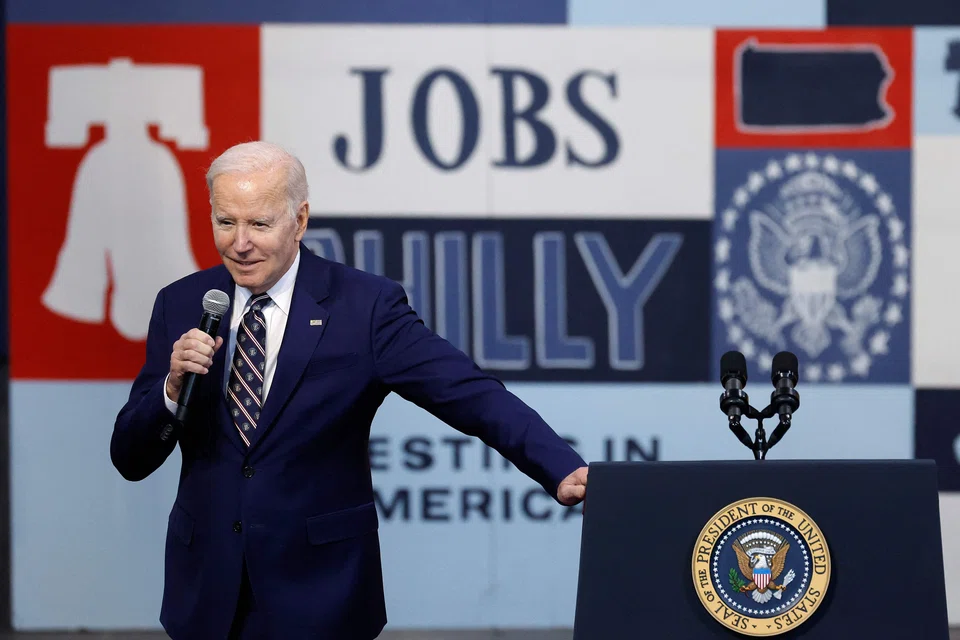
    • President Joe Biden talks about his proposed federal budget – seen as an attempt to highlight his policy priorities ahead of the 2024 presidential election – at the Finishing Trades Institute in Philadelphia, Pennsylvania.
    • President Joe Biden talks about his proposed federal budget – seen as an attempt to highlight his policy priorities ahead of the 2024 presidential election – at the Finishing Trades Institute in Philadelphia, Pennsylvania. PHOTO: AFP
    Published Mon, Mar 13, 2023 · 12:22 PM

    JUDGING by the amount of noise made by both the White House and the Republicans as they prepare to work on the proposed new budget, you would assume that US President Joe Biden is about to launch historic fiscal programmes – the likes of those advanced by presidents like Franklin Delano Roosevelt or Ronald Reagan, which restructured the American economy.

    In reality, both sides in the debate, operating in a new legislative environment in which the Republicans now control the House of Representatives, have less of an interest in economics per se and more in politics – specifically, the 2024 presidential and congressional election.

    For Biden, the budget proposal can be seen as an attempt to highlight his policy priorities. These include investing in American manufacturing; protecting the nation’s safety-net programmes; increasing the number of high-tech factory jobs; fighting climate change; ensuring that corporations don’t exploit consumers; and continuing to provide Ukraine with military assistance.

    The Republicans will counter with budget proposals reflecting a different set of priorities. Under pressure from the hard-right wing of lawmakers in the House of Representatives, Speaker Kevin McCarthy will propose major cuts in healthcare programmes and assistance to the poor.

    Their focus is cutting the budget deficit and the growth in the national debt without raising taxes – unlike the president, who proposes reducing the deficit through taxes on large corporations and the wealthy.

    Most significantly, the Republicans insist that they will agree to raise the limit on government borrowing only if the president pledges to make deep cuts in federal spending.

    Biden has refused to link any spending cuts to raising the borrowing cap. But the expectations in Washington are that after a stand-off, the Republicans will agree to make a deal with the administration, rather than being blamed for causing a global financial meltdown and devastating the American economy by not raising the borrowing cap.

    The Republicans have also made it clear that they will not make cuts in the major entitlement and politically popular programmes, including Social Security and Medicare, and are unlikely to touch the defence budget. They will mostly target assistance for the poor as well as programmes, championed by Democrats, that promote diversity and equity.

    Much of the debate between the White House and congressional Republicans will focus on Biden’s plans to support his socio-economic programmes and climate change-fighting efforts by raising close to US$3 trillion in taxes on corporations and high earners.

    After losing the Democratic majority in the House, Biden recognises that he will not have the votes to promote such an ambitious agenda. Instead, he hopes that if his tax increases are thwarted, he and the Democrats will be able to promote a political narrative in 2024 that depicts the Republicans as allies of Big Business and the very rich.

    The Republicans, on the other hand, will counter by blaming the president and the Democrats for the rising deficit and – depending on whether prices remain high in 2024 – for the major threat to the economy, the inflationary surge.

    This suggests that while neither side will succeed in changing the fiscal status quo in Washington, it is monetary policy that will make all the difference, both economically and politically, in 2024.

    From that perspective, it is the chairman of the US Federal Reserve, Jerome Powell, who remains the most important economic player in Washington. His monetary policy could determine not only if inflation will be tamed, but also whether the US will enter a painful recession before the election.

    Most observers agree that Powell failed miserably in 2021 to 2022 by disregarding the implications of not tightening monetary policy and thus allowing an inflationary surge.

    But after learning its lesson, the Fed made a significant turnaround last year and has raised its benchmark rate by 4.5 percentage points.

    It has embraced a path of gradualism as opposed to aggressive tightening: making four three-quarter-point rate moves, slowing to a half-point increase in December and then a quarter-point increase in February. This policy, according to some indications, could help the central bank return inflation to its 2 per cent target level.

    But to achieve that goal, the central bank may have to tighten monetary policy more substantially than it already has, and in the process increase the economic costs in the form of rising unemployment and a possible recession.

    Based on historical evidence, monetary tightening of the magnitude currently pursued by the Fed is bound to result in higher unemployment.

    At a minimum, the federal funds rate would have to be raised by at least 1 percentage point to get inflation back to 2 per cent, with rates peaking above 5.5 per cent this year – which in turn could raise unemployment by more than 1 per cent.

    Hence, Powell’s success depends on his ability to resist the temptation to ease monetary policy too early yet also ensure that the expected economic slowdown will not end up as a full-blown recession – which would be the political nightmare scenario as far as Biden is concerned.

    Powell, who addressed the Senate Banking Committee and the House Financial Services Committee last week, made it clear that if the “totality of the data” – in particular, job market and inflation figures – suggested that more drastic tightening was necessary to tame inflation, then the Fed was ready to increase the pace of rate increases.

    But while this suggests a possible half-point hike next month, Powell stressed that “no decision has been made on this”.

    He has also warned Congress that it needs to suspend or increase the debt limit and avoid a default, suggesting that it could be difficult to continue raising interest rates against a backdrop of looming financial catastrophe.

    “Congress raising the debt ceiling is really the only alternative,” Powell said. “There are no rabbits in hats to be pulled out on this.”

    He stressed that the Fed cannot protect the economy “from the non-payment of the government’s bills, let alone a debt default or something of that nature”. When The Man talks, lawmakers need to listen.



