Big business agenda for King Charles’ US visit
The diplomatic mission will be one of the most important tours by a UK monarch in seven decades
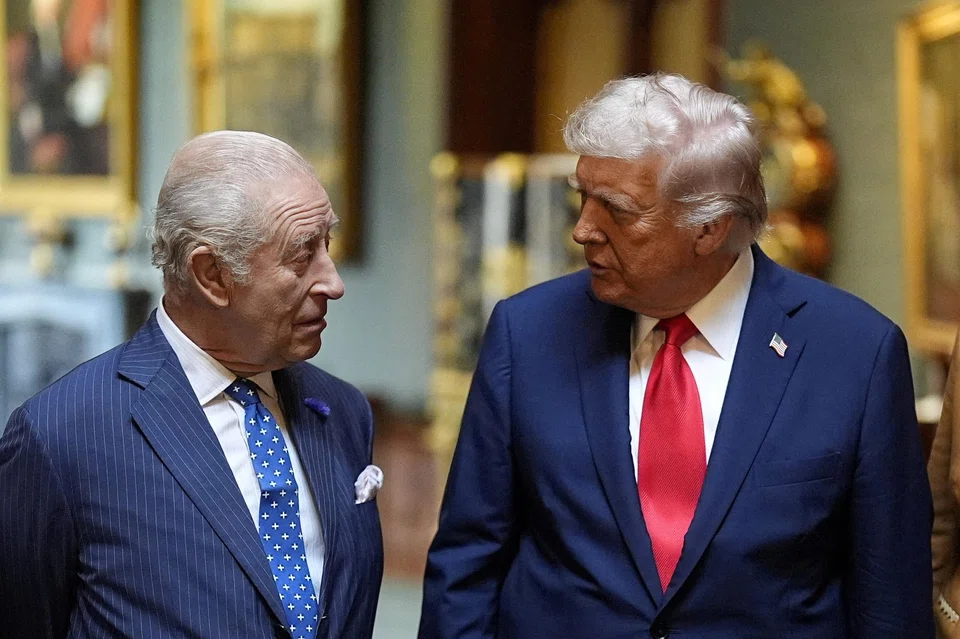
THIS week’s state visit by King Charles III to the US – his first as monarch – is arguably one of the most important tours by a UK sovereign in seven decades.
Tasked with steadying key business and political relationships, the king’s four-day itinerary reflects a heavy economic agenda.
Beyond meeting US President Donald Trump and Congress in Washington on Tuesday (Apr 28), King Charles will visit New York City on Wednesday before concluding in Virginia on Thursday to mark the 250th anniversary of US independence from Britain.
While the 250th landmark sets the stage, another date looms large: October 1957, when Queen Elizabeth II made her first US state visit to engage then president Dwight Eisenhower.
During the Suez crisis, US-UK relations had significantly deteriorated with the fallout between Eisenhower and then UK prime minister Anthony Eden. Queen Elizabeth II’s tour stabilised bilateral relations.
Today, King Charles faces a similarly fractured backdrop, with US-UK relations strained by a new Middle Eastern war, security and trade disagreements.
Trump has chastised UK Prime Minister Keir Starmer over his refusal to join the war against Iran, and questioned the UK’s military capabilities and its performance in recent wars, including Afghanistan.
Another thorny security issue is the proposed Starmer deal on the future governance of the Chagos Islands in the Indian Ocean, where a key US-UK base is located.
The Starmer government is on the political back foot, too, following the removal of the UK’s previous ambassador to the US, Peter Mandelson, over his links to paedophile Jeffrey Epstein.
US-UK business challenges and opportunities
On business issues, too, tensions are running high. Trump has criticised Starmer on a range of matters, including the UK’s digital services tax. The president has threatened to impose extra tariffs on the UK if Starmer does not drop the tax.
The king’s visit also comes in a context of growing concerns about the local (US and UK) and global economies, underscored by recent International Monetary Fund-World Bank growth downgrades.
Trump has said “everything” will be on the agenda with King Charles this week, even though the king is not an elected politician.
The UK business community is understandably concerned that the deterioration in Trump-Starmer ties could unravel some of the deals announced in 2025 during the US president’s state visit to the UK, notably the £250 billion (S$431.3 billion) “Tech Prosperity Deal”.
During that visit, Trump and Starmer signed a landmark tech partnership aimed at strengthening US-UK cooperation in artificial intelligence, quantum computing and nuclear energy. Microsoft, Google, Nvidia and OpenAI had pledged to invest tens of billions of dollars in the UK.
Starmer called it “the biggest investment package of its kind in British history” and “groundbreaking”, not least given that it would bring thousands of UK jobs.
Royal wooing of Trump on business
Given the growing tensions between Trump and Starmer, King Charles will likely be pitching for UK industry and a potential post-Brexit trade deal.
While the UK has signed agreements with various US states, including North Carolina, South Carolina and Indiana, it has not yet secured targeted federal-level deals on key UK exports, such as Scotch whiskey.
As head of the Commonwealth, King Charles may also extend his charm offensive for African and Asian members – including Singapore and Malaysia – which are also impacted by tariffs and Trump’s wider agendas.
In these efforts, King Charles will be joined by Queen Camilla, who will co-host an AI event with US First Lady Melania Trump on Tuesday.
The king and queen will likely lean into Trump’s well-documented admiration for the royal family. Trump has described fond memories of watching television coverage of Queen Elizabeth II’s coronation in 1953 with his Scottish-born mother.
A portrait of the late queen is on display at Trump’s Mar-a-Lago residence in Florida.
The king may underscore the distinction between the head of state and head of the government. This difference makes the UK royal family a key asset when it comes to international diplomacy, as Queen Elizabeth II showed in 1957 with Eisenhower.
Ultimately, this week’s visit is about more than smoothing troubled waters. It is a reminder that commercial and cultural ties between the two powers run deeper than individual politicians who come and go.
By emphasising a longer-term bilateral relationship built on history, law, economics and security, King Charles will try to make the two nations’ business and political collaboration work as well as possible – even as dynamics between their government leaders prove challenging.
The writer is an associate at LSE Ideas at the London School of Economics