THE BOTTOM LINE

Bond yields may be finally baking in an AI world

Investment firms are reassessing the long-term macroeconomic impact of artificial intelligence
Summarise
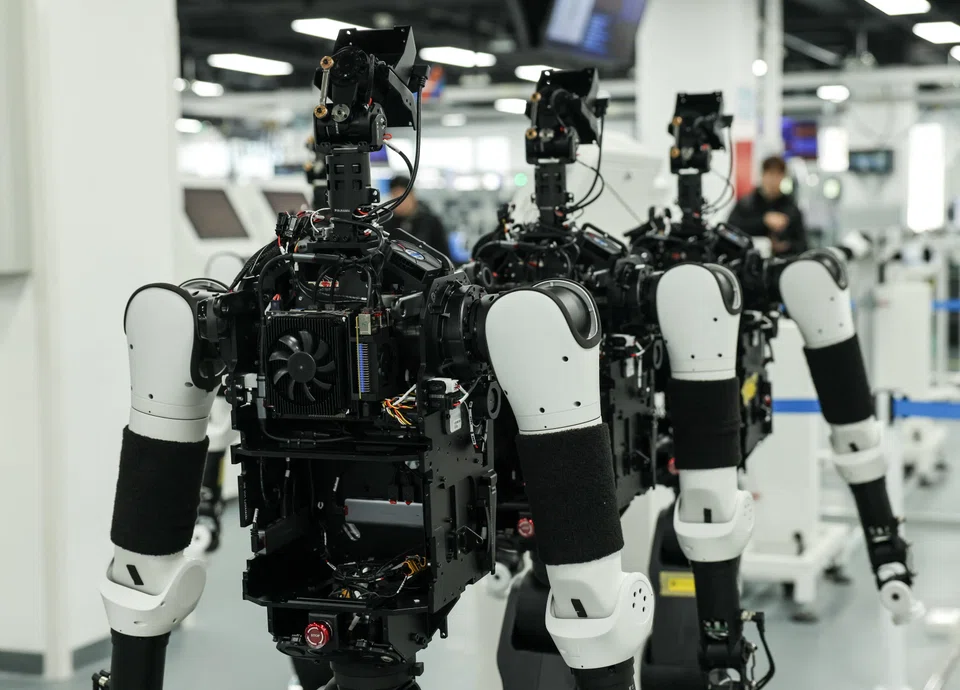
    • Humanoid robotics may lift economy-wide productivity more than other AI forecasts suggest – but it will also affect more jobs.
    • Humanoid robotics may lift economy-wide productivity more than other AI forecasts suggest – but it will also affect more jobs. PHOTO: REUTERS
    Published Thu, May 21, 2026 · 06:30 AM

    ALTHOUGH some are puzzled by the coincidence of an artificial intelligence boom and rising borrowing costs, they are closely linked.

    Beyond the immediate heat of the AI investment frenzy, a long-term productivity surge is lifting estimates of neutral interest rates even as workers’ share of the gross domestic product pie declines.

    The Iran-related oil shock and its immediate inflation fallout explain some of this month’s bond market jitters. Record-high stock markets have been harder to explain during an energy crunch.


    But the sheer scale of AI capital expenditure – estimated by Goldman Sachs at US$7.6 trillion over the next five years – is perhaps a bigger driver of bonds and stocks alike, and is forcing investment firms to reassess the long-term macroeconomic impacts of AI more broadly.

    The idea remains controversial in some circles. But a growing consensus holds that the shift from savings to investment, combined with the boost to potential GDP growth from AI productivity gains, will push up R-star – the theoretical neutral real interest rate at which the economy sits in equilibrium.

    Last week, the Institute of International Finance said a successful AI cycle should raise R-star, because higher expected returns and stronger capital formation will lift desired investment relative to savings. “Markets should not assume a return to the very-low-real-rate world of the 2010s based on the ongoing AI boom,” it added.

    Barclays’ annual Equity Gilt Study on Tuesday (May 19) reached a similar conclusion. “Rising productivity, combined with large capital expenditure needs, points to a higher neutral real interest rate,” it said.

    Although the move has been aggravated by oil-fuelled inflation and its implications for interest rates, long-term bond markets may finally be repricing to account for the latest wave of upgraded AI spending plans and the economic fallout.

    With inflation-adjusted central bank policy rates turning negative even as a massive investment boom unfolds and long-term neutral rate estimates climb, policymakers risk falling badly behind the curve in tightening monetary policy.

    Bond markets may be front-running the policy adjustment. At the very least, it goes some way to explaining why both AI-led major stock indices – such as the S&P 500 and Nasdaq – and long-term bond yields are rising in parallel.

    Labour share

    What could come unstuck? The other aspect of AI “futurology” in the economics world is what both generative AI and AI-infused robotics may mean for jobs and wages across the rest of the economy.

    Ultimately, that may put further pressure on the long-declining labour share of GDP versus capital and, by extension, on inequality within economies.

    TS Lombard economist Dario Perkins pored over this on Monday, and concluded that he sees the AI boom as one that augments existing jobs rather than one that replaces them completely.

    Perkins showed how the wage share of GDP – which resumed its steep decline since the 1990s after a brief post-pandemic recovery – was closely correlated with R-star estimates. The wage share should rise again, he argued, as workers demand more of the spoils through populist politics, fiscal activism and deglobalisation.

    “Either the wage share must recover, or all this talk about a new regime of structurally higher bond yields is probably wrong,” he wrote.

    Yet, the labour share is still falling – a potentially sore political point for US President Donald Trump’s administration, which promised the opposite.

    In its deep dive into AI’s macro effects, the Barclays Equity Gilt Study suggested that one reason the labour share will stay under pressure is that AI combined with AI-enhanced humanoid robotics widens the range of sectors and workers affected. Humanoid robotics may lift economy-wide productivity more than other AI forecasts suggest – but it will also affect more jobs.

    “To the extent that AI plus humanoid robotics accelerates the process of automation relative to augmentation, it will likely skew the distribution of national income further from labour towards capital,” wrote Barclays’ Christian Keller and Akash Utsav.

    “This has already occurred over past decades, and the aggregate slice that labour receives from the income generated by the economy could shrink further as labour can be more easily substituted.”

    If labour’s share of the pie declines further and weighs on demand, that may rein in rising bond yields to some degree, as TS Lombard’s Perkins suggested.

    But the Barclays economists think that, even if the effect on wage growth is ambiguous, one thing is clearer: The electricity and commodities needed to build and sustain the AI and robotics world may stoke long-term inflation pressures through power, energy and raw materials, rather than jobs and wages.

    That outlook leaves bond markets hoping for a recession to cool things down. But thanks largely to the AI surge, a downturn looks like a distant prospect to most investors.

    Just 4 per cent of global asset managers polled by Bank of America this month see a “hard landing” on the horizon. More than 60 per cent expect the 30-year US Treasury yield to top 6 per cent over the next 12 months. This suggests that for all the uncertainty, investors are still betting the AI boom has further to run. REUTERS