

This bull market still has legs, so stand still
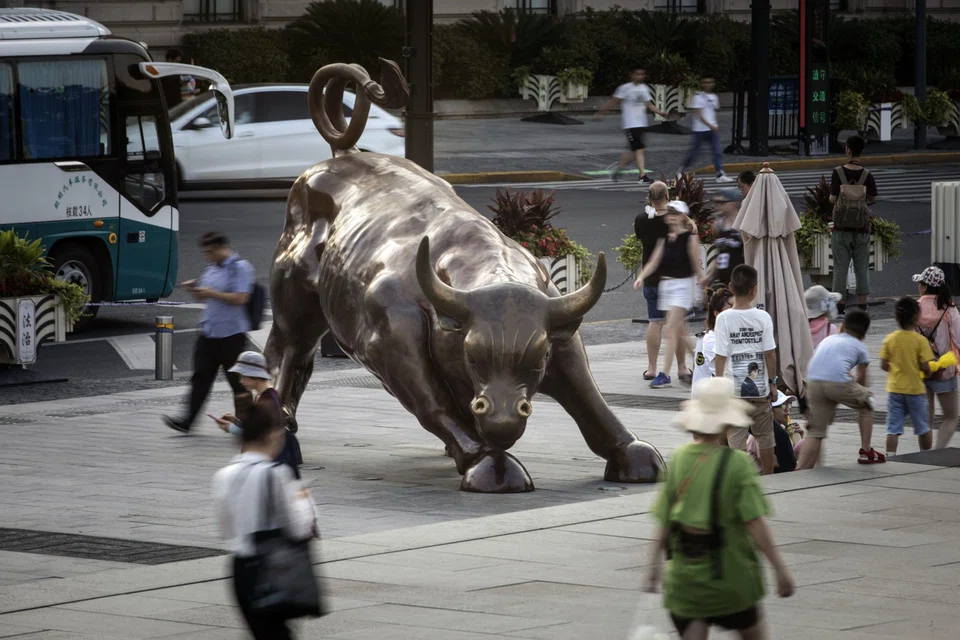
“DON’T just do something. Stand there!”
Legendary US investor Jack Bogle’s words are sage investment advice when a bull market wiggles, as it is doing now.
I have long called the stock market The Great Humiliator. It is again trying to shake the timid from its nascent upturn with scary stories about China weakness, declining global trade and slumping Singapore dealmaking activity.
Don’t let these false fears fool you into acting rashly. Here is why your best move now is no move at all.
John Templeton famously said bull markets are born on pessimism, grow on scepticism, mature on optimism and die on euphoria.
Recent pessimism has evolved into scepticism. Singapore’s latest manufacturing expectations are slightly more positive for the rest of 2023, an Economic Development Board poll indicated.
Soft landing
Three-quarters of surveyed global fund managers now expect a soft landing for the world economy – slower growth, but no harsh recession.
Still, China slowdown fears percolate. Oil prices creeping towards US$100 a barrel and strikes at Chevron’s LNG facilities in Australia have re-ignited energy fears.
Slowing eurozone lending and contractionary services purchasing managers’ indices also spur worry, alongside higher-for-longer global interest rate trends.
August and September’s sharp market swings illustrate all this.
Yet, volatility isn’t a flaw in this bull market. It is a feature of all bull markets, which proverbially climb a wall of worry. The myriad fears are all bricks in that wall. Recent wiggles are a crucial reminder that stocks’ ascents aren’t linear.
Consider America’s S&P 500 for its longest history. Since 1926, it endured 34 corrections – sharp, sentiment-driven drops of 10 per cent to 20 per cent.
The median decline was 13.7 per cent – a gut-churner. I counted 50 dips of 8 per cent or more, which works out to roughly one every other year.
Some bull markets have many such declines, often tied to “Fear” – false evidence appearing real.
Take the Straits Times Index (STI), for instance. Its bull markets from 2003 to 2007, and from 2011 to 2015, each had three full-fledged 10-per-cent corrections (before dividends).
The early 2016 to mid-2018 bull market had none. The bull market beginning in March 2020 has recorded two so far.
There is no pattern. Corrections strike at any time, for any or no reason.
I am not predicting that now. Short-term swings defy forecasting. Just know that they happen. Bull markets are volatile.
Globally, many recall the late 1990s as a red-hot easy stretch when Internet exuberance brought rocketing gains.
World stocks soared 37.5 per cent, 20.2 per cent and 24.8 per cent in Singapore dollar terms during that decade’s last three years, respectively.
Asia’s currency crisis sent world stocks tumbling in 1998’s back half. That wasn’t exactly an easy stretch. Nor were the 8.9-per-cent five-week nosedive of 1997 and the 9.2-per-cent plunge from mid-July to mid-August 1999.
Along with Asia’s regional crisis, headlines hyped Russia’s rouble implosion, Long-Term Capital Management’s bankruptcy and Y2K decimation fears.
Standing still then, as now, was hard work.
Short-term volatility is the price tag for stocks’ high longer-term returns. Trying to out-wiggle the wiggles is dangerous.
Again using United States data for their longest history, S&P 500 corrections’ median duration is 2.1 months. Recoveries take a median of 2.6 months. That’s fast.
The median market gain six months after a low was 22.9 per cent in US dollar terms. Too many miss that, selling after declines and re-entering after rebounds – which is portfolio disaster.
Certain conditions warrant exiting stocks. Late in the market cycle, when euphoric investors overlook big economic negatives, is one example. Another would be if you spot a looming multi-trillion-dollar economic shock that others completely miss.
Such circumstances are rare, and we are not in the late-cycle phase now.
Worried about higher-for-longer rates? The surprise power of rate hikes is gone, and high rates don’t preclude rising stocks.
Higher stocks
Including dividends, the STI is 11.4 per cent higher than it was before the Monetary Authority of Singapore began tightening its monetary policy in October 2021.
US stocks are also higher than before 2022 Fed hikes started.
China troubles? Despite deflation fixation and ancient property market scare stories, analysts expect a pre-pandemic-like 5.3 per cent growth in China’s gross domestic product for 2023.
Remember when a return to pre-pandemic norms was all anyone wanted? Its arrival should not be a bearish signal.
Sluggish Singapore exports and tepid global trade? I showed you in June that exports don’t dictate stock or economic growth.
Bull markets usually run long and strong. The Great Humiliator impishly persists in scaring off as many investors as possible along the way. Be ready for the wiggles and waggles. You can’t control them, but you can control your reaction to them.
The writer is the founder, executive chairman and co-chief investment officer of Fisher Investments, an independent investment adviser serving both individual and institutional investors globally






