

Cambodia’s new PM Manet may seek diplomatic space with cooperative style
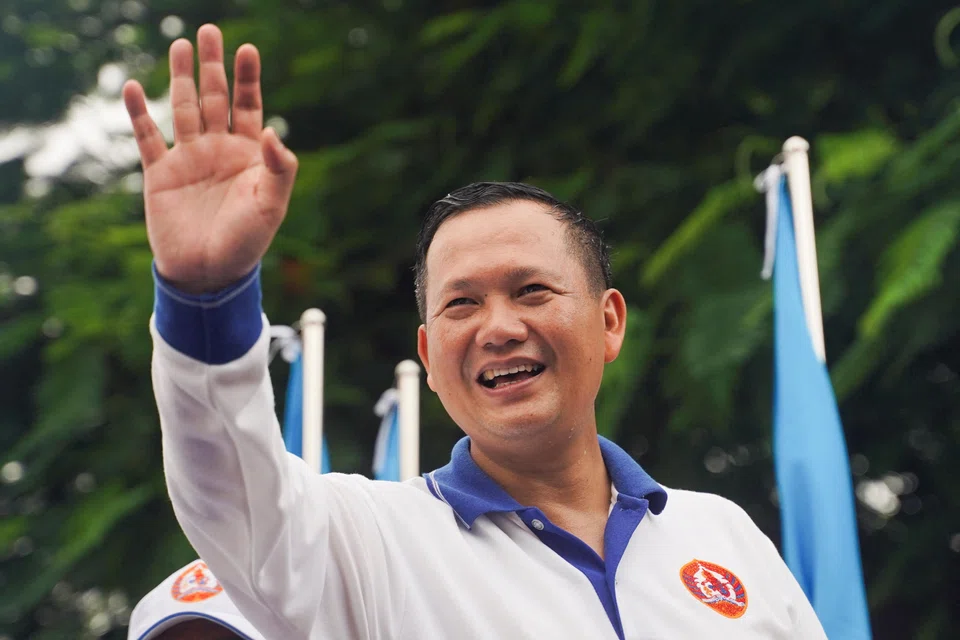
CAMBODIA’S new prime minister Hun Manet has been carefully groomed by his father and predecessor Hun Sen, who included him in foreign trips and prepared the young man for solo pilgrimages abroad to meet leaders and senior officials of Asean and its dialogue partners.
Manet is not a mystery man in the region, having engaged with its leaders over the past several years. Yet little of the 45-year-old’s thoughts have appeared in the media, mainly because he has continued to avoid interviews.
For our 2013 book on Hun Sen, Strongman: The Extraordinary Life of Hun Sen, my co-author and I interviewed Hun Manet extensively: face to face in Bangkok in April 2003, and later by email.
Manet was 26 years old at the time. After graduating from the US Military Academy at West Point in 1999, he attended graduate school at New York University, and went on to earn his PhD in economics at the University of Bristol in 2008-2009.
At NYU, his master’s thesis was on the land distribution mechanism in Cambodia. He also interned at the World Bank in Washington, DC, during a semester break, gaining valuable experience that he intended to use in economic development work back home.
“Despite my short time at the World Bank, I have been able to learn different types of policies concerning development issues, which is the main focus of my study,” he told us then.
He added that he “had understood the benefits and challenges associated with the bank’s activities in developing countries, including Cambodia”, and that “this knowledge and experience will help me enhance my ability to achieve my ultimate goal of contributing to the development of Cambodia” and “to improve the standard of living of the Cambodian people”.
Tough beginnings
Manet was born in October 1977 – four months after his father’s defection from the genocidal Khmer Rouge – at a difficult time for his mother, Bun Rany, who survived the brutal regime during her pregnancy with only rice porridge and fish paste for her meals.
The tough childhood years steeled Manet for the rigours of West Point, that in turn helped to build character. The American immersion was a culture shock with strict army rules, physical challenges, mental pressures and hazing, he recalls.
At NYU, Manet lived on a monthly allowance of US$600 from his parents, saving some of it to share with his less fortunate friends there. Bun Rany told us with pride and resignation: “Even though he may not have much money, he gives it to his friends. This is his nature.”
The young Manet was concerned about Western media’s negative reporting on Cambodia. “They tend to focus their reports more on problems and less on positive developments taking place in Cambodia”, he said then, arguing that they should instead “disseminate balanced information abroad about the actual Cambodian situation”.
As an economist, Manet steered clear of politics. His father saw a role for him in the Royal Cambodian Armed Forces.
Hun Sen told us in an interview: “He can be a person within the mechanism of the armed forces. He can do neutral work without involving himself in politics. I would prefer him to be a good economist, and if he enters the army, he would concentrate on the economy. I’ve prohibited my children from getting into politics.”
But after Manet became the commander of the army, plans changed. Manet stepped into politics when Hun Sen thought the time had come for him to retire.
Since becoming prime minister in 1985 at the age of 33, Hun Sen ruled without interruption for nearly four decades until he was succeeded by his eldest son this July.
Improving foreign relations
In Hun Manet, the international community will deal with a man whose experience spans both military and economic affairs, and who will prioritise trade and investment.
Manet has already travelled widely, meeting numerous leaders from Asean and its dialogue partners, and has been particularly active in regional defence diplomacy.
This included a June 2019 meeting with Singapore’s Senior Minister and Coordinating Minister for National Security Teo Chee Hean and Minister for Foreign Affairs Vivian Balakrishnan. Manet and the Singapore leaders reaffirmed the longstanding relations between both countries, and their “wide-ranging and substantive cooperation”.
After Hun Sen announced in June 2020 that he was grooming his son to be Cambodia’s future prime minister, Manet’s interactions with regional and global leaders increased markedly. He met Chinese president Xi Jinping on a trip to China with his father that year.
In February 2022, wearing his military uniform, Manet met Japanese Prime Minister Fumio Kishida on a visit to Japan. They agreed to boost security cooperation to achieve a Free and Open Indo-Pacific region (FOIP).
This was something of a surprise, because acceptance of this idea could be seen as hostile to China, one of Cambodia’s major allies. Even while agreeing to the FOIP, Cambodia would need to accommodate Chinese concerns somehow, as Beijing claims many of the islands in the South China Sea.
From his initial meetings with foreign leaders, it is clear that Manet aims to tighten relations with Asean and its dialogue partners. He may even find ways to improve relations with the United States.
There is no reason why the US – which has historically courted brutal dictatorships in Latin America and Asia – should not deepen its engagement in Cambodia, where elections have been held since 1993, albeit under a cloud of controversy.
While a new Hun Manet administration is unlikely to swerve away from his father’s policies, he may find the diplomatic space to improve relations with the major Western powers, bringing a change in style with a friendlier, more cooperative engagement than his father’s.
The writer is editor-in-chief of Rising Asia Journal
TRENDING NOW

Britain’s mansion tax shows the difficulty of targeting wealth

Once staunchly pro-China, Malaysian Chinese businesses are now distancing themselves from Beijing

The only common thing in S-E Asia is that we all eat rice: Cisco’s Asean president

Singapore data centre operator DayOne opts for US IPO at likely US$20 billion valuation

