Can the US reprise its 1973 Middle East war diplomacy?
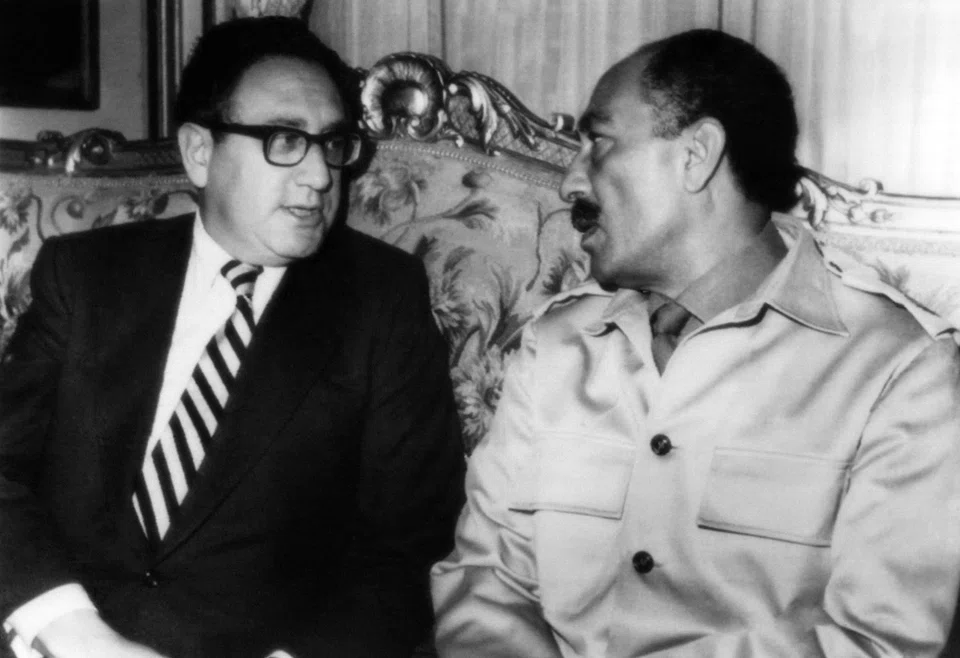
IN 1973, in the midst of the war between Israel, Egypt and Syria (aka Yom Kippur War) the then US secretary of state Henry Kissinger helped end that battle between the Jewish state and its Arab adversaries, and then went on to negotiate a historic diplomatic deal between Egypt and Israel that ushered in an era of relative stability and an ensuing Pax Americana in the Middle East.
Dr Kissinger’s diplomatic success was based on his belief in a gradualist, step-by-step approach that in a way became his leitmotif. His strategic objective was to remove Egypt from the arena of the conflict with Israel by integrating it, like France after the Napoleonic Wars, into the new US-led Middle Eastern order while isolating the radical Arab states then backed by the former Soviet Union.
In the pursuit of these strategic objectives at the end of the 1973 war, Dr Kissinger managed emergency supplies of weapons to Israel after it was attacked by a coalition of Arab states that almost destroyed the Jewish state.
Dr Kissinger helped turn the tide in favour of Israel but then went on to avert a complete Israeli military victory. He ensured the survival of the Egyptian army by not allowing the Israelis to force its surrender, thus preventing then Egyptian president Anwar Sadat’s humiliation by a triumphant Israel.
If the latter had happened, neither Israel nor Egypt “would have been malleable enough to be moulded into the roles Kissinger needed them to play”, wrote former American ambassador to Israel, Martin Indyk, in his 2021 book, Master of the Game: Henry Kissinger and the Art of Middle East Diplomacy. “The hard-won Egypt-Israel agreements that followed vindicated Kissinger’s conception and his judgement, creating the mainstays of his grand design,” Indyk pointed out.
In a way, US President Joe Biden is facing a somewhat similar strategic reality in the Middle East today, where like in 1973 the Israelis were overwhelmed by a surprise attack by an Arab foe that posed threats to its existence – then by Egypt and Syria, today by the militant group Hamas that is ruling the Gaza Strip.
In 1973, then US president Richard Nixon, following the diplomatic script authored by Dr Kissinger, supplied Israel with the weapons it needed to defend itself against its foes, and even placed America’s nuclear threats under alert after the Soviet Union threatened to intervene in the war in order to save Egypt from a defeat by Israel.
Very much along the same lines, President Biden reasserted the American commitment to defend Israel and deployed two US aircraft carriers to the Middle East in order to deter Iran and its proxy, the Lebanese Hizbollah group, from intervening in the Gaza war.
“Two-state solution”
But like in 1973, America’s support for Israel isn’t unconditional. It hasn’t only pressed the Israelis to allow humanitarian aid to enter the Gaza Strip, but has also made it clear that while it supports Israel’s goal of defeating Hamas, it would oppose any Israeli plan to re-occupy the Gaza Strip. And it also continues to back the idea of the creation of an independent Palestinian state in the West Bank and the Gaza Strip, the so-called “two-state solution”.
From that perspective, the US may be in a position, very much like in 1973, to promote a creative diplomatic approach in the Middle East – one that would build on Israel’s military strength and aimed at containing Iran, but which would at the same time position the Americans as the only global power that could help the Palestinians achieve the goal of political independence and economic recovery as part of an overall Arab-Israeli strategy while marginalising Teheran and its proxies.
Hence, Washington could revive its plan to normalise relations between Israel and Saudi Arabia, along the lines of the so-called Abraham Accords and integrate into that process a renewed effort to achieve the two-state solution.
In that context, Saudi Arabia could emerge as a central player in an effort to rebuild the Gaza Strip and its economy while the Palestinian Authority (PA), a moderate force in peace with Israel, could replace the Hamas as the ruling power in Gaza – and all that as part of a diplomatic initiative embraced by the Arab League.
Indeed, a multinational military force led by Egypt and Jordan could take over control of the Gaza Strip with the support of peacekeeping forces of the European Union (EU) that has an interest in bringing stability to its strategic backyard.
This process could take several years. After all, following the US intervention, the final Egyptian-Israeli agreement was only signed in 1977. But the initiative today would be driven by an agenda and a vision of peace advanced by the US, of an Israeli nation and a Palestinian state living side by side and integrated into an American-backed Arab-Israeli partnership.
Is it possible that after decades of fighting and bloodshed, the Palestinians and the Israelis are now exhausted – like the Egyptians and the Israelis were in 1973 – and are ready to take the long road towards peace? Washington could at least give the idea a try.