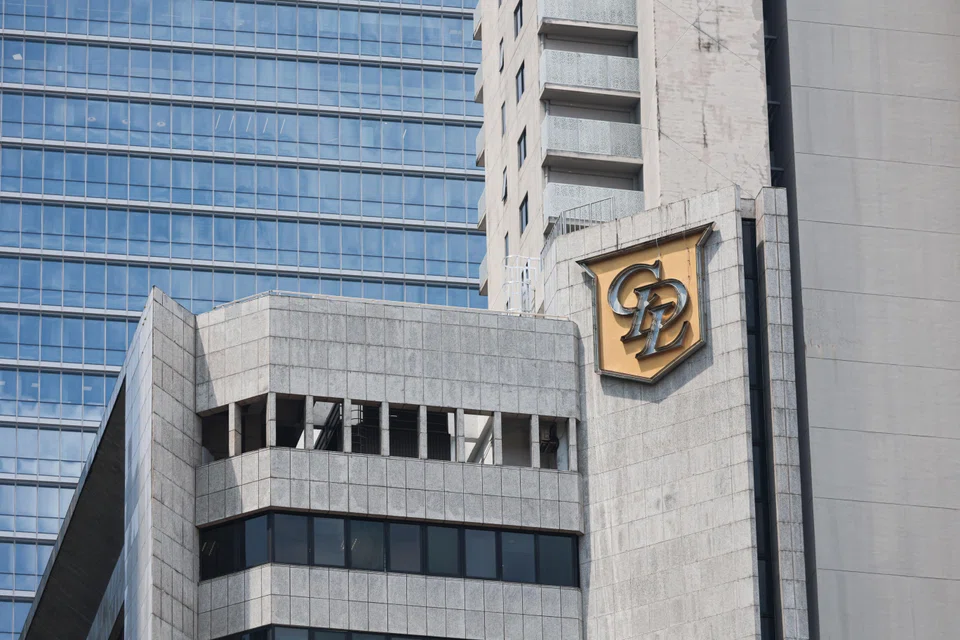
CDL may catch up with its soaring peers
The developer has been actively unlocking value, but is trading at a much steeper discount to RNAV than UOL

[SINGAPORE] Back in February last year, the market was agog as a power struggle erupted at City Developments Ltd (CDL) following the controversial appointment of two independent directors. Less than a year on, the property group’s once-depressed shares are rising fast – and some analysts see “multiple tailwinds” lifting them much higher.
What is behind all the excitement? One obvious factor is that interest rates have been softening. Another is that new home sales rose strongly last year, and are expected to remain resilient this year.
Yet, the strongest driver of CDL’s share price might be the growing excitement in the market about its potential to unlock value and boost its profitability.
Like other Singapore-listed property groups, CDL was trading at a deep discount to its net asset value (NAV) early last year. With efforts by the Monetary Authority of Singapore (MAS) to reinvigorate the local market, investors have become more willing to take a chance on these seemingly undervalued counters.
OCBC Group Research said in a report last week that several Singapore-listed stocks have already experienced significant re-ratings on the back of the MAS reform measures, and that investors might now focus on “value opportunities” within the market.
“The real estate sector could attract renewed investor interest, given its current discount to NAVs, although the discount has narrowed,” the research house noted.
“While concerns about the sector being a potential value trap have persisted in the past, we believe this perception is gradually diminishing as property players implement strategic initiatives to unlock value and enhance shareholder returns,” it added.
Since the beginning of the year, CDL shares have risen 13.8 per cent, while the Straits Times Index (STI) has gained only 3.9 per cent.
Only two other constituents of the STI have fared better during the same period – both of which are also property stocks. Hongkong Land is up more than 21 per cent, while UOL has advanced 17.2 per cent.
Work in progress
The value-unlocking moves at these property groups are something of a work in progress, though.
Hongkong Land has arguably come the furthest in this journey. In December, the group announced plans to inject its interests in One Raffles Quay and Marina Bay Financial Centre (MBFC) Towers 1 and 2 into a new private real estate fund.
Dubbed the Singapore Central Private Real Estate Fund, this new investment vehicle will focus solely on commercial properties in the Republic. It is expected to have assets under management of S$8 billion at inception.
Under its contractual obligations ahead of this move, Hongkong Land had also agreed to sell its one-third stake in MBFC Tower 3 to Keppel Reit at an agreed property value of S$1.45 billion.
In another significant move, Hongkong Land said in September that it would sell its Singapore and Malaysia residential development business for about S$739 million. The group had announced plans in October 2024 to exit the build-to-sell residential development business, and focus on ultra-premium integrated commercial properties in Asia’s gateway cities.
Hongkong Land has also been actively repurchasing its shares in the market. At the end of last year, it had fewer than 2.16 billion shares outstanding – down nearly 3 per cent from more than 2.22 billion shares at the end of January 2023.
Meanwhile, UOL’s public-listed subsidiary Singapore Land (SingLand) made headlines last month with an internal restructuring that could pave the way for a big value-unlocking move at its Marina Square complex.
SingLand said in its announcement that it had submitted a revised proposal to the authorities in the second half of 2025 to transform this key asset into a “hyper-mixed development”, with the addition of a residential tower, a serviced apartment block and a mixed-use tower with hospitality, office and performing arts spaces.
DBS Group Research said last month that the redevelopment of Marina Square could result in a value uplift of more than 3.5 times for the property.
In another interesting move, UOL said in September that it would divest all the freehold commercial strata lots at the Kinex mall, located along Tanjong Katong Road, for S$375 million.
UOL is also part of a consortium that was awarded a S$1.5 billion tender earlier this month for an integrated residential and commercial site at Hougang.
Steep discount to RNAV
CDL has been similarly busy recycling its assets. Last month, the group said that it had agreed to divest its prime waterfront retail asset, Quayside Isle @ Sentosa Cove, for S$97.3 million. This was 47.4 per cent more than the book value of the asset.
Together with other divestments – such as its stake in South Beach, the Piccadilly Galleria, and the Bespoke Hotel Osaka Shinsaibashi – CDL is estimated to have monetised about S$2 billion of assets in 2025, according to a report by DBS last week.
The research house estimates that CDL will realise divestment gains of more than S$600 million – or more than S$0.65 per share – from these transactions; and that it could pay special dividends of up to S$0.20 per share.
CDL’s core residential development and hospitality businesses are also expected to maintain their momentum in 2026 and beyond, according to DBS. “We foresee multiple tailwinds for the group in the coming years, with strong earnings visibility driven by largely pre-sold residential projects in Singapore and an attractive pipeline.”
Based on DBS estimates, CDL is currently trading at 0.5 times its revalued NAV (RNAV). By contrast, UOL is trading at 0.7 times its RNAV. “We see scope for CDL to close the valuation gap with UOL,” DBS said.
The research house has a 12-month target price of S$11.80 for CDL. The property group closed up at S$9.10 on Tuesday (Jan 20).
As for the boardroom tussle that spilled into public view a year ago, DBS said that the concerns among investors sparked by the whole incident are fading away. “With the group executing well on asset-recycling initiatives and reinvesting into growth opportunities, we see management focus firmly on delivering growth for shareholders and restoring investor confidence.”
TRENDING NOW
He built the Vingroup empire. Now South-east Asia’s richest man is handing some key roles to his sons
Can CDL become a powerhouse in fund management?
Canada is upping oil flows to Asia, but South-east Asia’s refineries aren’t ready to handle them yet
Data centre energy demand from Asean telcos not a ‘big risk’, says industry group