China’s EV market shows the future is already here
By mid-year, half of all cars sold in the country will come with a plug. BYD is leading the charge
FORGET everything you’ve heard about how electric vehicles (EVs) are running out of charge. In the biggest car market, they’re on the brink of victory – and the rest of the world will soon follow.
Battery metals such as lithium, nickel and cobalt are down by, respectively, 80 per cent, 30 per cent, and 25 per cent over the past year. The cells made out of these metals are heading the same direction, with Goldman Sachs Group predicting a 40 per cent drop in pack prices between 2023 and 2025, putting the global average well below US$100 per kilowatt-hour.
That’s a level that carmakers have long viewed as analogous to the technological singularity, the point where artificial intelligence (AI) theorists believe machines will irreversibly take over. Below US$100 per kWh, EVs will be cheaper than petroleum-powered counterparts to buy as well as run. The days of the internal combustion engine will be strictly numbered.
In China, the future has already arrived. Six of the 10 best-selling cars in February came with a plug. Wang Chuanfu, chief executive officer of market-leading EV maker BYD, expects half of all cars sold by the middle of the year to be either battery or plug-in hybrid.
You might feel tempted to dismiss that as an executive’s customary bullishness, but the China Passenger Car Association, an industry group, expects such new-energy vehicles to already comprise nearly 46 per cent of sales this month.
BYD’s annual results posted on Tuesday (Mar 26) confirm the solidity of this shift. It’s a truism in other countries that it’s impossible to turn a profit selling EVs, but even after China abolished purchase subsidies in 2022, BYD’s net income came in at 30.04 billion yuan (S$5.7 billion). That’s an 80 per cent increase on the previous year, meaning profit is accelerating faster than the 60 per cent increase in sales volumes.
This didn’t happen in the middle of a cosy, stitched-up market, either. Savage waves of discounting over the past year have left China’s car sector resembling a battle royale, where non-battery cars are being squeezed out by a dizzying array of cheaper, more exciting electric models, even as BYD maintains steady margins that are likely to be around US$1,000 per car.
March is traditionally the peak season for China’s car industry, as consumers return from the lull around Chinese New Year, and sets the tone for the year. With lower battery prices promising relief on costs, EV makers this year are going in for the kill, with price reductions that conventional vehicles will be unable to match.
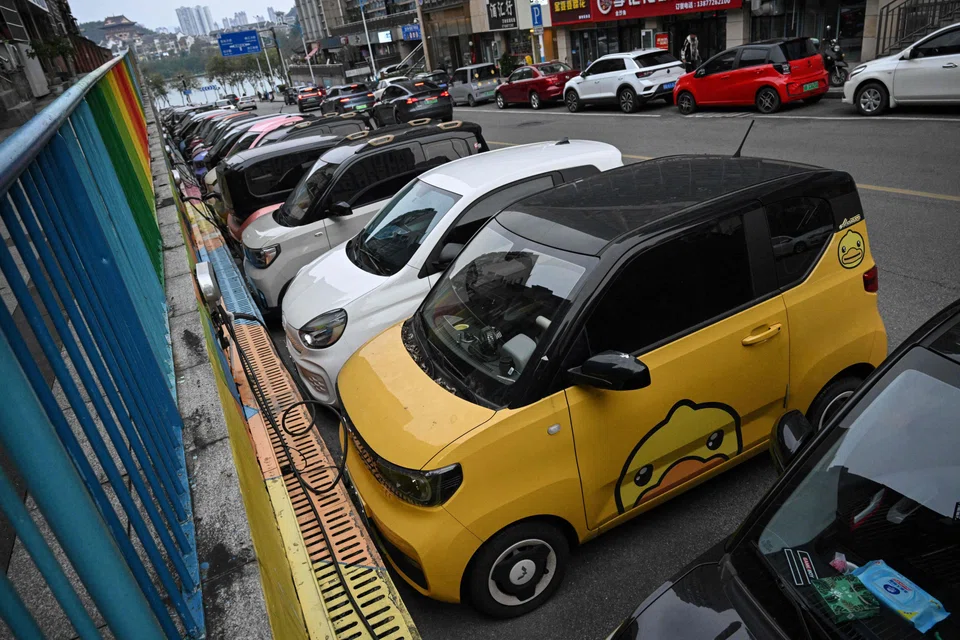
BYD’s Seagull, a zippy battery compact which is unlikely to be offered in many overseas markets, now sells for less than US$10,000, Bloomberg News reported this week. The Qin Plus, a plug-in hybrid with the range and specs to compete head-on against mainstream sedans, is barely more costly at US$11,000. If you’re really short of cash, the Wuling Hongguang microcar can be had for less than US$6,000.
That’s particularly damaging for offshore brands, who’ve been slow to ramp up their electric offerings. Volkswagen’s sales in China last year were their weakest since 2011, while Honda sold the smallest number of vehicles since 2015. Volumes from Nissan and General Motors have fallen about 40 per cent since 2019, when they were respectively the fourth- and sixth-biggest auto brands in the country; neither is even in the top 10 now.
The industry outside China can’t expect to stay immune for long. The average price of EVs in the US continues to decline, but at US$52,314 in February is well above the 100,000 yuan to 150,000 yuan range, where BYD and its rivals are competing most aggressively.
Even with a 27.5 per cent import tariff and up to US$1,000 of shipping costs, a Chinese import offers drastically better value than anything available in Europe or North America, one reason that they’re likely to take up about a quarter of Europe’s EV market this year.
It’s not impossible that governments in developed countries try to tighten restrictions even further to protect local industries, as we’ve argued. Still, those industries have vocally opposed such moves, especially in Europe – both because they’re fearful of retaliation from Beijing, and because they hope to take advantage of China’s low production costs to export to the rest of the world from their factories there.
“Protectionism is a value destruction move,” Mercedes-Benz chairman Ola Källenius told investors in February. Volkswagen’s chief executive Oliver Blume makes the same point. “It is important to have a free world trade,” he told investors this month. “We are concerned of rising of protectionism.”
Rich countries where the EV revolution is still yet to break are missing what’s happening in the rest of the world. They’re about to find themselves wrong-footed by the pace of change. Oil demand will keep growing into the 2030s because moves toward electrification outside of the developed world are slowing down, Russell Hardy, chief executive of commodities trader Vitol, said in February.
Try telling that to a Chinese car dealer.