

Biden wins points in the Middle East, but inflation is what will move voters
AFTER concluding his trip to the Middle East last week, United States president Joe Biden has left America’s allies in the region with a sense that the US is back in business there.
The US “will not walk away from the Middle East”, Biden declared as he addressed a summit of Arab leaders in Saudi Arabia on Saturday, insisting that his administration would “not leave a vacuum to be filled by China, Russia and Iran”.
In the aftermath of the costly invasions of Iraq and Afghanistan, the perception in the Middle East was that the US was disengaging from the region, as it was pivoting to East Asia and has more recently been preoccupied with the war in Ukraine.
But in a speech at the Gulf Cooperation Council after visiting Israel and Saudi Arabia, Biden pledged to pursue a military and diplomatic strategy in the Persian Gulf and the Levant under “active, principled American leadership”.
He did not explain how exactly Washington was planning to juggle its massive commitments in East Asia and Europe – of containing China and of deterring Russia – while re-asserting its leading position in the Middle East. But he did seem to succeed in repairing the US’s deteriorating relationship with Saudi Arabia, an 80-year-old strategic ally and a leading energy producer.
Members of the progressive wing of the Democratic Party, who have been calling on the Biden Administration to reassess the US’s close ties with Saudi Arabia and Israel, have criticised the president’s decision to meet with Saudi crown prince Mohammed bin Salman, whom they see as responsible for the killing of Arab-American journalist Jamal Khashoggi.
But Biden decided that human rights concerns are less pressing than US geo-economic interests at a time of rising energy prices, as America and its Western allies try to punish Russia for its aggression in Ukraine by restricting its capacity to export oil.
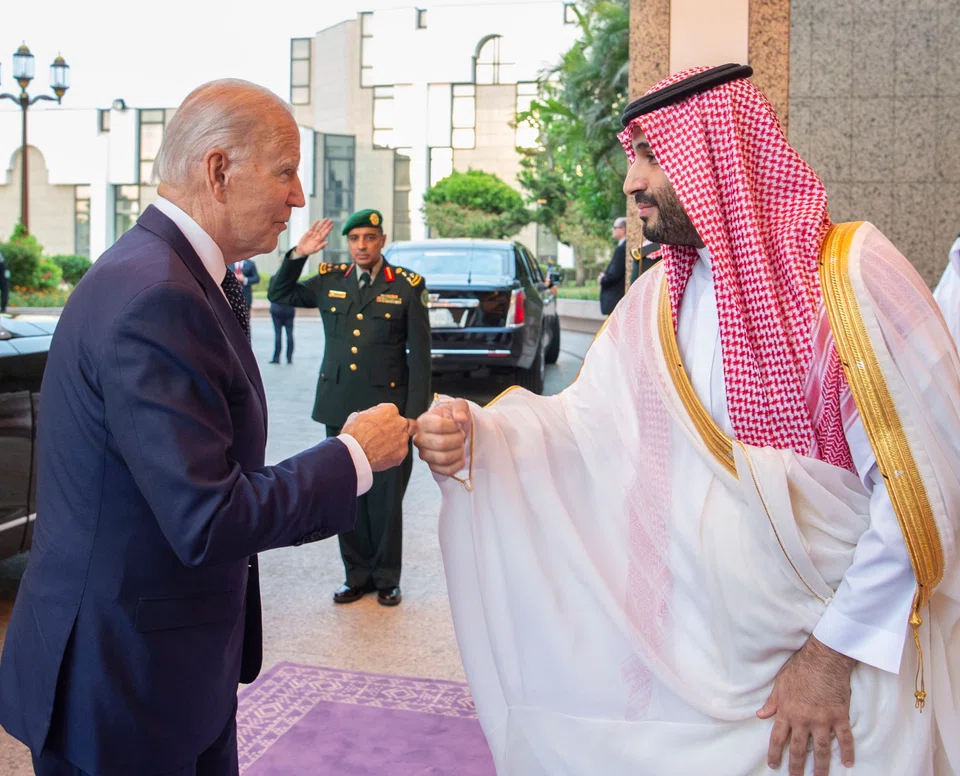
The 79-year-old US president and the 36-year-old Saudi crown prince ended up meeting at the Al-Salam royal palace where they exchanged a fist bump, marking the beginning of a diplomatic rapprochement that Washington now considers central to determining global oil prices as well as to advancing the growing ties between Israel and its Arab neighbours.
While Biden – who during his presidential election campaign pledged to treat Saudi Arabia as a “pariah” – told reporters that he did raise the issue of Saudi human rights violations during his discussions with the crown prince, it clearly wasn’t the top policy issue.
Dominating the talks instead was Biden’s push on the Saudis to increase oil production, a move that the Americans hope will help tame soaring global energy prices that are near US$100 a barrel, and perhaps lower the price of gas that American consumers face at the pump.
According to US officials, Saudi Arabia has agreed to start increasing oil production soon, together with the United Arab Emirates (UAE) – two producers that have enough capacity to boost global output significantly, with the former being the world’s top oil exporter and de facto leader of oil cartel Opec (Organization of the Petroleum Exporting Countries).
The Americans and the Saudis also agreed to work together to end the civil war in Yemen, where the Saudis have been fighting guerrilla forces backed by their archenemy Iran.
And in what Biden described as a “historic decision”, the Saudis announced that they were opening the country’s airspace to Israeli flights, in a decision that reflects the growing economic and security ties between Israel and Arab governments who – like the Jewish state – regard Iran as the main threat to their national security.
Many left-leaning Democrats have also demanded that Biden press Israel towards reaching a settlement with the Palestinians that would bring about Israeli withdrawal from the occupied West Bank. But the president showed no sign that he would place the issue on the top of his Middle East agenda during his visit to Israel.
Instead, Biden seemed to be building on the diplomatic achievement of his predecessor, the 2020 Abraham Accord, under which Israel and four other Arab states agreed to normalise diplomatic relations while placing the Palestinian issue on the policy backburner.
The Americans hope that the opening of Saudi airspace to Israeli flights, as well as Israeli support for Egypt’s transfer of two Red Sea islands to Saudi Arabia, would open the road for the normalisation of relations between the Saudis and the Israelis, America’s two leading allies in the region.
And although Biden did meet with Mahmoud Abbas, the head of the Palestinian Authority in Ramallah, he resisted pressure from the Palestinians and their American supporters to blame Israel for the killing of Palestinian-American journalist Shireen Abu Akleh in an incident involving Israeli soldiers and armed Palestinians.
It remains to be seen whether Saudi Arabia and the UAE will fulfil their pledge to increase oil production and what impact such a move would have on global energy prices – and in particular, on gas prices in the US, where consumers are blaming the Biden Administration for surging inflation.
Indeed, most opinion polls suggest that the American voters will punish Biden’s Democratic Party in the coming midterm elections in November, with some polls predicting that the Republicans will take over the House of Representatives and the Senate.
According to a recent New York Times/Siena College poll, only 10 per cent of voters say that the US economy is “good” or “excellent”, despite the falling unemployment rate and rising wages. Apparently, the rising cost of gas and food is colouring the outlook of Americans about the economy.
Indeed, in the same poll, 76 per cent of voters say that inflation will determine their vote in November.
From that perspective, Biden and aides hope that if energy prices fall after Saudi Arabia and the UAE increase oil production, that – together with the impact of the US central bank’s interest rate hikes – could put downward pressure on inflation before the 2024 presidential election.
But just as he was preparing to return to Washington from the Middle East, Biden learned that his long-term economic agenda, including a plan to reduce health-care costs, was in political peril. Democratic Senator Joe Manchin from West Virginia had announced that he would not vote in favour of the president’s programme, depriving the Democrats of any chance of getting it passed in the Senate.
Overall, foreign policy wins have very limited effect on a president’s long-term electoral standing – as discovered by former Republican President George H. W. Bush, who led the US into a major military victory in the first Gulf War in 1991, but ended up losing the presidential race a year later to Democrat Bill Clinton due to an economic recession.
To put it differently: even if Israel and Saudi Arabia establish diplomatic relations next week and the Ukrainians were to force Russia out of their country, as long as inflation remains high, President Biden – if he decides to run for re-election – would probably lose the 2024 presidential race. The political truism still holds: It’s the economy, stupid!






