Gun violence in US unlikely to end anytime soon
In deeply polarised America, Republicans -- backed by powerful interest groups led by the National Rifle Association -- have staunchly opposed toughening gun laws.
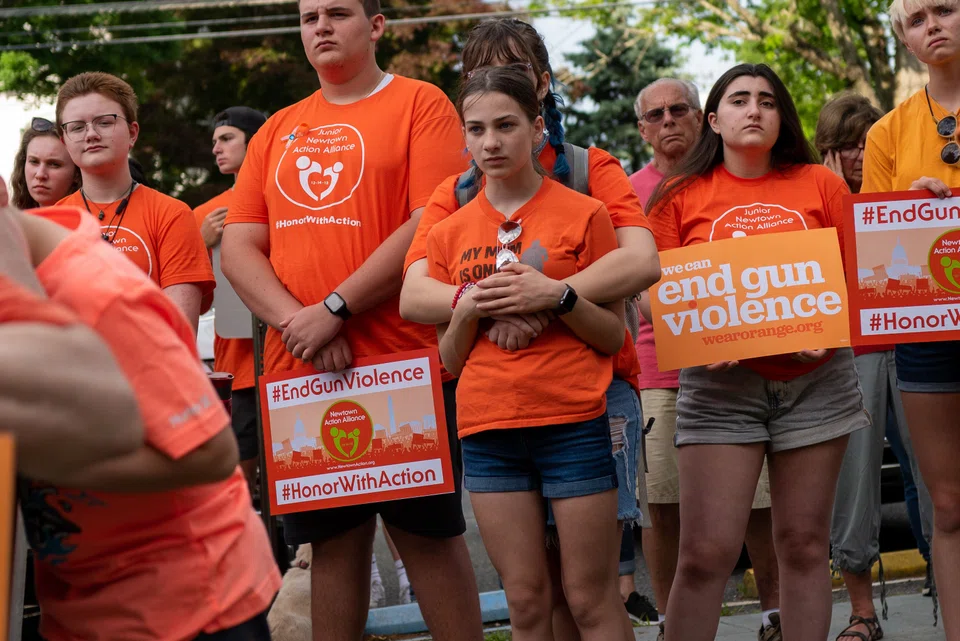
HERE we go again! I hate to write this, but over the years that I have been covering the United States I have adopted a sense of almost fatalism when it comes to the recurring horror that has unfortunately become as American as apple pie: The ghastly mass shootings that have extinguished the lives of some 1,500 innocent people since 2009 in this country.
Just in the last three weeks since May 14 when an 18-year-old man shot 13 people at a supermarket in Buffalo, New York, it has become a human challenge to count the number of these horrific massacres or, for that matter, just to look at the pictures of the victims: Men, women and even children who have been slaughtered by fellow Americans in gun attacks that turned peaceful communities to what President Joe Biden described last Thursday evening (June 2) as “killing fields”.
In fact, since the devastating attack on an elementary school in Uvalde, Texas, on May 24, that took the lives of 19 children and two teachers, and before President Biden addressed the nation on the subject last week, 20 more shootings occurred around the country including outside a liquor store in Michigan; at a private party in California; in a town in Tennessee; and in Tulsa, Oklahoma, where at least four people were killed last Wednesday. And this was followed by yet another spate of gun violence over the three days between last Friday and Sunday that left several more dead and dozens injured.
The May 24 attack on the elementary school in Texas is just the latest in the growing number of school shootings since the 1999 high school massacre in Columbine, Colorado, where 12 students and one teacher were killed. At the time, it was the deadliest high school shooting in US history and was considered to be an outlier.
Since then “Columbine” has become a byword for school shootings that have become more frequent and deadlier. Already, 27 school shootings have taken place just this year.
What is almost as disturbing as the horrifying scenes of these shootings and the many innocent lives they cut short, has been the reaction to these tragic events by the public and by politicians. It reflects a sense that Americans have to accept what can be described as the normalisation of mass violence, to admit that it has become a part of everyday life.
Yes, in the immediate aftermath of the shootings, political leaders would typically declare that their “thoughts and prayers” are with the families of the victims and pledge to “do something”.
But then nothing really happens later, and life, indeed, goes on, and before the names of those massacred in the last shooting are forgotten, another one occurs. More innocent people are murdered, and their deaths are accepted as inevitable.
Also, after every mass shooting, the media try to “make sense” of what just happened. So after it was discovered that the slaughterer in the supermarket in Buffalo, where 10 African-Americans were killed, was a white supremacist, one could then construct a narrative that centres on race relations in America, and propose that if only America could defeat the plague of white nationalism, it could then make it less likely that such mass killings would take place in the future.
But then, although he was clearly driven by hatred of people of “other" ethnicities, the Buffalo murderer wasn’t a member of a racist group, and while it’s true that some of those responsible for the mass shootings that occurred in recent years were motivated by racism and anti-Semitism, many of the other gun-wielding killers apparently suffered from mental problems. Does that mean that all we need to do to prevent gun violence is to improve America’s mental health system?
When it comes to school shootings, researchers have suggested that the horrific incidents may have been the result of the effects of school bullying, as well as teenage use of pharmaceutical antidepressants, Internet influences, and violence in video games and movies.
Yet there has to be some way to explain why these horrific mass shootings have become so frequent and commonplace only in the United States? Why have they not occurred as regularly in, say, Canada or Australia, that share many of America’s cultural traits, as nations that were built by ruthless pioneers ready to pull out a gun to defend themselves.
And bullying and use of antidepressants happen as well in schools in Norway and Greece, and teenagers in Germany or Italy are also exposed to violence in video games and movies. But when was the last time you heard about a school shooting in Norway, Greece, Germany or Italy?
That the US has the highest number of civilian-held arms per capita, ahead not only of Australia and Canada and other democracies, but also of many Third World countries, including Yemen and Libya, may be the main reason that guns are killing so many Americans, including children.
The fact is that there is no other Western country where it is so easy for citizens to obtain mass killing weapons, including military-style arms that are supposed to kill enemy forces on the battlefield, to be used to defend people against foreign invaders, not to slaughter children in an elementary school.
And, indeed, numerous studies have made it clear that there has been a direct correlation between the availability of these kinds of weapons and the incidence of mass shootings in the United States.
Or to put it in concrete terms, common sense gun regulations, like a ban on semi-automatic weapons, could help reduce the number of mass shootings of innocent civilians, like it did in Great Britain. That may suggest that Americans can actually “do something” when it comes to preventing mass shootings. So why hasn't that happened?
Most Americans actually support some forms of gun control. According to a recent Pew Research Centre survey, more than two-thirds of Americans support keeping guns out of the hands of mentally ill people, and say that gun purchases should be subject to background checks. And 51 per cent of Americans favour a nationwide ban on the sale of AR-15 rifles and other semi-automatic weapons, while 32 per cent oppose it. But here is where the problem starts: While three-quarters of Democrats support such measures, less than a quarter of Republicans do.
This political polarisation along party lines explains why Republicans, backed by powerful interest groups led by the National Rifle Association (NRA), have constantly opposed toughening gun laws.
The result was that a 10-year ban on semi-automatic weapons expired in 2004, leading to a rise in the number of mass shootings. President Biden called for reinstating the ban during his address last Thursday.
Republicans justify their opposition to gun control, including the ban on semi-automatic weapons, by insisting that Americans have a constitutional right to purchase guns and other weapons for the purpose of defending themselves, not to mention for use in hunting.
The Second Amendment to the US Constitution does say that “the right of the people to keep and bear arms, shall not be infringed".
But many legal scholars have pointed out the historical context in which the Second Amendment was passed. The Founding Fathers were opposed to the creation of a standing army and instead wanted the citizens to rely on “a well-regulated militia, being necessary to the security of a free state".
It was in that setting that Americans’ right to bear arms was stipulated. The expectation was that if and when the country would come under attack, adult members of an American family would reach for the weapons they kept in the closet and use them to fight the aggressors.
But these days the US has a permanent military establishment, including an army and a navy, controlled by a civilian government that defends the nation. So no one really expects everyday citizens to drop everything they are doing in order to respond to a domestic insurrection or an invading force, armed with weapons like AR-15 assault rifles. And by the way, if American citizens can buy semi-automatic rifles to defend themselves, why not allow them to purchase tanks and missiles?
Republicans tend to blame American popular culture, including films and video games that depict violence, for creating an environment that supposedly drives young men to engage in thrill-killing and other acts of violence. They also note that many of the gun laws that are in place, like not people allowing under the age of 18 to purchase semi-automatic weapons, wouldn't have prevented the recent mass shootings in Texas and New York since both shooters were over that age limit.
So perhaps, as President Biden has suggested, the age limit should be raised to 21. After all, many states don’t allow young men below 21 years of age to buy alcoholic beverages out of concern that they would drink and drive and as a result kill innocent people on the road. But they allow a teenager to purchase a semi-automatic weapon on the day he celebrates his 18th birthday.
That doesn’t make sense. But don’t expect even such common sense gun control rules to pass anytime soon, because as President Biden noted last Thursday, “the majority of the Senate Republicans don’t want any of these proposals to be debated or come to a vote”.
And since that Republican majority is expected to grow following the midterm elections in November, the only thing Americans can do now is to patiently brace themselves for the next mass shooting.