HOCK LOCK SIEW

Investors can ride Taiwan’s AI boom with Singapore depository receipts

Several are available, offering an option to tap the sizzling stock market

Summarise
Tay Peck Gek
Published Wed, May 27, 2026 · 07:00 AM
    • If there are Singapore depository receipts for Taiwan stocks, their accessibility for Singapore investors will be improved.
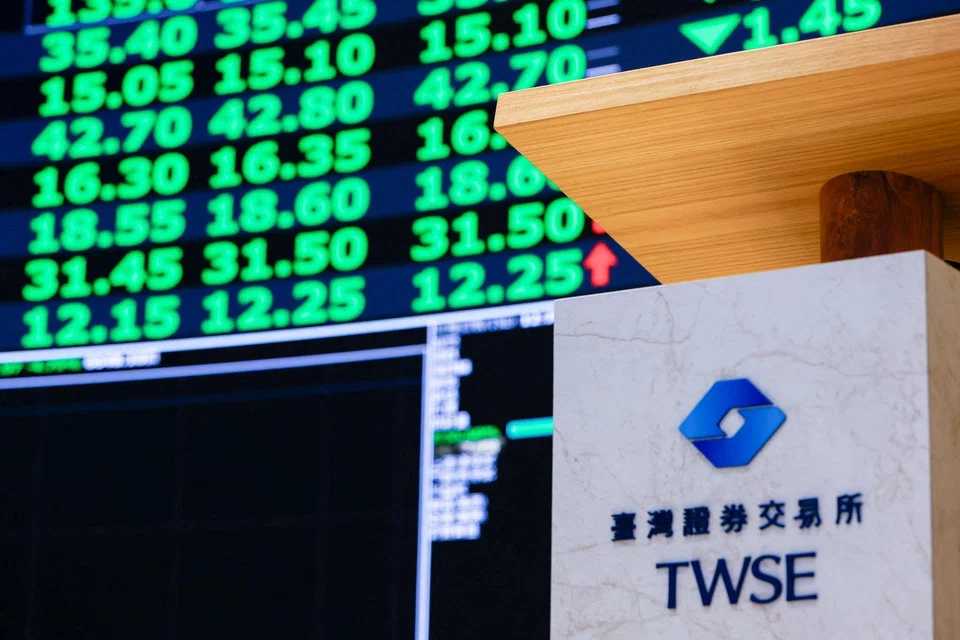
    • If there are Singapore depository receipts for Taiwan stocks, their accessibility for Singapore investors will be improved. PHOTO: REUTERS

    [SINGAPORE] In April, Taiwan overtook Canada, the United Kingdom and France to become the world’s sixth-largest stock market by market capitalisation, at US$4.7 trillion. On Monday (May 25), it knocked India off its position, rising to fifth place.

    Back in 2004, Taiwan ranked just 12th globally, with a market capitalisation of about US$500 billion.

    JPMorgan recently raised its targets for Taiwanese stocks for the second time in less than a month, recommending the market as “the most pure-play exposure to the global artificial intelligence build-out”.

    The Wall Street bank lifted its base case for the benchmark Taiex to 47,000 and its bull-case target to 50,000. Those are up from the base and bull targets of 43,000 and 48,000 it set in April.

    The Taiwan market’s performance was helped by strong investor demand for AI-related stocks and a sharp rise in the share price of its index heavyweight: the world’s top semiconductor contract manufacturer, Taiwan Semiconductor Manufacturing Co (TSMC).

    Specifically, the island is deeply integrated into the semiconductor and memory-chip supply chain that powers AI expansion. Several companies stand out with their competitive advantages; their share prices have rocketed this year.

    TSMC is the world’s largest foundry service provider. It benefits from strong demand for chips from major customers, including its biggest client, Nvidia.

    All four major US cloud service providers – Google, Amazon, Microsoft and Meta Platforms – are TSMC clients. In total, they have announced capital expenditure of US$725 billion for this year. That bodes well for TSMC, which has a net profit margin of 47 per cent.

    Meanwhile, Ase Technology is the world’s largest outsourced semiconductor assembly and testing provider, with its capacity pre-booked years ahead.

    Delta Electronics is a power infrastructure supplier for next-generation data centre, electrical vehicles and industrial automation.

    MediaTek, a TSMC customer, is the largest fabless semiconductor designer in Taiwan. It is a primary rival to Qualcomm in the mobile, automotive and Internet of Things markets.

    Quanta Computer builds server hardware for hyperscalers such as Google and Amazon.

    The appeal of Taiwan’s AI ecosystem benefiting from the AI boom has not escaped investors and research houses.

    Foreign inflows into the island’s equity market have been strong, DBS noted in a recent report. Net foreign inward remittance into the Taiwan Stock Exchange (TWSE) and Taipei Exchange surged US$17.9 billion in the January-to-March quarter, reaching a record high of US$338 billion.

    Taiwan’s vibrant exchange-traded fund (ETF) market is worth NT$7.5 trillion (S$300 billion) to NT$8 trillion, dominated by the index-linked Yuanta Taiwan Top 50 ETF. Retail investor participation has also increased; new trading accounts on the TWSE rose to 102,000 in April from 58,000 in December 2025.

    With so much retail and institutional interest, Taiwan stocks are likely to enjoy strong support.

    The billion-dollar question, then, is: Are Singapore investors able to invest in Taiwan listed companies to ride the AI boom?

    While TSMC and Ase are available as American depository receipts (ADRs) and tradable by Singapore investors, most of their heavyweight peers are not.

    Depository receipts (DRs) are instruments that represent beneficial interest in an underlying security listed on an overseas exchange.

    A check of the major stock brokerages operating in Singapore shows that few offer direct trading in Taiwan-listed stocks. 

    Phillip Securities customers can access Taiwan stocks, but they must place their orders through a trading representative. In an age where perhaps most investors are already used to buying and selling stocks online or through apps, trading via a dealer or remisier is not only archaic but also inefficient.

    Asked if it will have DRs for Taiwan stocks, the Singapore Exchange said that its existing Singapore depository receipt (SDR) line-up also provides exposure to the global AI and digitalisation theme.

    It pointed to technology players including Alibaba, Delta Electronics and mainland China’s largest chip maker Semiconductor Manufacturing International.

    “We continue to work closely with intermediaries and investors to deepen adoption of SDRs, and identify new markets and sectors for expansion.”

    The writer owns TSMC ADR