

Making industrial policy “in”
Biden’s effort to boost American manufacturing prowess marks continuity, not change
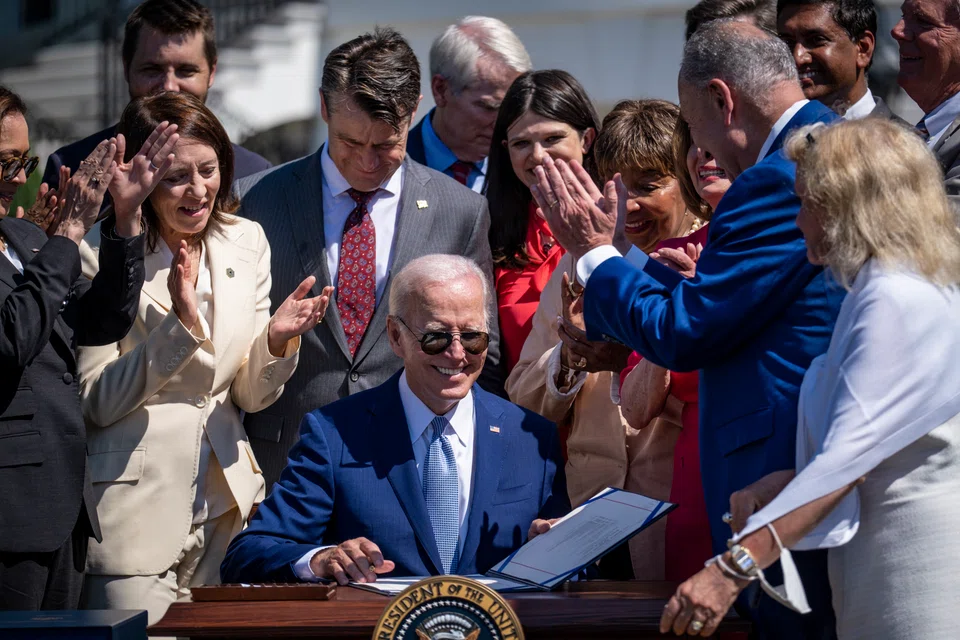
MANY American pundits have described US President Joe Biden’s signing a US$280 billion bill aimed at bolstering the American chip manufacturing industry as a turning point of sorts in the nation’s economic policy.
Since the end of World War II, US presidents and lawmakers from both major political parties have criticised many of its economic partners for violating the principles of American-style capitalism by pursuing a national strategic effort, to encourage the development of leading sectors of their economies, in particular the manufacturing sectors, instead of allowing the free market to determine the outcome of the competition between their various industries.
That the East Asia tigers, led by Japan Inc; the mercantilist France and the social democratic Germany, actively intervened in their domestic economies through industrial policy was seen as harmful, since governments supposedly lacked the information and the capabilities to determine the cost-effectiveness of promoting any particular economic sector. Not to mention, as it was argued in Washington, that the policy of protecting and subsidising certain industries gave those countries an unfair trade advantage in their competition with American exports.
In fact, the notion that the US has always been committed to embracing a laissez faire approach in pursuing its economic policies amounted to a fairy tale, especially when one considers American defence policies.
Since 1945 the Pentagon has been pursuing activist and costly industrial policy programmes, through government-controlled laboratories, shipyards and depots, and by turning the defence industry into its active partner. In the process, these policies strengthened American global economic might in the form of its space programme, its nuclear power and even the development of the Internet and other technological innovations.
Much of this defence-oriented industrial policies were pursued in the name of the geo-strategic rivalry with the Soviet Union during the Cold War. The argument was that you cannot compete successfully with a giant centralised economy like the Soviet Union by relying on the private sector.
And after the Cold War ended, US administrations have continued to pursue a competitive economic strategy which enabled American private companies to respond to what was seen as the geo-economic threat from Japan and the European Union (EU).
But much of the effort by Washington during the evolving globalisation age was to press trade competitors – like Japan, South Korea and Germany – to alter their industrial policy in the direction of the free market.
More recently, decision makers in Washington have concluded that this US strategy has had very little impact on China, the rising global economic giant that has gradually been seen as America’s new geo-strategic threat, not unlike the Soviet Union during the Cold War. That development, it was argued, required the embrace of a coordinated national economic approach.
Indeed, the notion that a re-energised industrial policy was necessary to compete with China, especially when it comes to the high-technology sectors, has been accepted even by many Republicans who until recently have denounced any partnership between the US government and private companies, even when it came to strategically important sectors, as “crony capitalism”.
This national consensus in support of industrial policy has advanced in response to the continuing erosion in America’s manufacturing base, which, in turn, has helped ignite a political uprising that led to the 2016 election of the economic nationalist Donald Trump as US president.
From that perspective, the idea of government support for manufacturing and other labour-intensive sectors of the economy could be marketed to the public as an effort to create new American jobs and bring back home the old ones.
At the same time, the Covid pandemic has exacerbated global supply chains, exposing the extent to which the US had come to rely on foreign countries for various products, including for advanced semiconductor chips that are used in technologies ranging from electric vehicles to critical weapon systems.
When one combines geo-economic and geo-strategic thinking, the spectre of a powerful China in control of the kind of technologies that the US relies on to develop its missiles and drones was seen in Washington as a long-term threat not only to American economic interests, but more important, to its core national security interests.
Moreover, the massive intervention by the federal government in the economy following the 2008 financial crisis and the pandemic, and the need to respond to the challenge of climate change, may have helped change the perception of the role of government from an intrusive and bungling agency into one whose involvement was welcomed, for example, by fast-tracking the programme for Covid vaccines.
Taking all of that into consideration, there is no doubt that the passage in Congress at end-July of the bipartisan CHIPS and Science Act, which would provide US$52 billion in subsidies and tax credits for companies that manufacture chips in the US, and also includes US$200 billion for new manufacturing initiatives in artificial intelligence, robotic and quantum mechanics, marked an important step when it comes to American economic policy as well as its politics.
And, indeed, standing before business leaders and lawmakers in the White House’s Rose Garden during the signing ceremony of the bill, President Biden suggested that the legislation reflected a national effort to adapt to global technological change and to “strengthen our sense of control and security, of dignity and pride in our lives and our nation”.
President Biden also made it clear that the new initiative was part of a strategy to confront the rising threat from China, noting that it was no wonder that “the Chinese communist party actively lobbied business against this bill”.
Indeed, speaking during a ceremony for a new Intel factory in Ohio, the president pledged to invest in biotechnology, quantum computing and biotechnology. “We’re going to make sure we lead the world in industries of the future,” he said. Not China!
In addition to the CHIPS and Science Act, the Biden administration has promoted other initiatives that fall under the rubric of “industrial policy”, like the legislation that allocated US$370 billion to combat climate change, that included investments in clean vehicles and renewable energy.
As he prepares for the November midterm elections and possibly a second run for the White House in 2024, President Biden is also integrating politics into the marketing of his industrial policies, suggesting that they make it clear that perhaps he was more of an economic nationalist than his predecessor.
“Make It in America is no longer a slogan; it’s a reality in my administration,” he declared, boasting about “finally bringing home jobs that have been overseas for a while”.
But then, some of the technologies that President Biden is advancing, including robotics, will lead to huge productivity gains, under which robots would replace workers, instead of creating new ones or bringing jobs back home.
Moreover, while 17 Republicans senators did vote in support of the CHIPS and Science Act, the GOP remains opposed to more government intervention in the economy, except when it comes to national security policies. That, and the possible return of Trump to the White House or the election of a Trumpist Republican president, could set back Biden’s effort to make industrial policy more fashionable.
TRENDING NOW

One-third of Singapore-listed firms at risk in severe AI downturn: MAS

‘Not done’: Keppel CEO Loh Chin Hua transformed the group, but says there’s ‘still a lot to do’

He built the Vingroup empire. Now South-east Asia’s richest man is handing some key roles to his sons

‘We don’t want to stay as we are’: CEO Patrick Ng builds a more resilient Huationg

