

Should SIA disclose the maximum amount it is prepared to invest in Air India?
Given that the Indian associate’s results have weighed on the Singapore group’s earnings for two consecutive quarters, more information would benefit shareholders

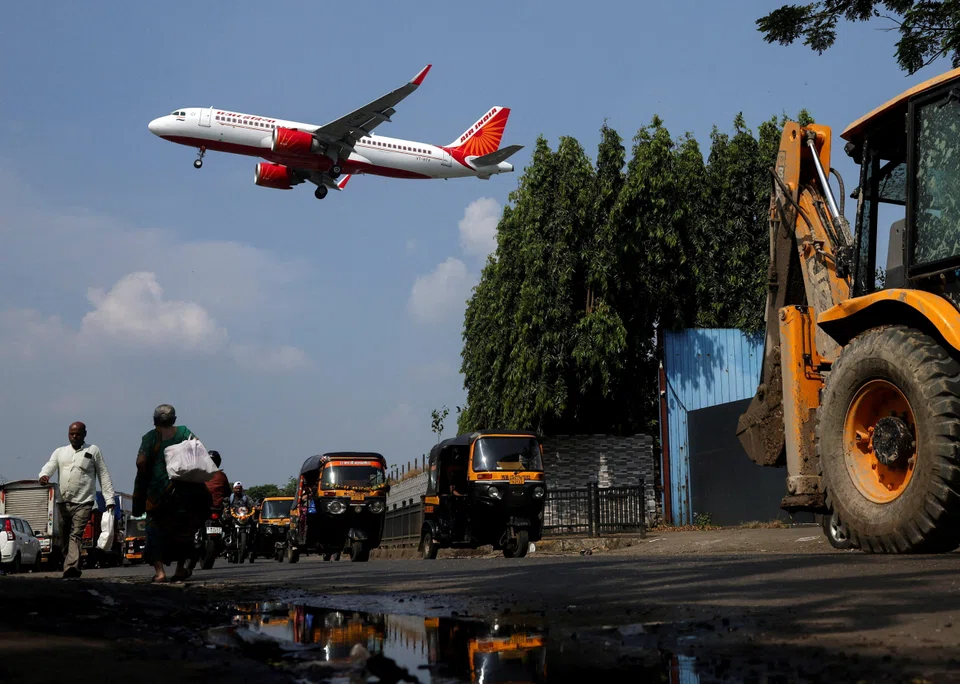
[SINGAPORE] Singapore Airlines’ (SIA) investment in Air India is featuring on the radar of investors after the associate’s results weighed down the Singapore group’s earnings for two consecutive quarters.
The group’s earnings for the second quarter ended September dived 82.1 per cent year on year to S$52.4 million - even though operating profit rose 22.4 per cent to S$398.4 million and revenue improved 2.2 per cent to S$4.9 billion.
The main cause behind the sharp earnings drop was SIA’s share of losses by associate Air India, a repeat of the scenario in the first quarter, when it also contributed to the group’s 58.8 per cent decline in net profit to S$186.1 million.
Air India embarked on a turnaround programme in September 2022, which spans fleet renewal, network expansion, product improvements and operational upgrades. The Indian carrier’s reputation took a hit after one of its planes crashed seconds after take-off months ago, killing hundreds. It reduced flights immediately after the incident, but has since resumed capacity.
Its costs, meanwhile, have risen, affected by the airspace closures over Pakistan and the Middle East, as well as unfavourable foreign currency movements.
SIA did not disclose the specific amount of its share of Air India’s losses for the quarters.
A check of the financial statements showed that its share of associates’ losses – excluding contributions from SIA Engineering’s associates – stood at S$428 million for the first half-year of FY2026.
The corresponding figure for the year-ago period – without accounting for Air India’s loss – was a S$3.2 million profit.
The group began to account for the Indian carrier’s performance only from December 2024, after completing the integration of its loss-making joint venture Vistara into the also-unprofitable Air India.
SIA now holds a 25.1 per cent stake in Air India post-merger, with Indian conglomerate Tata Sons owning the remaining.
The corporate action saw the Singapore flag carrier pay about S$322.1 million in addition to its 49 per cent stake in Vistara for the shareholding in the merged entity, according to SIA’s annual report for FY2025.
Separately, SIA has agreed to contribute its share of any funding previously provided by Tata prior to the completion of the merger, up to S$880 million. SIA contributed about S$499.9 million of this additional capital in November 2024, and then another S$166.9 million in March 2025. The capital injections post-merger amounted to S$666.8 million.
If SIA’s S$322.1 million equity payment is included, its total cash injections into Air India would amount to S$988.9 million.
In October, Bloomberg reported that Air India had sought S$1.5 billion in financial support from its shareholders, with SIA’s implied 25.1 per cent share at S$376.5 million.
If SIA accedes to this cash call, its cash investment would amount to nearly S$1.4 billion.
Would that be the maximum the airline group is willing to pump into Air India? If not, what would be the ultimate amount?
And, what is the accumulated loss that will make SIA decide to call it a day with its Air India investment?
SIA chief Goh Choon Phong declined to comment on both questions when they were raised at the post-results briefing on Nov 14, saying that these involve projections.
He, however, reiterated the group’s support for Air India, saying that SIA is in it for the long haul regarding this investment.
Also, Goh extolled the potential of the Indian market: it is the world’s third-largest aviation market, and the South Asian country is poised to be the world’s third-largest economy by around 2030.
SIA’s stake in Air India would allow the Singapore carrier – which does not have a domestic market – to participate directly in India’s markets internally and internationally, across both full-service and low-cost segments.
But India has a highly competitive aviation scene that historically has not been very profitable.
Vistara never turned a profit since its establishment in 2013, with the net asset value of SIA’s billion-dollar investment decimated to zero as at end-September 2022.
Air India was also unprofitable even before the pandemic struck, while several Indian carriers have gone out of business.
Gulf carriers, meanwhile, have muscled in successfully for a slice of the pie – reportedly accounting for about 40 per cent of India’s international flights.
Indeed, SIA is aware that Air India might not be profitable due to inherent market risks and the industry’s operating conditions.
DBS analyst Jason Sum pointed out that the Indian carrier is a wild card for SIA, given the lack of visibility of the associate’s path to profitability. Other analysts do not think Air India will turn around in the near term.
Notably, SIA has made several foreign investments, following its decision to adopt a multi-hub strategy. It, however, has a less-than-stellar track record in such ventures. It had to write off its 20 per cent stake in Virgin Australia during the pandemic and recognised an impairment loss of S$344 million for FY2020, for instance.
Thus, SIA should make it clear to shareholders the total amount it is prepared to invest in Air India, the extent of loss it is willing to accept, and the approximate timeline during which the investment is projected to start reaping returns.
Only then can shareholders make an informed decision as to whether they should journey with SIA regarding its investment in Air India.
TRENDING NOW

Once staunchly pro-China, Malaysian Chinese businesses are now distancing themselves from Beijing

Looking beyond looming CEO succession, should UOB potentially pursue a transformative merger?

Could stablecoins be the future of money?

Grab CEO’s wife Chloe Tong on life with Anthony Tan and finding her purpose

