Singapore’s farming crunch has wider lesson: companies like grants, but prefer customers

SINGAPORE’S farms are finding it tough to turn a profit in spite of government aid. If the country is serious about its “30 by 30” target – to produce 30 per cent of domestic nutritional needs by 2030 – it must do more to boost demand.
The best businesses are those that can benefit from economies of scale. This is one thing the Magnificent Seven stocks have in common. Design one chip well, and it can be sold to billions. Make one movie, then charge millions to watch it.
Farming is similar. Larger farms can better spread the cost of investment in machinery and other farming technology. They are also more likely to win contracts with large buyers, such as restaurant chains.
Local vegetable production accounted for just 3.2 per cent of vegetable consumption in 2023, suggesting plenty of growth opportunity. Yet, that figure is actually down from 3.9 per cent in 2022 and 4.3 per cent in 2021.
Many of Singapore’s farmers say the biggest challenge to acquiring scale is finding customers. Large customers are difficult to come by, while the average household prefers cheaper imported produce.
The Singapore government in 2020 launched a campaign to encourage the purchase of local produce, introducing a red label for local fresh produce and working with local supermarket chains on promotions.
This light-touch approach is unlikely to move the needle for farms, though. What is needed is a whole-of-government push of the demand engine, starting with the government itself.
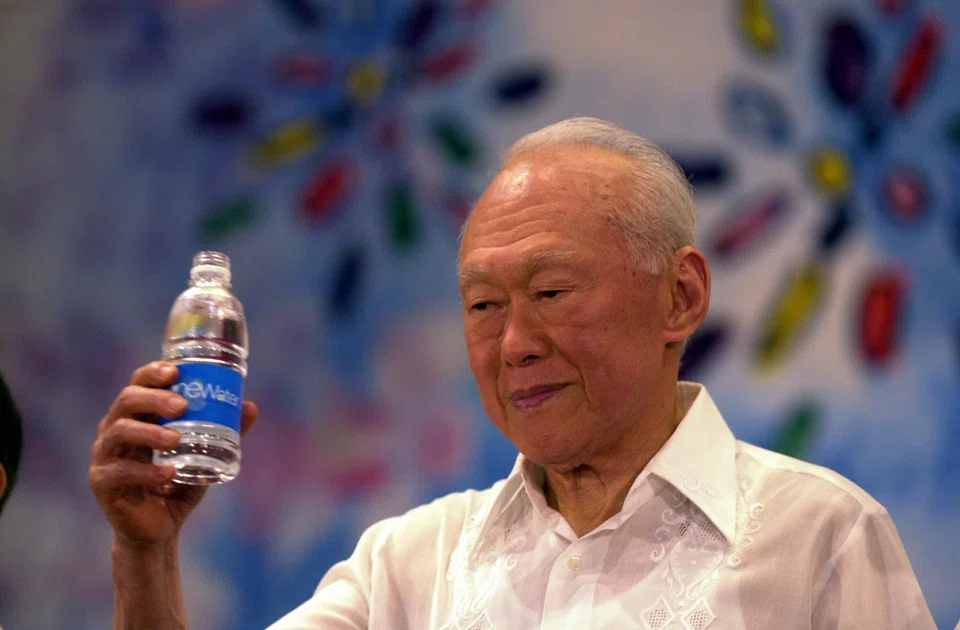
One of the most iconic photos of the late Lee Kuan Yew, Singapore’s founding prime minister, was taken at a National Day celebration. In it, he is drinking the locally produced purified water Newater in hopes of assuaging Singaporean concerns about its safety.
Lee’s support of Newater and determination to ensure Singapore’s water security has reaped rewards beyond what many would have imagined, but it required significant sacrifices.
Once, at an international event, he was quoted as saying that the water issue “dominated every other policy. Every other policy had to bend at the knees for water survival”.
Singapore probably has no need to take its ‘30 by 30’ goal with the same level of seriousness. Indeed, Senior Minister of State for Sustainability and the Environment Koh Poh Koon hinted in a recent interview that the goal could be revised.
There is something to be said about creating more demand for local goods and services, however, particularly those with some national significance or with the potential to benefit a wider ecosystem.
The demand-side challenge that Singapore’s farms face is not unique to the food and agriculture industry. Founders of startups operating in various sub-segments of the technology industry have the same gripe. Many of them feel like the proverbial prophet who is not without honour except in his hometown.
Difficulties making headway with government or government-linked entities have pushed several local startups to move their headquarters elsewhere. This is not good for Singapore’s agriculture ecosystem, nor its financial ecosystem.