SingPost’s bid to raise market value might not yield immediate results

SINGAPORE Post (SingPost) appears intent on making efforts to revive its fortunes and lift the stock’s declining market value amid the postal services sector’s structural decline.
Last week, the national postal service provider announced the completion of a strategic review aimed at enhancing shareholder value and to ensure that the group is properly valued.
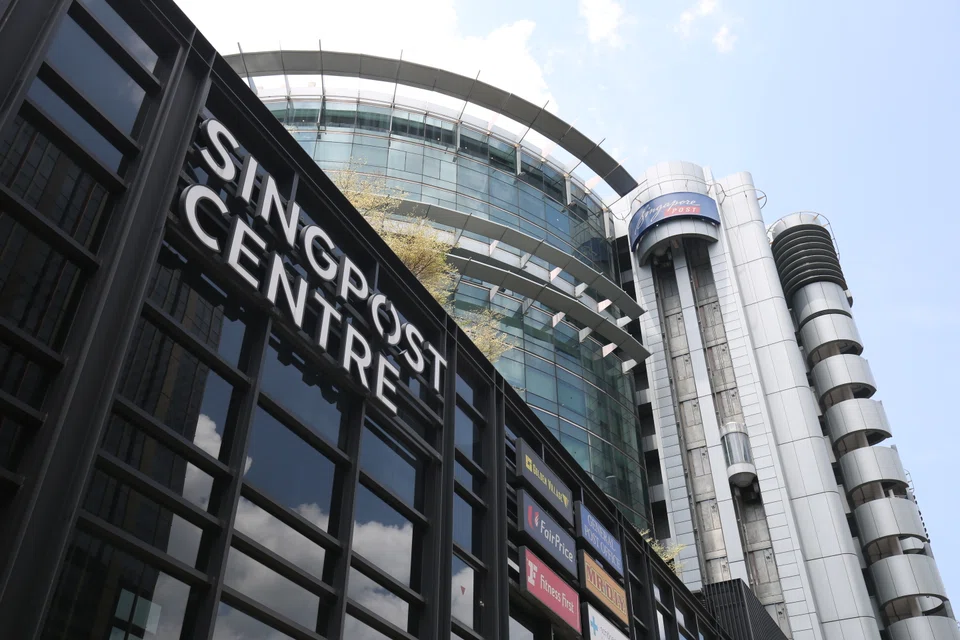
It also laid out plans to pivot to becoming a pure-play logistics provider, including divesting non-core assets and businesses such as the retail-commercial mixed development SingPost Centre.
Listing its Australian business is among the options being explored by the significantly leveraged group. This move aims to secure a valuation for its logistics venture in Australia and reduce the debt incurred from a series of acquisitions in the region.
On the day of the announcement, SingPost’s share price spiked 6.6 per cent, boosting its market capitalisation to S$911.3 million from S$860 million the previous day. This increase seemed to affirm chairman Simon Israel’s remark that the market has undervalued the group.
Israel pointed out that the share price did not accurately reflect the group’s intrinsic value, especially when considering assets such as SingPost Centre, valued at S$1.1 billion as at September 2023, the group’s Australian business and its upside potential.
However, the rally did not sustain; and SingPost’s market capitalisation continues to be under S$1 billion. The counter closed on Wednesday (Mar 27) at S$0.425, up 4.9 per cent, with a market value of about S$956.2 million.
Investors seeking gains in share price and profitability might hold off on investing in the stock, preferring to wait for sustained improvements in SingPost’s financial performance. Meanwhile, those on the hunt for dividend yields are likely to overlook SingPost as an option for the time being.
Firstly, SingPost said it will lower the dividend payout ratio to 30 to 50 per cent of its underlying net profit from the existing policy of paying out 60 to 80 per cent.
Vincent Phang, SingPost’s chief executive, highlighted that the company is no longer a public utility provider as the steady flow of postal income – which had once supported dividends – has dwindled due to the decline of that business. Additionally, he emphasised the need for capital to fund investments.
Investors no longer view SingPost as a yield play since the company reduced its dividend to S$0.035 (with a payout ratio of 66 per cent) in FY2017.
Furthermore, dividend in absolute amount has also dipped over recent years.
Notably, SingPost has not adhered to its own dividend policy since FY2021, as the payout has not exceeded 50 per cent.
Retail investors generally have a penchant for yield-generating investments, which explains the former market darling status of real estate investment trusts (Reits). An asset class known for typically distributing at least 90 per cent of their taxable income, Reits have seen their appeal diminish due to elevated interest rates.
Existing SingPost shareholders can expect to receive a significantly lower dividend in absolute terms under the new dividend policy beginning from the new financial year, should the company fail to enhance its financial performance. This is particularly the case in the absence of stable property income following the divestment of SingPost Centre.
Proceeds from the sale of SingPost Centre – that is if the divestment gets the green light from authorities and shareholders – will go towards paying off debt, funding investments and rewarding shareholders.
But given that SingPost has considerable borrowings and finance costs, reducing debt would likely be a top priority.
As at end-2023, the group had borrowings of S$675.6 million or net debt of S$238.3 million, excluding the S$250 million perpetual securities on its books, as allowed by accounting rules.
Finance costs surged 47.3 per cent year on year to S$14.5 million in the first half of FY2024, higher than its net profit of S$11.5 million.
S&P Global Ratings projected that the group’s debt-to-Ebitda (earnings before interest, tax, depreciation and amortisation) ratio would range between four and 4.7 times for FY2024. However, this metric is anticipated to improve to below three times by FY2026.
Given its pursuit to diversify and establish a significant presence in Australia, SingPost is likely to prioritise using the proceeds from the sale of SingPost Centre for further acquisitions and repaying borrowings over distributing rewards to shareholders.
While the Australian venture is performing well, ranking among the top five logistics providers by revenue, the robustness of the Singapore dollar compared to the Australian currency has dented SingPost’s profitability.
S&P Global Ratings noted that SingPost’s share of the Australian logistics market will remain “modest” even after the latest acquisition of courier and logistics services provider Border Express, as the industry is highly competitive and fragmented.
SingPost’s efforts to enhance shareholder value and better its operations are laudable. But investors may prefer to wait and see the fruits of such labour.
Until then, for the short term, the market may begrudge the company the valuation it believes it merits.