

A conspiracy of silence
Book details how Democrats covered up President Joe Biden’s decline
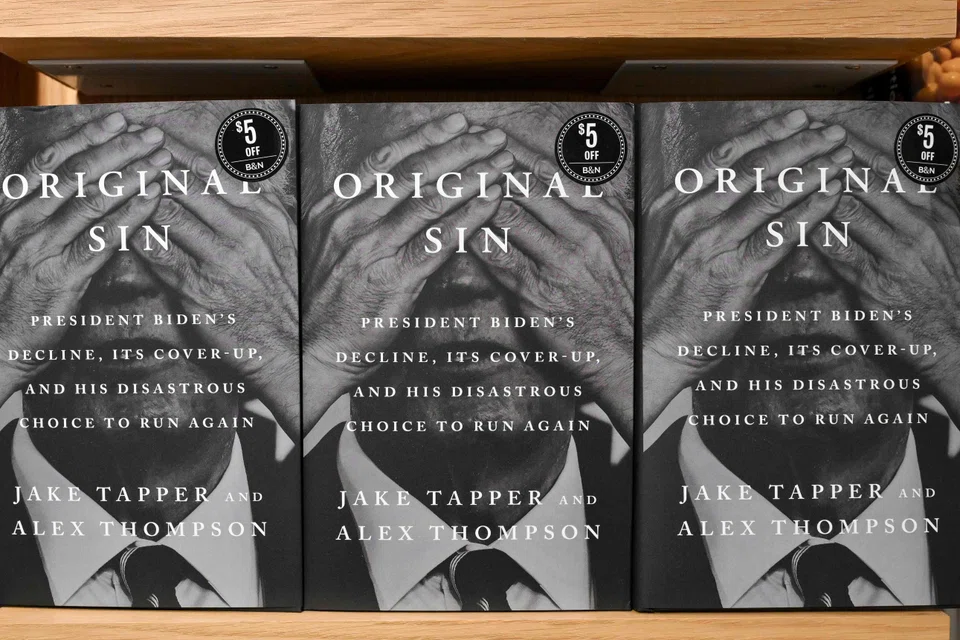
JAKE Tapper and Alex Thompson’s Original Sin: President Biden’s Decline, Its Cover-Up and His Disastrous Choice to Run Again provides a picture that most Americans would have recognised, which was “in front of our noses”, as the authors put it. It was that of a tottering president who was frequently incoherent and confused when he spoke, who lost his recall of names and faces, and who seemed to be drained of energy.
Tapper, a CNN correspondent and anchor, and Thompson, a journalist with Axios, depict a Democratic Party, White House staff and a Biden campaign that – though aware of Joe Biden’s confusion, incoherence and forgetfulness, including his failure to recognise actor George Clooney at a fundraiser and reference to French President Emmanuel Macron as ex-leader Francois Mitterrand – remained largely silent about it, and instead attempted to hide and spin it.
Biden’s enablers rationalised their conduct by arguing that he was solely capable of defeating Republican presidential candidate Donald Trump.
According to the authors, Biden’s decline started with the death of his elder son Beau Biden in 2015. “Beau’s death wrecked him,” a senior White House aide is quoted as saying in the book. “Part of him died that never came back after Beau died.”
Another “inflection point”, Tapper and Thompson write, was the legal troubles surrounding Joe Biden’s other son, Hunter Biden.
The book details instances of Joe Biden’s decline, struggling to remember the name of his top aide Mike Donilon, forgetting the words of the Declaration of Independence, failing to recall the names of his national security adviser and communication director, culminating in his fumbling, disastrous performance in the televised debate with Trump on Jun 27, 2024.
“What the world saw at his one and only 2024 debate was not an anomaly,” Tapper and Thompson write. “It was not a cold, it was not someone who was unprepared or over-prepared. It was not someone who was just a little tired.”
The president’s aides continued to insist that he was fine and that his health was not a critical problem, and that, in any case, a reduced Joe Biden would still be better than a second Trump term.
“(Joe) Biden, his family and his team let their self-interest and fear of another Trump term justify an attempt to put at times an addled old man in the Oval Office for four more years,” the authors write.
The president’s wife, Jill Biden, who told White House staff to call her “Dr B”, would have been among the most active accomplices. She was, Tapper and Thompson write, “one of the chief supporters of the president’s decision to run for re-election, and one of the chief deniers of his deterioration”. They attribute this drive to the purest motives: “All she ever wanted to do was love Joe.”
Moreover, a liberal media consensus evolved that assumed it would be unseemly, and perhaps even taboo, to keep enquiring about Joe Biden’s mental state and fitness for office. Doing that, the consensus believed, would play into Trump’s hands.
Hence, the reaction of the White House and its media allies to the February 2024 report by Robert Hur, the special counsel appointed to investigate whether Joe Biden had committed a crime by taking home classified documents.
Hur, who interviewed the president for five hours over two days, concluded that no criminal charges should be made, because a jury would not convict “a sympathetic, well-meaning, elderly man with a poor memory”.
Joe Biden’s aides accused Hur of “pejorative judgment”. The White House strategy, the authors write, was to “slime Hur as an unprofessional right-wing hack”, whose observations about the president’s age had been “gratuitous”. Some journalists accused the special counsel of “ageism”.
When David Axelrod, an aide to former president Barack Obama, suggested that Joe Biden’s age was a liability, he got an angry phone call from Ron Klain, his chief of staff. “Who’s going to beat Trump?” he asked. “(Joe) Biden is the only one who has done it. You better have a lot of certainty about a different candidate before you say the president should step aside. The future of the country depends on it.”
The notion of sticking with an unsound candidate because his victory was essential assumed that Trump’s glaring shortcomings would determine the outcome of the race.
“(Joe) Biden had the mindset that what Trump was saying was so outrageous, that if the American people saw them side by side they would realise that Trump was unfit.”
But then came the Jun 27, 2024, debate – “the worst moments, if not the absolute worst, for any major party candidate since televised American presidential debates began in 1960”, Tapper and Thompson write.
By embracing the code of silence until Jul 21, 2024, the day Joe Biden announced that he would drop out of the presidential race, his team ended up handing the election to Trump.
TRENDING NOW

Once staunchly pro-China, Malaysian Chinese businesses are now distancing themselves from Beijing

New launch or resale unit? Here’s a guide for homebuyers

The lesser-known prospects in the Asian chipmaking supply chain

Cliff Tan has 7 million followers and a 4-month waitlist. Why won’t he expand his business?

