DBS, OCBC, UOB face rate hike reality check
The recent sell-off may not have been about the micro fundamentals of the 3 banks but a broader repricing of risk

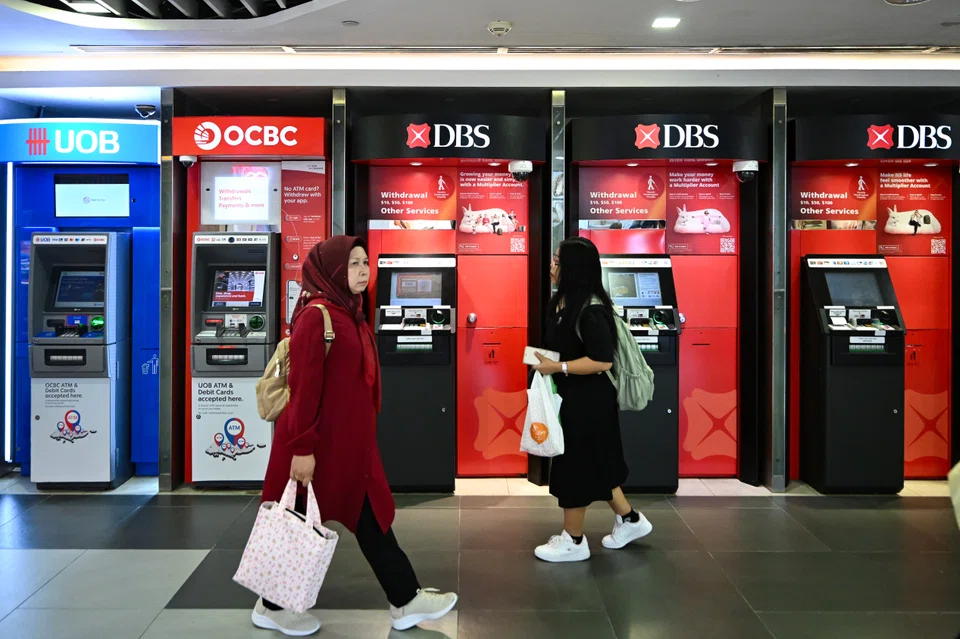
[SINGAPORE] When the US Federal Reserve hiked rates in September, some analysts said the move might help support net interest margins (NIMs) at DBS, OCBC and UOB.
Less than a month on, the most influential voices in the market are now predicting that tighter monetary conditions may actually weigh on the profitability of the three banks – and drive their share prices lower.
Notably, Citi warned last week of “misplaced optimism” surrounding higher interest rates as it lowered its earnings forecasts for OCBC, and downgraded its rating on the stock from “neutral” to “sell” – with a price target of S$27.50.
Citi said it expects OCBC’s NIMs to contract in Q3 2026, as its deposit rates rise faster than its lending rates. It also sees the bank’s non-interest income “normalising” following the “exceptional” performance of its wealth business in H1 2026.
The research house also trimmed its earnings forecasts for DBS and UOB for similar reasons. However, it maintained a “buy” recommendation on DBS shares, with a target price of S$86.80. It also kept its “sell” call on UOB, with a target price of S$38.00.
Citi’s bearish tilt on the banks seemed to puncture investor sentiment towards these crucial market anchors. OCBC closed on Friday (Oct 9) at S$29, down 8.4 per cent for the week. DBS ended the week 5 per cent lower at S$73.36, while UOB sank 7.3 per cent to S$39.96.
The Straits Times Index (STI) closed at 5,401.89, down 4.1 per cent for the week.
Is this a buying opportunity? Or is it the beginning of a bigger sell-off?
Banks still leading STI
First, a dose of perspective may be helpful. DBS, OCBC and UOB have delivered very strong total returns over the past few years, driven by stronger profitability, higher dividends and expanding market valuations.
Even after its recent pullback, OCBC is up 46.8 per cent this year, making it the biggest gainer among the 30 constituents of the STI.
DBS is the third-best performer within the STI this year, with a gain of 30.2 per cent. UOB is in eighth place, with a gain of nearly 14 per cent.
The STI itself is up 16.3 per cent since the beginning of the year.
Not surprisingly, the valuations of the banks remain rich. In particular, DBS is currently trading at nearly three times its Jun 30 net asset value (NAV) of S$24.69 per share. This reflects its relatively high return on equity (ROE), which came in at an annualised 17.5 per cent in H1 2026.
OCBC is trading at 2.1 times its Jun 30 NAV of S$13.73 per share, versus its H1 2026 ROE of 13.7 per cent.
UOB reported an annualised ROE of 11.6 per cent in H1 2026, and is currently trading at 1.3 times its NAV of S$29.99 per share,
Tellingly, neither DBS nor OCBC resumed their share buybacks in the wake of last week’s sell-off. DBS last repurchased its shares from the market in July last year, when it bought 350,000 shares at an average price of S$46.18 per share.
OCBC last repurchased its shares in May this year, when it scooped up 447,300 shares at an average price of S$22.86 per share.
On the other hand, UOB has maintained a steady pace of share buybacks. It picked up 64,000 shares every trading day in October except last Friday, when it bought 70,000 shares.
So far, UOB has repurchased a total of 454,000 shares in October, at an average price of S$42.31. During the preceding nine months, it repurchased more than 7.75 million shares at an average price of S$39.25 per share, indicated data compiled by the Singapore Exchange (SGX).
Broad repricing of risk
Some market watchers noted last week that the share prices of Singapore’s three banks have not pulled back in isolation. Since September – as the Fed hiked rates and US Treasury bond yields surged – banks stocks around the world have sagged.
In the US market, for instance, Bank of America and Goldman Sachs have each declined 13.8 per cent from the respective September highs, while JP Morgan has declined more than 8 per cent.
Closer to home, HSBC and Standard Chartered have fallen 13.4 per cent and 10.2 per cent from their respective September peaks.
The common thread seems to be concern that rising interest rates may increase their funding costs, and erode the value of their bond holdings. Higher interest rates may also have an adverse effect on the health of certain borrowers and their collateral values.
This suggests that the sell-off that has engulfed DBS, OCBC and UOB is not entirely about their micro fundamentals but a broader repricing of risk across the global banking sector.
The three Singapore banks will probably shed important light on the impact of rising interest rates on their businesses when they report their Q3 2026 financial numbers next month. Yet, until interest rate volatility abates, investor sentiment may not fully recover, in my view.
Decent dividends
To be clear, I am not suggesting that investors abandon the three Singapore banks altogether.
While there may be some downside risk in the immediate future, the banks seem sufficiently profitable to continue returning significant amounts of cash to their shareholders.
Notably, DBS paid an ordinary dividend of S$0.66 per share and a capital return dividend of S$0.15 per share for each of the first two quarters of the year. If it pays the same amount for the last two quarters of the year, its dividend yield for 2026 will amount to 4.4 per cent, based on its current share price.
Citi said last week that DBS may be able to maintain its capital return dividends until Q2 2028, by redirecting excess capital earmarked for share buybacks that seem to have stalled.
UOB is currently trading at a yield of 4.4 per cent based on its annualised H1 2026 dividend – even as it continues buying back its shares. OCBC is trading at an annualised H1 2026 dividend yield of 3.2 per cent.
This column said two months ago that investors should not chase the soaring bank stocks, and suggested rotating towards sector laggard UOB. With the whole sector now under pressure, my inclination is to just sit tight.
The way I see it, the three banks embody the best of the Singapore market – with a demonstrated ability to generate strong revenues and earnings, attract talent and mobilise global capital.