

Europe seeks to stiffen Trump’s spine against Russia
The gathering in Washington was a concerted attempt to strengthen Zelensky as much as possible in any forthcoming talks with Kremlin
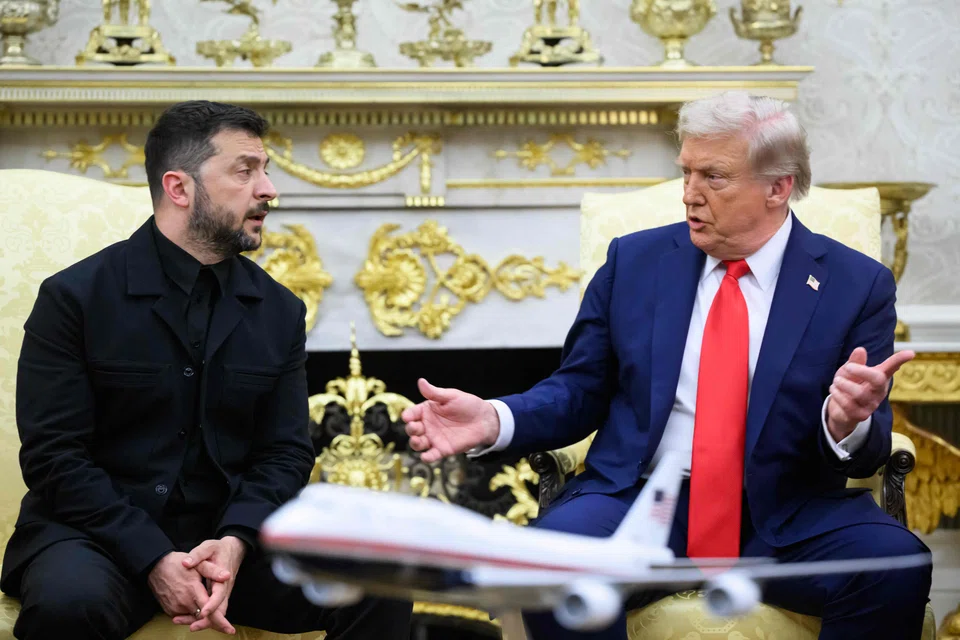
“THIS is no time to go wobbly,” former UK prime minister Margaret Thatcher reportedly said to then-US president George Bush, after Iraq’s 1990 invasion of Kuwait.
Fast-forward some three and a half decades, and this message rings similar to the one that the current generation of European leaders sought to share with US President Donald Trump on Monday (Aug 18).
The meeting at the White House represented an extraordinary counter-demonstration of Western diplomatic support for Ukrainian President Volodymyr Zelensky, who was joined by the region’s most powerful leaders.
These included Nato secretary-general Mark Rutte, European Commission President Ursula von der Leyen, German Chancellor Friedrich Merz, UK Prime Minister Keir Starmer, French President Emmanuel Macron, Italian Prime Minister Giorgia Meloni, and Finnish President Alexander Stubb.
To be sure, there are multiple moments each year when world leaders gather en masse, mostly for pre-planned events such as Group of 20 or Nato summits. However, there may be no modern precedent for Monday’s gathering, which was a hastily created wartime crisis summit, following last Friday’s Alaska meeting between Trump and Russian counterpart Vladimir Putin.
Europe had one key message to Trump: The region, by and large, backs Zelensky 100 per cent, and has grave concerns about Putin’s good faith in upcoming potential negotiations.
This show of solidarity sought to prevent any repeat of February’s awful White House meeting between Trump and Zelensky. Then, the Ukrainian president was shaken down not only by his US counterpart, but also Vice-President JD Vance.
“At the least, Trump’s disruptive diplomacy, for all of its many shortcomings, is forcing Europe to take a clearer, coordinated approach if it is to have significant influence in the coming weeks.”
The latest meeting underlined that European leaders have gradually learnt how to best deal with Trump – that is, through flattery and persistence. Meloni told Trump that “something has changed thanks to you”. Meanwhile, Merz praised the US president for creating a potential new pathway to ending the war.
Persistence was also key. Merz and Macron pushed again the idea that a ceasefire is a key necessity, and stressed that all leaders in the room supported this.
Monday’s negotiations were the culmination of many months of hard work to foster a European-led initiative to try to end the conflict. This has been led primarily by Macron and Starmer, but involved multiple others, including Rutte and Dr von der Leyen.
The gathering was also a concerted attempt to strengthen Zelensky as much as possible in any forthcoming bilateral or trilateral talks with Russia. They asserted that Europe will continue to strengthen Ukraine’s immediate military position, including with more financial aid, as fighting continues.
Post-war security guarantees
Another focal point was planning for post-war security guarantees. Every European leader spoke about the importance of such assurances from the US to keep the peace in Ukraine after any peace deal with Russia. A breakthrough may have been reached here with Trump. He reportedly told the European leaders that he was open to offering US security guarantees to Ukraine, which the Wall Street Journal called a “significant shift in his stance” towards the US’ role in ending the war.
While Kyiv’s European allies are not expecting the US to commit ground troops, they are seeking US help, probably including air support, logistics and intelligence capabilities.
Starmer has repeatedly said that the Ukraine endgame “is going to need a US backstop because I don’t think it would be a guarantee without it, I don’t think it would be a deterrent without it, so the two have to go together”.
Yet, despite the apparent success of these meetings, much uncertainty still remains about next steps. Trump’s stunning U-turn last Friday on the necessity of a Russia-Ukraine ceasefire remains a case in point. He had also backtracked on his threat of greater sanctions on Russia unless the war ended by last week’s deadline.
Could the ground now be shifting towards the beginnings of a potentially difficult, protracted negotiated settlement?
At the least, Trump’s disruptive diplomacy, for all of its many shortcomings, is forcing Europe to take a clearer, coordinated approach if it is to have significant influence in the coming weeks.
The region’s leaders know they now must rise to the occasion, especially given their conviction that any outcome in Ukraine that is perceived as a potentially big Russian victory may only embolden Putin and his allies across the world.
Darker scenarios
While Europe is still hopeful of keeping the Trump team on board, it is also continuing to prepare for darker scenarios. This includes the possibility that, if the war continues for months more, the US president might lose patience with the peace-seeking process.
The US might also stop, at some point in 2025 or beyond, any support for Ukraine. This would leave critical gaps in intelligence sharing, for instance, that only Europe and allies such as Canada, Japan and Australia can try to partially fill.
There are also concerns that Trump may ultimately blame Ukraine for any failure to reach a deal, which he appears to think must include Zelensky giving up land. Yet, Kyiv may refuse to capitulate, not least because of the Ukrainian constitutional challenge with ceding territory.
Now is therefore the time for Europe to double down with a clearer, multi-year grand strategy. The potential deeper political integration of Ukraine into the European Union may require a much faster pace for Kyiv’s accession talks.
The writer is an associate at LSE IDEAS at the London School of Economics
TRENDING NOW
Prima to move out of historic Keppel Road flour mill building in 2028
Temasek-related Azalea, SeaTown, Seviora Capital to merge in 2027
Family offices see more tailored products, leverage ‘collective firepower’ for direct deal access
Singapore room rates soar, but hotels seeing mixed demand from F1 race and events

