Cabin fever: Airlines are rushing to refurbish plane interiors, but will their bets pay off?
The focus is on whether such moves will boost carriers’ competitiveness – and if customers will pay the price

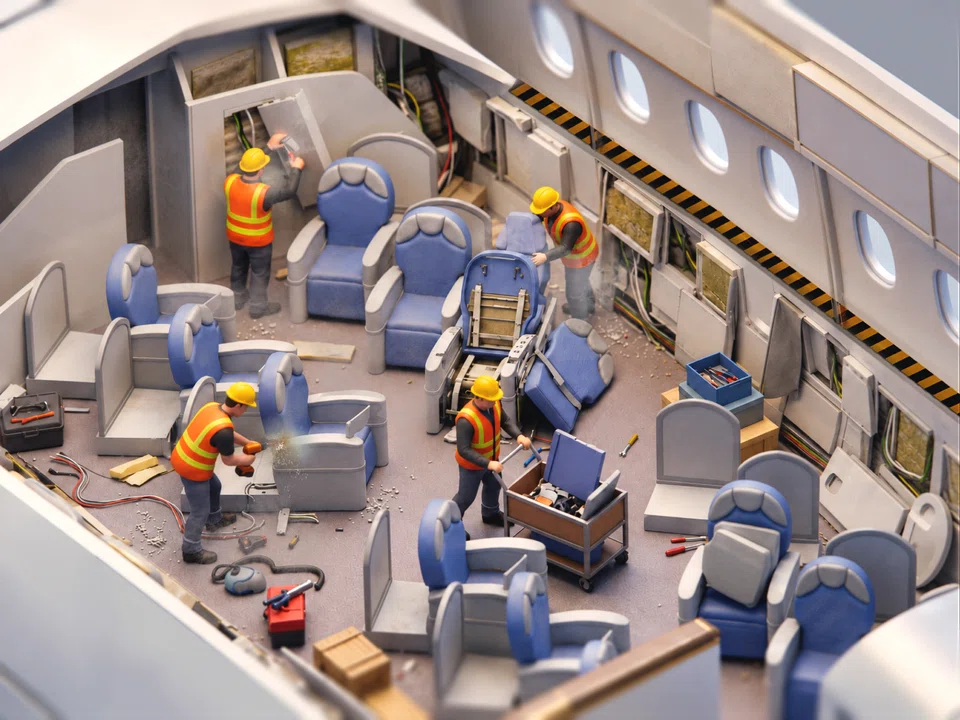
[SINGAPORE] Singapore Airlines (SIA) will soon pull the cover off its highly anticipated next-generation cabin products, which are part of its S$1.1 billion retrofit programme for 41 aircraft.
The launch is in line with a broader industry overhaul – what airline reviewer Aaron Wong, who runs travel hacks website The MileLion, describes as an “aviation arms race”.
SIA aside, Emirates, All Nippon Airways (ANA), Cathay Pacific and other airlines have also embarked on or announced makeovers for their aircraft interiors in recent years. Some carriers are splashing out as much as US$7 billion on modern features and cutting-edge technology.
But does a facelift really help to improve airlines’ competitiveness? Is the retrofit worth the hefty investment and opportunity cost – and will customers see fares rise as a result?
Longer lifespans
Since a cabin has a commercial life of roughly seven to 10 years, and a plane’s airframe lasts 20 to 25 years, “refurbishment closes that gap” in the lifespan of airlines’ core assets, Linus Bauer, founder of aviation consultancy BAA & Partners, says.
Emirates’ ongoing cabin modernisation, announced in late 2021, is the largest such push in the aviation industry.
“It reflects our philosophy of continuously investing in the customer experience rather than waiting for a product to become outdated,” a spokesperson says.
Emirates has retrofitted 107 aircraft as at early October, with another 112 to go. Factors that go into when and whether to retrofit a plane include aircraft age, business strategy for the overall fleet, technological advancements, and customer expectations, the spokesperson adds.
Bauer observes that networkwide consistency in cabin products is another important driver for refurbishment, because “a brand promise is only as strong as the oldest aircraft on the network”.
That’s as DBS analyst Jason Sum notes that seats, entertainment systems and cabin design can become dated much more quickly – a trend that The MileLion’s Wong attributes to travellers’ increasing demands, such as the expectation of state-of-the-art conveniences.
For instance, passengers who get used to the high-speed Internet provided by SpaceX’s Starlink satellites could go out of their way to book flights with Starlink connections on board.
“It’s very hard to go back to a non-Starlink flight because it’s just night and day,” Wong muses.

Keeping up with peers
Cabin refurbishment can also be driven by changes in passenger preferences, Sum says.
For example, premium cabins have become increasingly important, particularly on long-haul routes, so airlines may use refurbishment programmes to introduce newer business-class seats, premium economy, improved entertainment systems and better connectivity.
Concurring, Bauer believes it gives the airlines a chance to increase the percentage of premium economy seats in their planes amid robust demand for that category.
Emirates introduced a new premium economy cabin during its retrofit, with 3,800 seats in this between-business-and-economy class installed to date.
But Dr Jeffrey Goh, managing director at Alton Aviation Consultancy, argues that airlines do not often use refurbishment to reconfigure layouts and replace economy seats with premium seats.
Such a move “must be aligned with the nature of the market in which the airline operates and hence its demand dynamics”, says Dr Goh, a veteran of aviation network Star Alliance who served as its CEO from 2017 to 2022 before running Gulf Air Group until October 2025.
He says: “This is a strategic matter that takes into account the airline’s current and future network, fleet, customer segments and travel trends in order to optimise revenue.”
ANA will be refreshing its business class seats for mid-sized aircraft for the first time in a decade with the addition of privacy doors on its long-haul Boeing 787-9 Dreamliner fleet from 2026.
Still, fleet configurations are determined by internal route-by-route yield evaluations and capacity planning, even as the industry shifts towards premium cabins, its spokesperson says.
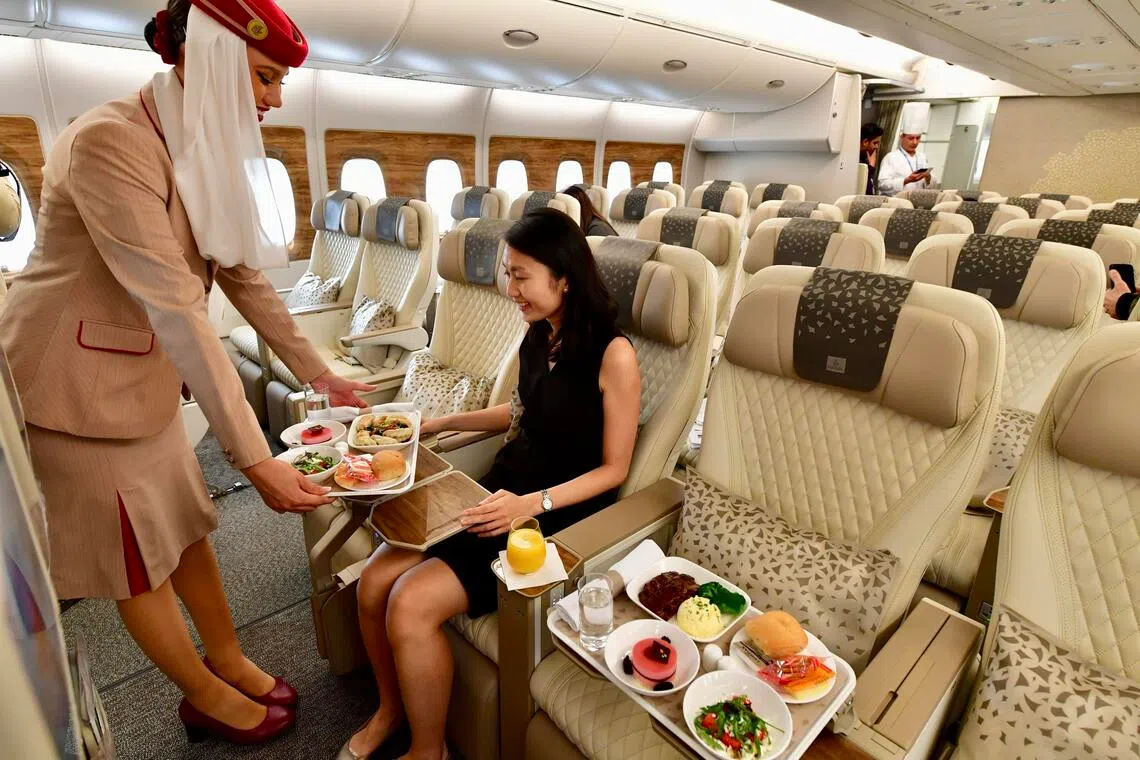
While airlines invest in cabins to reinforce their brand appeal and competitiveness, industry observers note that the edge will be blunted as peers similarly upgrade their own products.
When it’s the first to market, a materially better cabin can strengthen customer preference, DBS’ Sum notes – particularly among premium passengers. But as peers give theirs a facelift as well, the benefit shifts from differentiation towards maintaining product parity.
Bauer says: “You run to stay in place. A refurbishment rarely creates a lasting advantage. Not refurbishing, however, creates a lasting disadvantage.”
Ultimately, the aviation industry is highly competitive, with customers choosing an airline based on their overall experience – not just cabin products, but passenger service, lounge offerings, entertainment, connectivity, network and reliability as well, Emirates’ spokesperson notes.
“Airlines will continue to invest in their products, just as we will continue to innovate and evolve ours. But our focus remains on continuously raising the bar for the overall customer experience rather than comparing any single feature against our peers,” the spokesperson adds.
Does the price tag pay off?
Cabin refurbishment does not come cheap.
Cathay Pacific in August 2026 committed HK$150 billion (US$19.1 billion) in investments for its fleet, cabin and lounge products, and digital innovation, according to Aldric Chau, regional general manager for South-east Asia and Oceania, though he did not give a breakdown for each category.
Upcoming refurbishments at the Hong Kong carrier include new business class seats for regional routes on selected Airbus A330s, and enhancements to its Airbus A321neo cabins.
Globally, the aircraft refurbishing market is projected to grow by an annual average of 5.1 per cent to hit US$9.7 billion in 2036, according to market research company Fact.MR.
But the spending can make sense for airlines, DBS’ Sum says – particularly for aircraft that still have many years of useful life remaining. Refurbishment is considerably cheaper than acquiring a new aircraft, and allows airlines to extend the commercial relevance of their existing fleet.
“The most direct return should come through higher yields, particularly if an improved cabin allows the airline to attract more premium passengers or reduce discounting versus competitors,” he says.
“Beyond that, refurbishment can also support customer loyalty, repeat business and brand perception, but these benefits are much harder to measure and quantify.”
If returns on investment are measured by revenue per seat and per flight, upsell conversion, share of corporate travel won, and satisfaction and loyalty, Bauer says: “A premium-heavy retrofit on an aircraft with a decade of life left can typically pay back within a few years.”
Yet Sum notes that there is also an opportunity cost, especially during periods where demand is robust, because aircraft have to be taken out of service during modification.
While refurbishment or retrofitting is generally scheduled in tandem with a major aircraft check to minimise disruption to aircraft utilisation, Dr Goh says that is not always possible, as the available timeslots may not be aligned.
At Emirates, which usually refreshes two to three aircraft a month out of its Dubai hangars, a Boeing 777 aircraft requires an average of 18 days to refurbish, while an Airbus A380 takes 22 days. Altogether, it took about 4.4 million people-hours to complete the retrofit of Emirates’ first 100 aircraft.

The good news is that travellers may not necessarily have to fork out more for a comfier flight, as the bill for cabin rejuvenation may not translate to higher ticket prices.
“Fare price movements are subject to the market environment and competition,” says Dr Goh. “Financing refurbishments is not necessarily (solely) dependent on future revenue. It may be financed by reserves that an airline has carefully planned over the years. Or a combination of both.”
Emirates’ spokesperson says that refurbishment does not have a direct impact on fares, while the ANA spokesperson tells The Business Times that airfares depend on a complex mix of market demand, seasonality, and broader economic conditions, rather than just hardware upgrades.
Still, Lorraine Tan, director of Asian equity research at Morningstar, does not expect the roll-out of fancy new cabin products to bump up ticket prices.
That’s as the airline business must strike a balance between load factor and yields. “If load factors start to slip because of competition, we think fares are unlikely to rise,” she says.
Instead, airlines monetise refurbishment more subtly, Bauer of BAA & Partners says: “They sell a better cabin mix, convert economy passengers into premium economy (ones), strengthen corporate deals and defend premium yields.”
As ANA’s spokesperson puts it: “While ticket prices are not directly pegged to cabin retrofits, investment in enhanced product features increases overall passenger perceived value, which naturally aligns with market willingness to pay for premium experiences.”
But The MileLion’s Wong cautions that airlines may be more restrictive about frequent flyer mileage redemptions when they release new cabin products.
He has seen “quite a few airlines” either block off lower-tier redemptions or completely disallow redemptions altogether after launching “nice new seats”, he tells BT.
“I understand that airlines always have a tendency, understandably, to prioritise commercial passengers – the ones paying cash – as opposed to the ones redeeming miles.”
Upgrades to continue
Refurbishing ageing cabins makes sense in light of an industrywide shortage of new planes. Airbus and Boeing delivered roughly 1,400 aircraft in all in 2025, even as more than 3,500 of the in-service planes built by these two titans were at least 20 years old.
But might cabin refreshment fall by the wayside when manufacturers ramp-up the delivery of new aircraft?
Perhaps not.
Though the supply of new aircraft may have some impact on the rate of refurbishment demand, there will always be planes in operation that require it, says Dr Goh.
It is unlikely that the rate of new aircraft deliveries will be able to replace older aircraft in operation, so there will likely be some sort of refurbishment still ongoing, says the consultant, who has a PhD in airline competition and regulation.
Indeed, the ANA spokesperson tells BT that refurbishment cycles depend on aircraft usage, maintenance schedules, technology evolution, and changing market expectations.
The airline periodically updates its cabin interiors to ensure safety, functional efficiency, and modern customer comfort throughout each aircraft’s operational life.
Meanwhile, Emirates’ spokesperson says that the carrier’s retrofitting efforts and new aircraft deliveries are designed to be complementary, as both programmes are important components of its long-term fleet and customer experience strategy.
The buzz around cabin refreshment is unlikely to taper off soon, according to watchers who highlight the years-long backlog in aircraft deliveries from Airbus and Boeing.
Sum from DBS notes that the production of widebody aircraft remains significantly below pre-pandemic levels, even as narrowbody production has recovered much more strongly.
“The supply of new long-haul aircraft is likely to remain relatively constrained for some time,” he observes. As such, airlines may need to keep older widebody aircraft in service for longer than they had originally planned – which supports continued refurbishment demand.
“Even as overall aircraft deliveries improve, I would therefore expect the refurbishment cycle for widebodies to remain fairly resilient until production normalises meaningfully,” says Sum.
Adds Bauer: “The 777-9 delays have forced carriers like Emirates and SIA to keep existing widebodies competitive for longer. Even when deliveries normalise, refurbishment is cyclical rather than one-off. The volume may flatten in the early 2030s, but it won’t disappear.
“Retrofit is now a permanent part of fleet strategy, not a stopgap.”
And, as SIA gears up to unveil new cabin products next month, Singapore’s flag carrier will soon be joining a crowded fray of in-flight interior upgraders.