Fed may have prematurely declared victory over inflation after super-sized rate cut move
If consumer prices resume rising rapidly in the coming months, the world will blame its former economic saviour, Powell
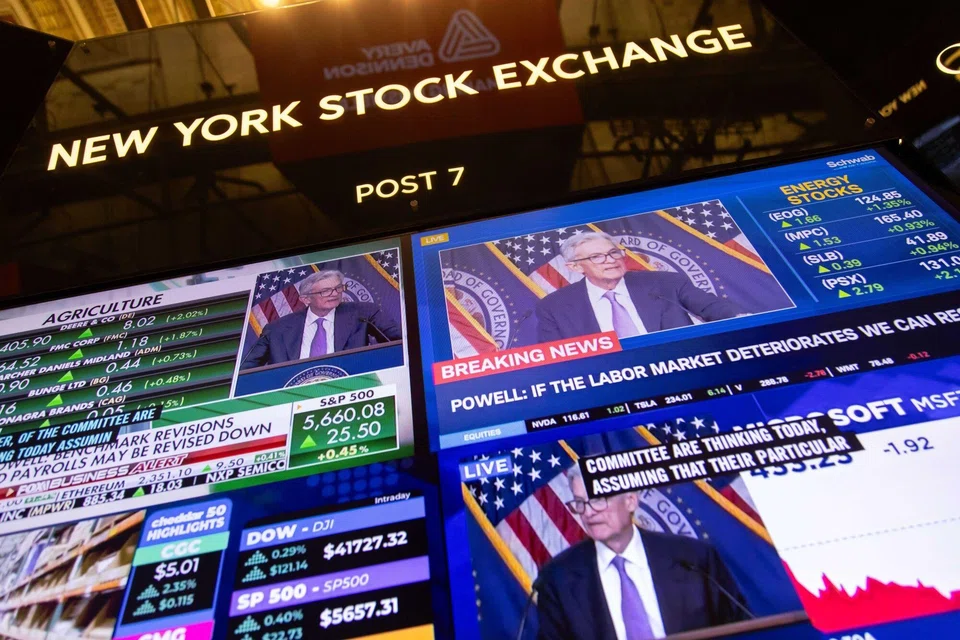
THE US stock market soared not long after the Federal Reserve fulfilled the bulls’ wildest dreams and cut its benchmark rate by half a percentage point, a move that most major brokers deemed improbable just a few days ago.
But the market still ended on Wednesday (Sep 18) with modest losses, suggesting that investors are concerned that the central bank has prematurely declared victory over inflation and may have inadvertently given its foe succour.
The Fed pivoted to an accommodative policy, kicking off its rate-cutting cycle with a super-sized 50-basis-point cut.
In a statement, the Fed said it has “gained greater confidence that inflation is moving sustainably towards its 2 per cent” target, and warned that the “economic outlook was uncertain”.
For Fed chair Jerome Powell, this marked the final step in the almost impossible mission to save the US economy from the Covid-19 pandemic that struck in early 2020.
When the pandemic hit, Powell slashed rates all the way to zero to keep economic activity going during a period when almost all factories, malls and restaurants were shuttered.
Making up for lost time
The only misstep of the last four to five years – up until now – was the manner in which Powell initially allowed inflation to run in the belief that it was a temporary response to the reopening of the global economy in 2021.
When prices kept rising in 2022 at the fastest rate in nearly 50 years, the Fed made up for lost time with a series of bumper rate hikes, driving benchmark Fed funds rates up to their recent peak between 5.25 and 5.5 per cent.
Now, with the US labour market showing signs of initial distress, the central bank has cut rates to between 4.75 and 5 per cent. Mortgage rates, which had peaked above 7 per cent, could soon test the 6 per cent level as Powell vowed to continue the cuts.
The “dot plot” of rate predictions shows many central bankers anticipating 1.5 percentage points of rate cuts by the end of 2025.
“That is also a living document that evolves over time,” said JD Joyce, president at Texas-based financial advisory Joyce Wealth Management.
Wall Street strategists are somewhat alarmed by the Fed’s sense of urgency. Generally, the quarter-point move is viewed as the conventional way to adjust policy.
The half-percentage point cut is reserved for moments such as the global financial crisis of 2008 and the onset of the pandemic.
The central bank could perceive a bloodier economic horizon than recent data has suggested.
Jobs data suggests that hiring has slowed in some key areas, including technology, where many of the new developments have involved automation.
So far, however, there has been little indication of widespread job losses.
For over a year, the economic data has provided a lot of fodder for prophets of doom, but very little fulfilment of their prophecies.
The unemployment rate rose by 0.5 per cent in less than six months to 4.3 per cent in July, violating the so-called Sahm Rule, which suggests this statistical development has always foreshadowed recession. But then the rate ticked down in August. Recent weekly data has not been consistent with mass layoffs of any kind.
Similarly, consumer confidence has retreated significantly for much of US President Joe Biden’s term in office but the pattern confidence surveys are supposed to foreshadow – a significant slowdown in spending – has not materialised.
Vulnerable state
Certainly, home-sales activity froze for much of the late summer as homebuyers waited for Powell to follow through with his widely advertised plan of cutting rates. Recent strong housing-starts data suggests that developers anticipate buyers coming back into the market now that the central bank has made its move.
Perhaps Powell and his rate-setting committee view the US economy as a fortress that has been subjected to years of cannon fire from the pandemic, inflation, a manufacturing slowdown and a housing slowdown.
With the fortress now in such a vulnerable state, Powell may have felt compelled to provide it with more powerful armaments than the latest besieging force of gradually rising unemployment would have otherwise warranted.
It is possible that the Fed was nudged by stockmarket anticipation into simply doing the major rate cut as a reassurance of intent.
The central bankers might have believed that a disappointing quarter-point cut would have rattled market confidence in its broader mission – to return to the job of defending the labour market after years of concentrating on inflation.
That was certainly how economists at brokerage Bank of America Global Research had read the action.
Based on Wednesday’s market-friendly bumper cut, “we think the Fed will be pushed into deeper cuts”, they said.
“Markets are pricing another 70-basis-points-plus of cuts this year, and after today we are sceptical that the Fed will want to deliver a hawkish surprise.”
Unfortunately, this pandering to markets may be remembered as Powell’s second mistake in an otherwise global economy-saving tenure.
Rate cuts can be inflationary forces because they release more money into the economy. If consumer prices resume rising rapidly in the coming months, the world will blame its former economic saviour.
“The Fed wants to initiate a rate-cut cycle without starting to inflate an asset bubble, but 50 basis points might have been too aggressive,” said Scott Helfstein, the head of investment strategy at Global X.