

Fed needs more time to gain confidence before it starts loosening monetary policy
Talking down an inflation victory at this point could well help keep the lid on market bullishness
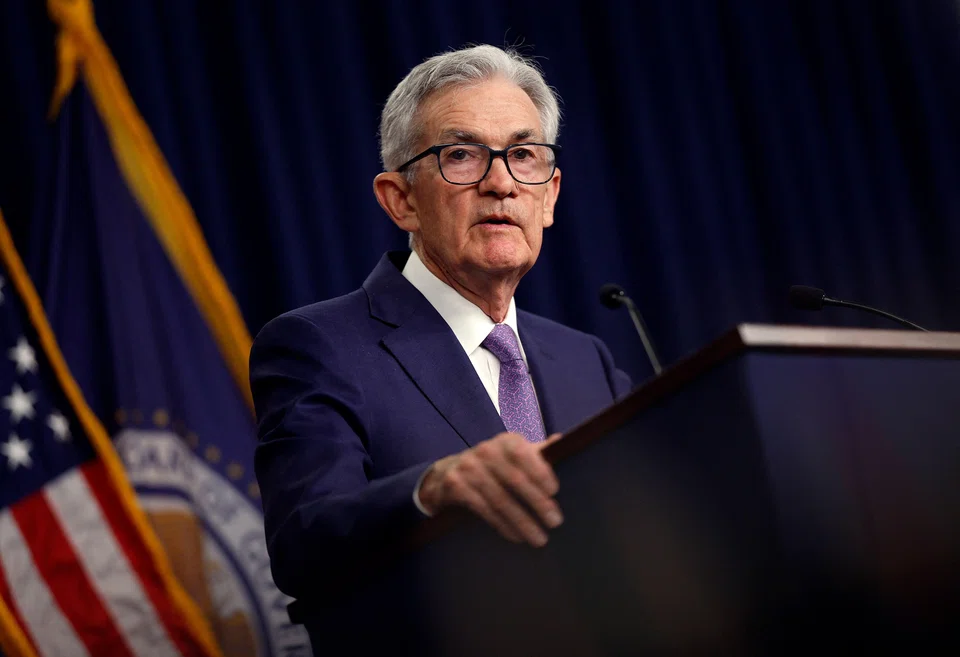
THE US Federal Reserve curbed the market’s enthusiasm with a sobering rate outlook on Wednesday (Jun 12), and did so by design.
Stock buyers had gone on a wild spree after a softer-than-expected reading of consumer price index (CPI), which showed a 3.3 per cent rise in the price of a basket of goods in May. During his press conference, Fed chairman Jerome Powell noted that the CPI typically runs hotter than the personal-consumption expenditure index, which corresponded with consumer inflation, at around 2.7 per cent.
Purchases of rate-sensitive stocks were particularly giddy, with the Russell 2000 Index adding roughly 3 per cent before the central bank statement hit the tape.
The small-cap index has lagged the broad market for much of the year; smaller companies are more reliant on debt markets than mega caps such as Apple and Microsoft, with their multibillion-dollar troves of cash.
Late in the session, the Fed revealed its latest policy decision to keep interest rates unchanged in a range between 5.25 and 5.5 per cent.
The statistic that tripped up the rally was not the Fed funds rate, which was widely expected to remain the same, but the “dot plot” – the projection for future policy moves. This formerly technical detail has become a market obsession, as traders attempt to ascertain the likely timing of a “pivot”.
The last time the US central bank provided an estimate two meetings ago, the majority of officials were predicting as many as three interest rate cuts in 2024. On Wednesday, the median projection was a single cut.
In his news conference, Powell explained the shift.
“We had really, really good inflation data in the second half of last year, and then kind of a pause in progress in the first quarter,” he said. “What we took away from that was that it’s probably going to take longer to get the confidence that we need to begin to loosen policy.”
One strategist said that the Fed might be downplaying its confidence in an inflation victory, so as not to unleash more of the “animal spirits” that had lifted the Russell 2000 and other speculative investments so drastically on Wednesday morning.
Rate cuts are often seen as a kind of “punch bowl”, which brings merriment to bullish stock traders. Markets, in the Fed’s eyes, are already intoxicated on artificial-intelligence profits – Nvidia and Apple reached new multitrillion-dollar highs this week – and other speculative asset moves. The last thing that these stock bulls need is Powell calling for another round of monetary-policy punch.
Quincy Krosby, the chief global strategist at brokerage LPL Financial, said: “The Fed statement, while acknowledging that inflation is moving towards the Fed’s 2 per cent target, was nonetheless muted about suggesting that the Fed is similarly moving closer towards easing monetary policy...
“This is most likely a function of not wanting to ease financial conditions unnecessarily, as the data-dependent Fed requires a series of cooler inflation reports before initiating a rate easing cycle,” she said.
In other words, Powell’s optimistic comments about the likelihood of inflation coming into the Fed’s comfort zone in 2025 could be closer to the Fed leadership’s true view of the inflation and rate picture than the sobering dot plot.
As JD Joyce, the president of Texas-based financial advisory Joyce Wealth Management, has pointed out, there was a legitimate fear of more rate hikes when consumer inflation began heading in the wrong direction in March and April readings of the CPI. In that context, a single cut is a relief.
Indeed, traders took the dot plot with a pinch of salt. The Russell 200 pared gains, but still finished 1.5 per cent higher. The odds on Fed funds futures markets still favour two rate cuts in 2024.
Powell’s comments could be construed as a Goldilocks moment, with growth not so hot that hikes are necessary, and not so cold that recession is an imminent threat.
Still, a veteran fund manager warned that Goldilocks herself never sticks around for long. Lorenzo Di Mattia, manager of hedge fund Sibilla Global Fund, warned that inflation in the US cannot reach the Fed’s 2 per cent target unless growth slows substantially.
“The biggest risk is that a slowdown comes, together with earning weakness, as usually happens,” he said.
TRENDING NOW

World’s largest offshore wind platform by Seatrium consortium on track to be completed by 2028

Is stamp collecting enjoying an analogue revival or are its best days over?

GovTech retrenches another 38 staff in second round of layoffs

MBS adjusted property Ebitda falls 20.6% in Q3 with fewer high-roller visits, weaker hold

