

First Greenland, then Gaza: Trump’s new world order
CANADA becomes the 51st state of the US. Then America retakes control of the Panama Canal. The United States also purchases the icy island of Greenland which would become an American territory.
And now the time has come to redraw the map of the Middle East, as US President Donald Trump did in the press conference that he held with Israeli Prime Minister Benjamin Netanyahu in the White House on Tuesday (Feb 4) night.
The war between Israel and Hamas in the Gaza Strip isn’t entirely over. Tens of thousands of Palestinians have been killed, and not all the hostages held by Hamas since Oct 7, 2023, have been released.
Never mind. The US military will be taking over Gaza soon, Trump told more than 100 journalists in the White House briefing room.
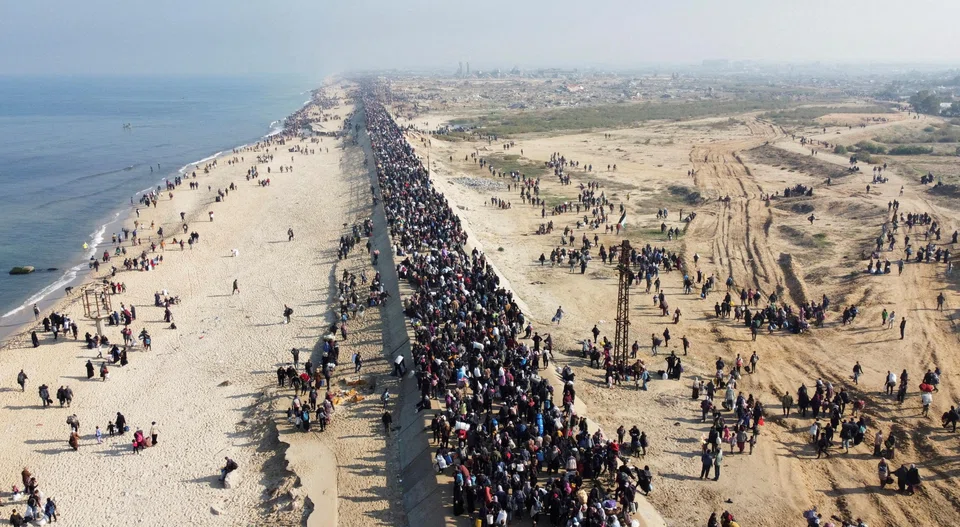
And before you know it, with the help of the other governments in the region, America will transfer the more than two million Palestinians in the Gaza Strip and settle them in Jordan, Egypt and other Arab states where they would all live happily ever after.
Then under Trump’s leadership, Gaza would be transformed into “the Riviera of the Middle East” – a booming resort area, with hotels (preferably belonging to the Trump chain) and casinos, that would attract tourists and investors from all around the world.
And to recall, Trump has been an unfaltering critic of America’s military interventions in Iraq, Afghanistan and the rest of the Middle East, arguing that they forced the US into long and bloody quagmires. The US should therefore try to disengage from the mess in the region as soon as possible, he said. Which he supposedly was planning to do.
In particular, Trump has attacked the notion that the US had the power to do “nation building” in the Middle East and elsewhere. America, he counselled, should leave those Middle Easterners to take care of their own lives and not try to impose on them the American way of life.
But now – forget about the US disengaging from the Middle East. As Trump insisted on Tuesday night, the US would not allow Iran to acquire nuclear weapons.
The US president announced that Washington would pursue a policy of “maximum pressure” to force the Islamic Republic to abandon its plans of going nuclear and implied that if that didn’t happen, the US would have no choice but to apply its military power to resolve the problem.
And he also has a vision of Arab-Israeli peace centring on his plan to expand the so-called Abraham Accords and normalise relations between Saudi Arabia and Israel, creating the basis for an Arab-Israeli axis to contain Iran.
The US taking over Gaza, the Palestinians settling in Jordan and Egypt, and Gaza turning into a Middle Eastern Riviera. A de-nuclearised Iran and a US-led Middle Eastern Nato.
It all sounds great. To be sure, while Trump’s somewhat shocking pronouncements did see White House officials seeking, the day after the press conference, to walk back and soften the ideas, there should be no doubt that the idea of “owning” Gaza has been on his mind for a while (he was, for one thing, reading off a sheet of prepared remarks on Tuesday, not speaking off the cuff). But there are numerous obstacles on the way to turning Trump’s grandiose vision for the Middle East into a reality.
First, the US doesn’t own Gaza (or, for that matter, Greenland). According to basic international law, Gaza is a sovereign area whose inhabitants have the right to decide on their future and that of their land.
And the reality is that the more than two million Palestinians residing on the Gaza Strip would like to return to their homes and remain there, however dire the conditions there may be, and have expressed no interest in emigrating from their homeland.
Second, Jordan and Egypt and the rest of the Arab nations have voiced strong opposition to the idea of relocating the Palestinians from Gaza to their countries.
In fact, from Jordan’s perspective, taking in a million or so Palestinians would amount to an existential threat. With a majority of Palestinians residing in Jordan, the Hashemite Kingdom would probably cease to survive.
Then there is the notion of deploying thousands of US troops into the Gaza Strip, which would make the military quagmires in Iraq and Afghanistan seem like a picnic.
In any case, the Congress and the American public in general would probably oppose such a move, and if it does take place, US soldiers would end up fighting with the Palestinian population, as well as Hamas forces, leading to many American casualties.
And who will undertake the economic reconstruction of the Gaza Strip? Saudi Arabia and the rest of the oil-producing Gulf states have made it abundantly clear they won’t do so, unless Israel commits itself to establishing an independent Palestinian state in the West Bank and Gaza. Netanyahu, on his part, has made it clear that that isn’t going to happen.
Trump, perhaps at heart a real estate tycoon after all, may be viewing the issues of international relations as business transactions. He is going to buy Gaza and turn it into a cross between the French Riviera and Las Vegas. People, after all, are having a great time in those places and elsewhere where the Trump hotels make a lot of money. So “everyone” will be happy with his proposal. Right?
But the problems of the Middle East go well beyond the realm of business deals. Historical conflicts and cultural clashes cannot be resolved like in a commercial transaction.
In 1982 after Israel invaded Lebanon, the US under then president Ronald Reagan decided to deploy thousands of American troops to Lebanon to help restore peace there.
The US military intervention only ignited more violence in that country, leading to terrorist attacks and the bombing of the American embassy and the Marine barracks in Beirut, resulting in the death of hundreds of Americans and Lebanese. The US ended up withdrawing from Lebanon with its proverbial tail between its legs.
Before launching his plan to take over the Gaza Strip and turn it into a Middle Eastern Riviera, Trump should perhaps study that sad chapter of US military interventions in the region. They mostly don’t end well.






