G20: Will Asian emerging markets continue to drive progress?
For the first time in 200 years, global income inequality is declining. But income inequality within nations could set this on reverse
[SOUTH AFRICA] The political mood music around this year’s G20 has been mixed, not least with the Trump team’s decision to boycott the big leadership event on Saturday (Nov 22) and Sunday.
However, the South African chairing of the global club has also secured some clear wins with an agenda of particular relevance for key emerging markets in Asia such as Indonesia, China and India.
Some 42 countries have confirmed their attendance for the weekend’s big event in Johannesburg.
This has officials from 19 of the G20 member states, including Indonesian President Prabowo Subianto, and leaders from 16 guest countries, such as Singapore Prime Minister Lawrence Wong and Vietnam Prime Minister Pham Minh Chinh.
There are also representatives from six states across Africa, the Caribbean and Asia, including Malaysia Prime Minister Anwar Ibrahim who is chairperson of Asean in 2025.
By the end of Sunday’s leadership summit, there would have been 133 official G20 meetings with an agenda focused around three main themes with a particular appeal to the developing world, especially in Asia.
These narratives are: first, inclusive and sustainable economic growth; second, building a more resilient world; and third, a fair and just future for all.
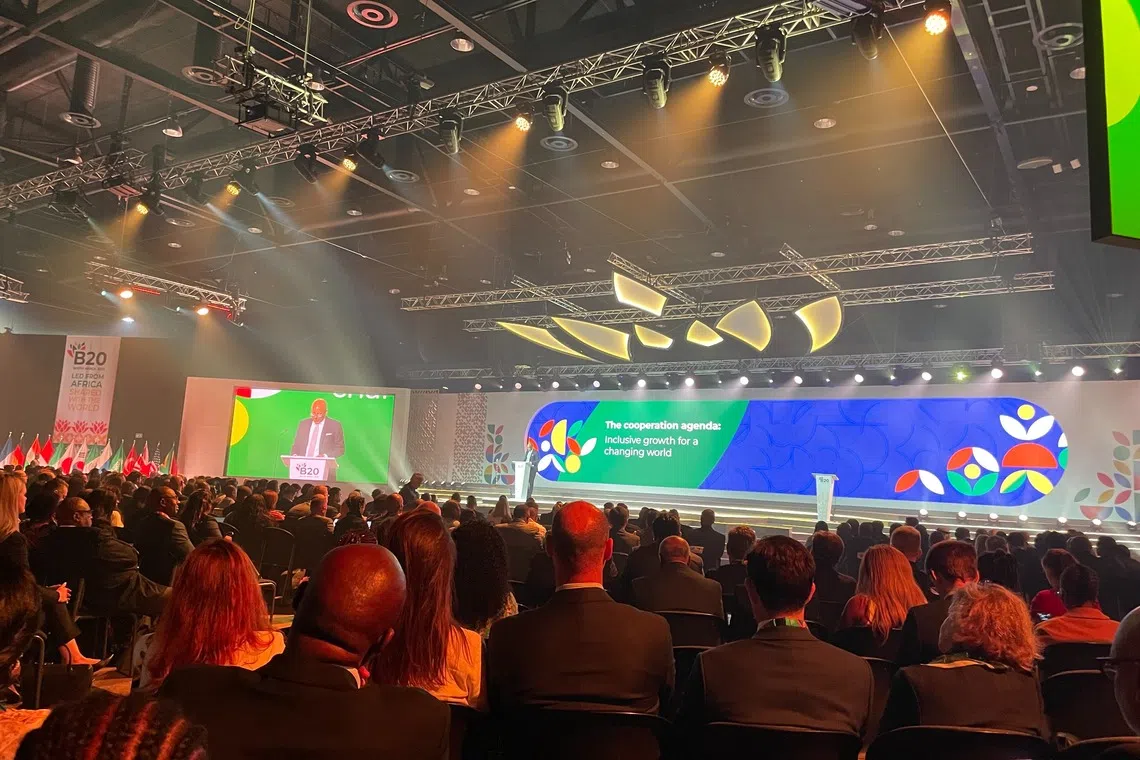
South Africa is particularly proud that its G20 presidency has sought to renew global commitment to justice, equity, and sustainable development, while firmly placing the priorities of the Africa continent at the heart of the G20.
As Minister of International Relations and Cooperation, Ronald Lamola, asserted this week: “Our presidency is a call to action… to bridge the developmental divide between the Global North and the Global South.”
One of the key deliverables on this agenda is a major new report on world inequality chaired by Nobel prize winner, Professor Joseph Stiglitz, and a committee which included leading Indian economist, Professor Jayati Ghosh.
A key recommendation from the report is the creation of a permanent international panel on inequality, modelled on the Intergovernmental Panel on Climate Change.
Asia drives key moment in world economic history
The G20’s focus on inequality is timely as it coincides with a potentially hugely exciting time in world history.
Ground-breaking World Bank research indicates that, for the first time in around 200 years, overall global income inequality appears to be declining thanks in large part to two emerging market giants, China and India, in a process which Asia has been the biggest beneficiary of so far.
However, for all its historic potential, this picture remains hazy due to a few reasons. One, data sources on income across the world are often incomplete, which means conclusions need to be caveated.
Two, the forces that determine the overall global income landscape are complex.
Chief among these cross-cutting mega-trends is growing income equality between countries as the Global South develops. At the same time, income inequality is increasing within many nations. These opposing forces, like tectonic plates, are pushing against each other.
Amid this complexity, China and India have clearly been key in promoting greater overall global income equality. Combining these nations’ economic growth and their very large collective population, estimated at more than 2.5 billion people, both have elevated huge numbers of people out of poverty.
In China alone, the number is an estimated 600 million between 1981 and 2004. This marks one of the biggest economic changes of unprecedented speed and scale in world history.
Yet, the opposing force – growing income inequality within many countries – has become increasingly politically salient, especially since the 2008/09 global financial crisis.
This is exemplified by the election in 2016 and subsequent re-election in 2024 of US President Donald Trump. While such inequality in the industrialised world gets substantial attention, the world’s most economically unequal countries are actually in the Global South, including South Africa, and Brazil which is hosting COP30.
The grand sweep of economic data shows that the net global trend for the two centuries has been towards greater overall income inequality.
However, in the last two decades, there is evidence that growing income equality between countries, reflecting the growth of emerging markets across the world, is superseding the impact of increasing inequality within nations.
This potential change moment has improved the overall lot of the Global South. The most prominent beneficiaries have been a fast-growing new middle class, estimated to be as large as a third of the world’s population, which is concentrated in key Asian emerging economies.
Much of the bottom third of the global income pyramid have generally benefited too. As in China, many other hundreds of millions of people in the Global South have transitioned from absolute poverty.
Elites within emerging markets have also tended to prosper. Many of these people are part of the top global 1 to 5 per cent of income earners, a group otherwise dominated by individuals in developed countries. These cohorts, at the very apex of the global economic hierarchy, have generally seen their incomes rise massively in recent years.
However, not all of the Global South has shared fully in this rising tide of prosperity in the period to 2008. Much of Africa, and some of South America, for instance, has generally not benefited nearly as much as Asia so far.
A key question for many leaders at the G20 summit will be whether the economic development of key emerging markets has enough momentum to continue driving forward this more equitable world order.
This will depend largely on the same twin issues: whether key emerging markets persist in growing robustly, and also whether rising income inequality within countries can be slowed or arrested.
On the latter, ever-growing income inequality within countries is not predestined, especially if there is political will to address it.
However, there is little consensus in the debate between right and left over what long-term reform agenda should be undertaken.
On the first issue, the trajectory of the global economy will continue to shift towards the Global South. For the foreseeable future, key emerging markets, including those in Asean, may generally remain in strong shape.
However, the remarkable wave of emerging market growth of recent years is decelerating, as shown in China. The global transformation it has engendered in recent decades is unlikely to be repeated.
Should income inequality within countries accelerate, and/or emerging market growth decelerate faster than forecast, this remarkable change could go into reverse. Should that happen, the political salience of the economic inequality agenda may only intensify, potentially with the election of more populists like Trump across the globe.
The writer is an associate at LSE IDEAS at the London School of Economics