

Ghost factories could be China’s new growth driver
OVER the past four decades, Chinese policymakers at the central and local level have had a handy tool at the ready to boost economic activity when everything else faltered: construction. Spending money on new apartment blocks, transport infrastructure, energy-generation plants and industrial parks is a convenient way to pump-prime the economy. Now, there is a new mechanism for driving gross domestic product (GDP).
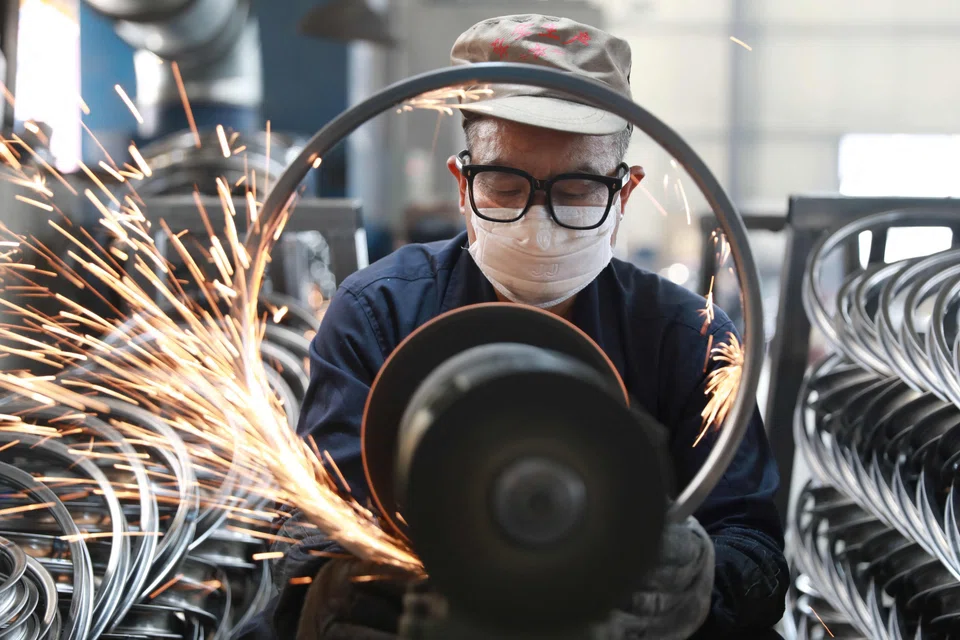
Industrial equipment used to make semiconductors, solar cells and electric vehicles presents a great way for corporate executives, bank managers and government bureaucrats to keep the wheels turning, even as consumers balk at spending money and foreign buyers cut purchases of Chinese exports.
The US-China tech cold war and continuing trade tensions serve as the perfect excuse to rack up expenditures that can support local businesses, keep people employed, and add to the economy.
Only one line item in China’s industrial output figures, out of almost two dozen, consistently posted double-digit growth figures in recent months. Electrical machinery and equipment manufacturing climbed 17 per cent in April, 15 per cent in May and the same again last month. Everything else, including auto manufacturing, metal smelting, and textiles, grew either by single digits or dropped.
Take Naura Technology Group and Advanced Micro-Fabrication Equipment (Amec), producers of equipment used in electronics and chip manufacturing. The former posted first-half revenue growth of around 54 per cent to 8.4 billion yuan (S$1.5 billion) and the latter 28 per cent to 2.5 billion yuan.
By comparison, China’s economy climbed 5.5 per cent for the six months to Jun 30. That gross domestic product (GDP) growth figure includes a disappointing 6.3 per cent for the second quarter, a period that benefited from a low base a year earlier when swathes of the country were in Covid-related lockdowns.
Nationwide, production of industrial-control computers and systems, crucial to running high-tech factories, climbed 34.1 per cent in H1, one of the strongest contributors to growth for the period.
Companies such as Naura and Amec benefit from a US-led halt on selling chipmaking equipment to China, as well as President Xi Jinping’s goal of turning the country into a semiconductor powerhouse that can function independently of the outside world.
It matters little that Naura, Amec and their Chinese peers are no match for the technology and productivity of US rivals Lam Research or Applied Materials. Foreign equipment is increasingly hard to come by, so local chipmakers are forced to buy more units of the less-productive local offerings to make up the shortfall.
Efficiency and profits take a hit, but Chinese statisticians log a rise in industrial production and a reduction in imports – both of which help boost GDP.
There are other sectors where China is a global leader, and that can be leaned upon to soak up excess production capacity and boost the economy. Manufacturing of solar cells grew 54 per cent in the H1, according to the National Bureau of Statistics, while electric vehicles were up 35 per cent.
Power generation and cars are not regular purchases, so this boom will end when the market is satiated. That does not necessarily mean an end to purchases of the gear used to make them, though.
As long as funding remains available, companies can continue to buy equipment and store it in factories. Sometimes it will be fully utilised; other times it will lay idle, waiting for demand that has already disappeared and may not return.
But as long as machinery gets built, bought and shipped, industrial production figures will hum along and contribute to Beijing’s picture of an economy that has “good momentum”, as the statistics bureau described the latest set of numbers.
Worth the cost
Theoretically, there is a cost: capital investments are recognised on the income statement through depreciation. But you can tweak the depreciation schedule to reduce expenses, or sell gear to affiliates at whatever price you decide in order to boost the bottom line.
Using equipment to juice economic data probably does not scale to the level of construction. According to a Bloomberg News analysis, China’s regions have announced spending plans for major projects adding up to more than US$1.8 trillion this year.
But there are some benefits. Most glaring is that you cannot easily spot hangars full of idle equipment the way you can track ghost cities by satellite or from a drive through empty streets.
And such under-utilised capacity is still useful. Unlike an empty apartment block, which can derive post-construction value only through collecting rents, machines can be spun up to produce real goods for sale locally or abroad – even if only to sit on shelves as excess inventory. Or they can be sold and shipped across the country, or the world.
Crucially, as Chinese industrial policy becomes increasingly driven by ideological rather than economic considerations, banks will be more inclined to lend to those businesses that support Xi’s broader vision. And executives – especially those at state-owned enterprises – are likely to get leeway to spend money on items regarded as strategically important.
The days of building and demolishing entire neighborhoods is likely over, but there is something to be said for a new era of high-tech ghost factories that can simultaneously boost growth and drive China towards industrial independence. BLOOMBERG
TRENDING NOW

World’s largest offshore wind platform by Seatrium consortium on track to be completed by 2028

Is stamp collecting enjoying an analogue revival or are its best days over?

GovTech retrenches another 38 staff in second round of layoffs

MBS adjusted property Ebitda falls 20.6% in Q3 with fewer high-roller visits, weaker hold

