
Globalisation of the Gaza War?
US President Joe Biden wants to avert a regional war that could draw in Hizbollah and Iran, and eventually possibly even Russia and China
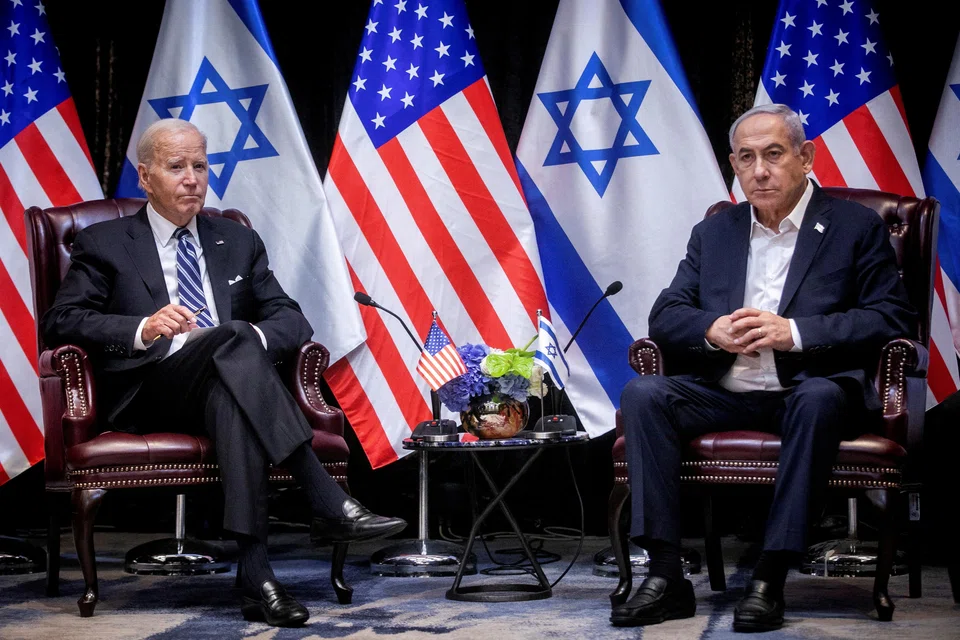
IN AN unprecedented visit to the Middle East as the war rages on between Israel and the Hamas movement that controls Gaza, United States President Joe Biden is trying to avert a regional war that could draw in Lebanon’s Hizbollah and its patron, Iran.
During his trip to Israel and his meeting with Israel’s Prime Minister Benjamin Netanyahu on Wednesday (Oct 18), coming a day after the visit of German Chancellor Olaf Scholz and a day before that of French President Emmanuel Macron to the country, the American president was seeking to assert continuing US support for the Jewish state, including through the supply of arms and diplomatic backing.
President Biden had already ordered the deployment of the USS Dwight D Eisenhower carrier strike group to the eastern Mediterranean Sea, where it will join the USS Gerald R Ford in a show of support for Israel.
At the same time, the US Department of Defence announced that about 2,000 US troops have been put on prepare-to-deploy orders for possible support to Israel, according to an official, who noted that would increase US ability “to respond quickly to the evolving security environment in the Middle East”.
The main strategic goal of the Biden administration is to avert a wider regional war that would involve a military confrontation between Iran and Israel, which in turn could draw the US and other players into the conflict.
Since the Hamas launched its attack on southern Israel on Oct 7, tensions have surged along Israel’s northern border, raising concerns of a new conflagration between Israel and the Hamas’ Iranian-backed ally Hizbollah in neighbouring Lebanon.
The Israelis and Hizbollah have exchanged fire in recent days and the leader of the Lebanese militant group has threatened to respond if and when Israel launches its expected ground incursion into Gaza.
Iranian officials have insisted that such an Israeli ground offensive would be a “red line” for them that could force them to intervene, and give the green light to the members of its “Axis of Resistance” in the Levant and the Persian Gulf – including other proxies in the region, like those in Iraq and Yemen – to attack Israeli and American targets.
One scenario that worries the Americans: If the Hizbollah attacks Israel and some of its 200,000 missiles hit the Jewish state’s urban centres, including Tel Aviv, then Israel, which possesses nuclear military capability, could threaten a massive retaliation against Iran.
In that event, Russia – which in recent months, against the backdrop of the war in Ukraine, has strengthened ties with Iran, which supplies it with Iranian-made drones – could defend the Islamic Republic against an Israeli attack. It could also call on China to join it in responding to the moves by Israel, a major American ally.
This is the kind of geo-strategic nightmare that has all the makings of a World War III. At the minimum, such geo-political tensions could lead to energy prices surging to the stratosphere and devastating the global economy.
There are already signs that the global order is beginning to shift, with both Russia and China – that until now have maintained friendly relations with Israel – choosing not to denounce Hamas. They hope that the military and diplomatic setbacks to America’s leading ally in the Middle East, Israel, would deliver a blow to the American position in the region and erode its global status.
The growing number of Palestinian casualties in the Gaza Strip has increased anti-American sentiments in the Middle East and could force America’s Arab allies, including Egypt, Jordan, and the Arab Gulf states, to reassess their relationship with the US.
Indeed, Jordan cancelled the summit it was to have hosted for President Biden and the Egyptian and Palestinian leaders during the US leader’s trip to the Middle East, after an explosion killed hundreds of people in a hospital in Gaza City on Tuesday.
Hamas has said that an Israeli air strike had caused the blast, while Israeli officials maintain that one of the rockets fired at Israel by the Palestinian militant group, Islamic Jihad, failed shortly after launch and caused the deadly explosion.
During a meeting with Prime Minister Netanyahu on Wednesday, President Biden said that he accepts Israel’s version of the event.
As Israel prepares for its ground invasion of Gaza, a major question is whether the Israelis would be able to regain their deterrence power by destroying Hamas’ infrastructure, as it has pledged to do.
But then Israel could find itself mired in long and costly urban warfare in Gaza with rising Israeli and Palestinian casualties; and the images of such a bloody conflict would make it difficult for the US to continue to support Israel.
Another question involves the deterrence power of the US.
Will America’s warnings to Hizbollah and Iran to not intervene in the war have their desired effect, or will the Iranians and their allies decide that the Americans don’t have the political will to intervene directly in the war and to take military action against them.
It’s clear that in the aftermath of the wars in Iraq and Afghanistan, and given the major ongoing geo-strategic challenges in Ukraine and Taiwan, the last thing the Americans need is another military quagmire in the Middle East. The Iranians may be betting on that.
TRENDING NOW
Incidence of civil servants buying property near unannounced MRT stations ‘a concern’, but may not establish misconduct: PSD
Grab CEO’s wife Chloe Tong on life with Anthony Tan and finding her purpose
Income Insurance appoints former Manulife Singapore top man as new CEO
HDB reviewing ‘jumbo’ flat scheme after Telok Blangah unit listed for sale at S$2.18m



