

Good Class Bungalow market activity picks up pace on ‘realistic’ pricing
Wealthy buyers keen to snag trophy assets at fair market value

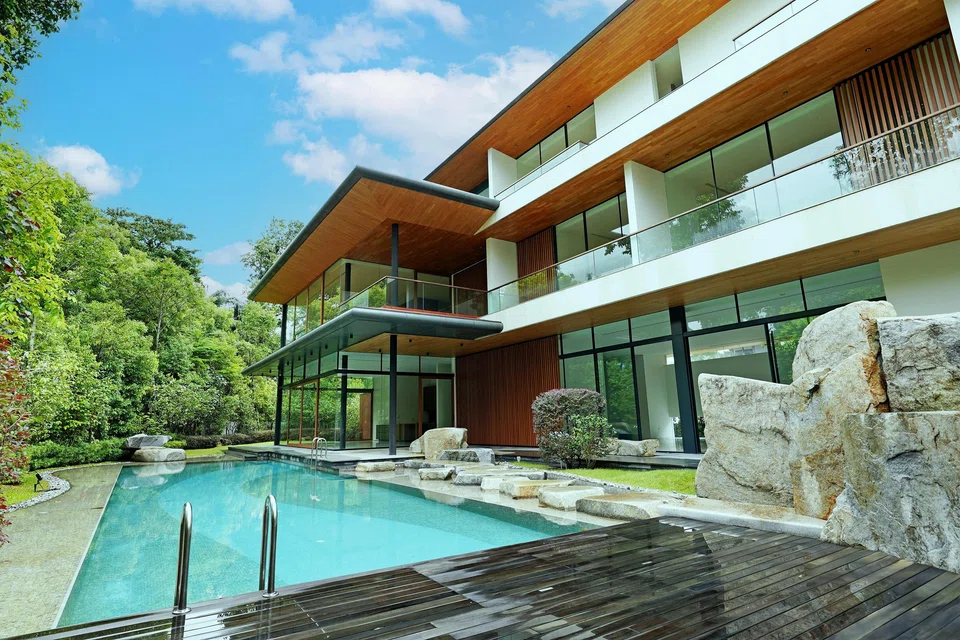
[SINGAPORE] For most of this year, the well-heeled shopping for a bungalow in one of Singapore’s Good Class Bungalow (GCB) Areas have been able to take their time before deciding on which best suits their requirements.
That’s in contrast with a bullish market, where buyers must often decide quickly as their shortlisted properties may change hands before they can put in an offer, observes Steve Tay, executive director of Steve Tay Real Estate (STRE).
Most market watchers found the GCB market quieter in the first eight months of 2026, as buyers became more selective and sought greater value in the face of global geopolitical uncertainty, oil supply chain disruptions and other drags on sentiment.
Meanwhile, GCB owners with strong holding power continue to hang on to lofty price expectations significantly above market value. The widening buyer-seller price gap has contributed to a drop in transaction volumes and values.
As transacted prices come off the highs seen in the last two years – especially in the case of land with potential for redevelopment – some owners have withdrawn listings, market watchers say.
There have also not been many new listings.
But the market looks set to pick up in the final months of 2026, with momentum carrying over into the next year as well.
Lower sales activity
Bungalows in Singapore’s 39 GCB Areas (GCBAs) are the most exclusive form of landed housing on the island, with only about 2,700 such properties, according to market estimates.
These bungalows are nestled mostly in wooded areas on large plots in prime districts 10 (such as Nassim Road, Cluny Hill, Dalvey Road, Victoria Park Close and Queen Astrid Park) and 11 (such as Bukit Tunggal and Eng Neo Avenue).
There are also a few GCB Areas in districts 20 (Windsor Park), 21 (Kilburn Estate including Yarwood Avenue, and King Albert Park) and 23 (Chestnut Avenue).

Bungalows in GCBAs are subject to strict planning conditions to preserve their exclusivity and low-rise character.
A minimum plot size of 1,400 square metres or 15,070 square feet (sq ft) is the specified planning norm for newly created bungalows in GCBAs.
Property consultancy Knight Frank’s analysis of caveats on the Urban Redevelopment Authority (URA) Realis portal found 14 transactions in GCBAs, to the tune of S$406.2 million, in the first eight months of 2026. This is down from 17 deals worth S$530.6 million in the same period a year earlier.
Recent deals have brought this year’s caveated transactions to 17 as at Tuesday (Oct 13), with a total value of S$517.5 million. The latest sale was dated Sep 30.
Market watchers additionally estimate that at least S$800 million of deals have been contracted in the year to date where buyers did not lodge caveats.
In comparison, in 2025, there were 30 deals in GCBAs amounting to S$1 billion for which buyers lodged caveats. In addition, there were at least S$1 billion of non-caveated transactions, based on market estimates.
Some of last year’s non-caveated deals include properties in Cluny Hill (at S$85 million and S$52 million), Dalvey Road (S$61 million), Tanglin Hill (S$76 million), Cornwall Gardens (S$75 million) and Victoria Park Close (S$52 million and S$63 million).
The pool of caveated and non-caveated deals this year includes a vacant plot in Nassim Road, sold by former Sincere Watch boss Tay Liam Wee for S$92 million, as well as an old house in Bishopsgate, sold for S$40 million by four members of the founding family of traditional Chinese medicine group Eu Yan Sang.
More recently, an old house in Dalvey Road went for S$56 million or S$3,029 per square foot (psf) on site area.
It is being sold by Dr Goh Kia Seng, president of the Academy of Chinese Medicine, Singapore and chairman of Singapore Chung Hwa Medical Institution’s board.
The rich show restraint
Some agents in the luxury residential property market suggest that the slower GCB market may be due in part to a smaller number of top-tier ultra-high net worth (UHNW) individuals among newly minted Singapore citizens.
In general, only Singapore citizens can buy a landed property in a GCBA.
Boutique property consultancy firm JQT Private’s executive director Jacqueline Wong says: “It appears that the government has tightened the criteria for granting new citizenships, even when it comes to billionaires.”
This can weigh on GCB demand – especially for brand-new properties with bigger price quantums, as new citizens form the bulk of the buyer pool in this segment, market watchers note.
Nine in 10 UHNW new citizens want to buy a GCB, says Wong.
Such a property can be “a prized possession they look forward to acquiring after having made the journey” to becoming Singaporean.
“That’s why newly minted Singapore citizens are willing to pay a premium for the best-in-grade GCBs,” she adds. They find a GCB attractive because it offers “unparalleled privacy” and has a much bigger usable or built-up area than most penthouses.
A luxury residential agent who declined to be named points to another recent dampener on GCB demand: Beijing’s recent clampdown on offshore trusts, which has caused some UHNW Singapore citizens originally from China to take a pause before buying any big-ticket assets outside of China.
Over the years, observers have noted that some UHNW families structure GCB acquisitions using trusts – such as purchasing in trust for Singaporean minor children or establishing family trusts – to facilitate long-term wealth transfer and estate planning.
But in late July, Beijing imposed a 20 per cent income tax on the offshore trusts that could be seen as a grey area for UHNW individuals to harbour wealth.
Stepped-up enforcement of taxes on Chinese tax residents’ offshore income and gains have also stoked concern that the authorities could enlarge their tax dragnet and deter investment, as The Business Times reported in September.
“A lot of our clients are going through with their lawyers and bankers to see how they are going to be affected,” says the luxury residential agent who declined to be named.
“Before all this becomes very clear, they may want to stay out of big transactions.”
Tale of two sellers
Another major reason for the slower pace of GCB deals so far is owners sticking to unrealistic price expectations.
As Realstar Premier managing director Julian Yip notes: “Compared with those who own smaller landed homes, GCB sellers usually have better holding power. Unless the price is right, they will usually prefer to hold on to their property.”

That said, Yip highlights another group of owners “who prefer to rightsize their homes due to a change in their family demographic – and who will price their property more realistically”.
This group comprises silver-generation empty-nesters who opt to move into a smaller, more manageable home and free up more cash for retirement. Higher residential property taxes may provide additional motivation to part with a GCB that they don’t need.
“This profile of GCB sellers surfaced gradually in 2023, when the government began increasing the upper tiers of residential property tax rates, and has featured more strongly since 2025,” says Yip.
Such motivated sellers have realistic price expectations – and they are being greeted by enthusiastic buyers.
Tay of STRE notes that this is particularly so for sites with ageing bungalows that are ripe for redevelopment, as well as for older bungalows that are well maintained and need only minor renovations.
An old property in Jalan Sampurna, in the Oei Tiong Ham Park GCBA, recently went for at S$31.3 million or S$2,089 psf on land area – down from the S$42.8 million guide price when the site was marketed in March 2025.
In June this year, a pair of old freehold bungalows in Belmont Road sold for a total of S$60 million or about S$1,437 psf on the land area of 41,741 sq ft.
This was below the indicative price of S$88.8 million or S$2,128 psf, during an expression of interest exercise that closed in March 2025.
These transaction prices take into account features that may weigh on buyers, such as a retaining wall, a downward slope, or a site that is below road level or affected by a drainage reserve.

With transaction volumes lower, sellers are realising that buyers are “willing to wait and look around for more suitable options rather than chase prices up”, Tay notes.
“If sellers are willing to be reasonable on pricing, in line with fair market value, it is likely the property will find a buyer,” he adds.
Tay also highlights strong demand for brand-new, well-built GCBs with modern designs – a segment sought after for its scarcity.
“There is a pool of buyers who do not want to go through the hassle of two to three years of constructing their own home,” he says.
“These buyers are willing to pay a reasonable premium for the convenience of acquiring such a property that meets their requirement and that they can move into soon.”
Room for growth
Knight Frank Singapore research head Leonard Tay says that GCB demand this year has been “stable but selective”.
“While capital is still available, buyers appear to be more disciplined, placing a greater emphasis on underlying land value, with more focus on a site’s attributes and its redevelopment potential, and the long-term upside,” he adds.
He remarks that demand continues to be supported by potential buyers’ stock market and business gains, as well as “wealth inflows into Singapore” from some new citizens.

In recent months, STRE’s Tay has observed an increase in enquiries and viewing requests compared with the first two quarters.
“The catalysts for this are the more realistic pricing for the GCBs on sale, as well as potential buyers who have done well in their investments in financial markets and commodities,” he says.
Would-be buyers may include the owners of businesses in growth sectors such as semiconductor manufacturing and healthcare, who are now “taking some profits and parking them into a GCB for long-term wealth preservation”, he adds.
Looking ahead to 2027, Realstar’s Yip identifies two bright spots for the GCB market: Singapore’s immigration policy and the Equity Market Development Programme (EQDP).
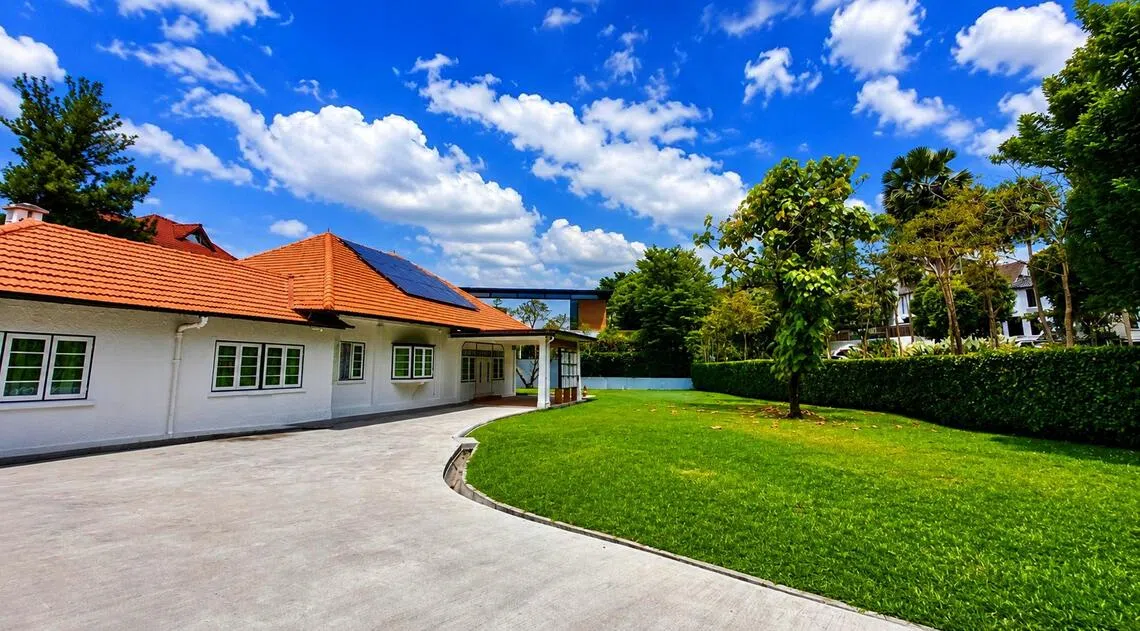
The Singapore government expects to take in around 25,000 to 30,000 new citizens annually over the next five years.
“Just 10 per cent of this number will equate to 2,500 new buyers of landed properties,” says Yip.
Meanwhile, the Monetary Authority of Singapore’s S$6.5 billion EQDP, first announced in 2025, is part of broader efforts to deepen investment capabilities, attract more capital into Singapore equities and boost investor participation.
Should more business owners opt for initial public offerings, founders and other existing shareholders would have an avenue to realise part of their investments.
Such liquidity could subsequently be deployed into other assets – including GCBs.
Knight Frank’s Tay notes that activity such as listings and asset divestments “can typically provide the capital that fuels demand for trophy residential assets among local business leaders”.
“Timely opportunity”
Both Knight Frank and Realstar project a 3 to 5 per cent increase in GCB prices in 2027. Knight Frank predicts that the volume of deals in GCBAs could be slightly higher year on year, while Realstar says the volume might be lower if geopolitical conflicts worsen.
Yip adds that the performance of the artificial intelligence sector and stock market, as well as economic and geopolitical stability, will affect sentiment in the GCB market in the near to medium term.
For instance, businesses in sectors such as semiconductors, data centres, or even construction could be hit if the much-feared AI bubble manifests and the industry crashes. “In turn, this may delay the plans of these business owners to buy a GCB.”
Still, predicting that transaction prices “will continue to go north” on a psf basis, Yip says: “There is potential of record-breaking sales.”
He tips top-tier locations, such as Nassim, Cluny, Dalvey, White House Park, Tanglin and Chatsworth, as areas to watch.
Yip expects that the transacted price gap between GCBs in the best locations and less prime areas – which has widened this year – will increase further in 2027, so “owners of properties in less prime areas might need to price them more realistically”.
At the same time, STRE’s Tay notes that “present pricing is at more realistic levels” than before.
“The current window presents a timely opportunity for GCB buyers to acquire good properties at fair values.”
Knight Frank’s Tay opines that beyond the existing bungalow on a site, prospective buyers should consider how land specifications lend to quality and long-term value, since “a house can be rebuilt”.
“Buyers should pay close attention to factors such as the plot shape and gradient, road frontage, planning parameters and future use.”
Finally, Wong of JQT suggests to clients that all those who will be living in the house visit a potential GCB home in person “to see if they like the vibes, the energy of the place”, rather than merely viewing it online.
Before making a decision, the multimillion-dollar question must be: “Do they feel a sense of peace in the various parts of the property?”
TRENDING NOW
MSCI proposes standalone status for Indonesia; Jakarta stocks plunge 8%

Palm oil stocks slide after Singapore begins looking into which firms responsible for haze

High Court rules against Julius Baer’s Singapore trust arm in US$50 million family trust dispute

Why is the haze so bad in South-east Asia this year?

