

Good news is bad news as Fed watches for hot US economic data
IN THE world of the US Federal Reserve, good news is now officially bad news. Investors, however, may be completely fine with that.
The Fed left benchmark interest rates unchanged for the second straight policy meeting on Wednesday (Nov 1), with the US central bank’s rate-setting group agreeing – as expected – to keep the key federal funds rate in a target range of between 5.3 per cent and 5.5 per cent.
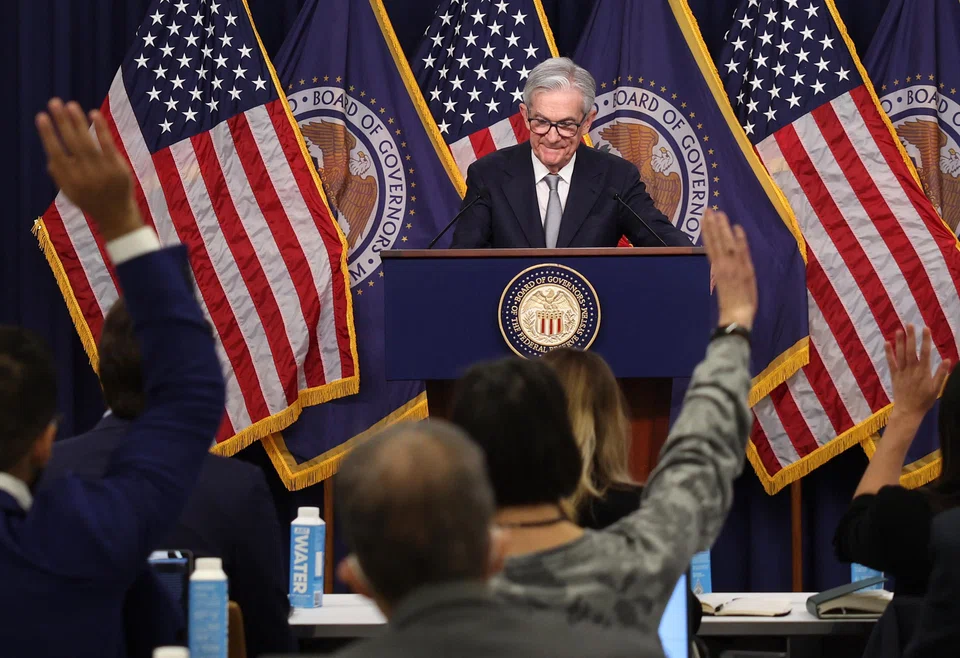
Fed chairman Jerome Powell issued a stern warning, however, that signs of surprising strength in the US economy is likely to force the resumption of the Fed’s inflation fight and another rate increase sooner rather than later.
“We’ve come very far,” he said, an acknowledgment that the Fed’s series of 11 rate increases that began in March 2022 has helped to tame inflation. “We’re making progress...it feels like we’re on a path.”
He said the central bank remains “strongly committed” to bringing consumer price inflation down to its 2 per cent target from current levels of about 4 per cent on an annual basis. To do so, analysts said that the Fed will have to keep rates high enough, and for long enough, to cause the unemployment rate to increase.
The Fed has a dual mandate to keep the rates of both unemployment and inflation low. However, there is little doubt which its priority currently is. Most economists have said it is much easier for a central bank to contend with recovering from joblessness than out-of-control inflation.
Powell said inflation expectations were in a good place. Despite some polls showing consumers’ expectations of future price increases are rising, the general message from surveys was clear, as consumers expect inflation to moderate over time.
There was “no crack in the armour” of declining inflation expectations, he said, describing it as the critical factor for the Fed’s policymaking and the battle against inflation.
“If we fail to restore price stability, the risk is that expectations of higher inflation get entrenched in the economy, and then inflation goes higher and more volatile,” said Powell. “That’s a prescription for misery. We’re really trying to make sure that does not happen.”
As the chairman noted, there’s a risk that the inflation battle is just beginning, and not ending, as investors would like to believe.
For example, the rate of wage inflation in the US may have come down steadily in recent months, but the labour market remains tight. The risk of a wage-price spiral, as witnessed in the 1970s and 1980s, is still very much alive.
On Wednesday, Toyota Motor boosted the wages for most of its US workers by 9 per cent, matching the aggressive wage hikes won by the United Auto Workers union in its strike against General Motors, Ford Motor and Stellantis – the Big Three Detroit auto makers and among the nation’s biggest employers. Other major employers, including movie and TV studios in Hollywood, are facing similarly stark wage demands.
Dovish overtones Powell stressed that the rate-setting committee’s conversations were focused on whether they had been aggressive enough with interest rate hikes, rather than if it was time to back off.
The main consideration during every meeting of the committee is that “(now we have) achieved a stance in policy sufficiently restrictive to bring inflation down to 2 per cent over time,” he said.
Economists at the Bank of America noted that Powell’s words had dovish overtones, as he did not rule out an end to rate increases.
“Powell did not break much new ground in his press conference, although again we thought it leaned dovish,” they wrote in a client note. “We retain our call for one more 25 basis-point hike in December, although it has become an even closer call after today’s meeting.”
Most analysts feel that investors cannot have their cake and eat it too. Either the surprisingly strong gross-domestic product and consumer-spending growth of recent months will continue, leading to higher Treasury yields, more rate increases and more stock sell-offs, or the growth will come to a halt.
And while the bear market in stocks that began in January 2022 appears to have concluded, it could well drag on indefinitely. Certainly, investors will not have the Fed’s shoulder to cry on if the stock-market correction of recent weeks becomes more extreme.
Powell has repeatedly warned that the central bank only considers equity-market stress one of a range of financial-conditions indicators. It would likely take a seismic sell-off on both the stock and bond markets to get the Fed’s attention.
If economic data – and particularly, wage growth – is too hot in the next couple of months, expect Powell to pull the trigger on more rate increases. Good news will be bad news, in that case. But, according to one strategist, bad news on rates might be better for the stock market than bad news on economic data.
“If you’re an investor, which would you rather have? Low interest rates because the economy is not growing, and the US is in a recession, or higher rates because the economy is growing, and corporate earnings are rising?” said Oliver Pursche, the senior vice-president at financial advisory Wealthspire. “I, for one, prefer the latter.”
TRENDING NOW

ComfortDelGro appoints two new independent directors

Once staunchly pro-China, Malaysian Chinese businesses are now distancing themselves from Beijing

NoonTalk needs continued financial support from CEO Dasmond Koh, auditors warn

DP Architects sets the benchmark for sustainability disclosure and design

