How to invest in the Year of the Fire Horse
Investors should be prepared to ride the momentum wherever it unfolds in 2026, and change horses when necessary

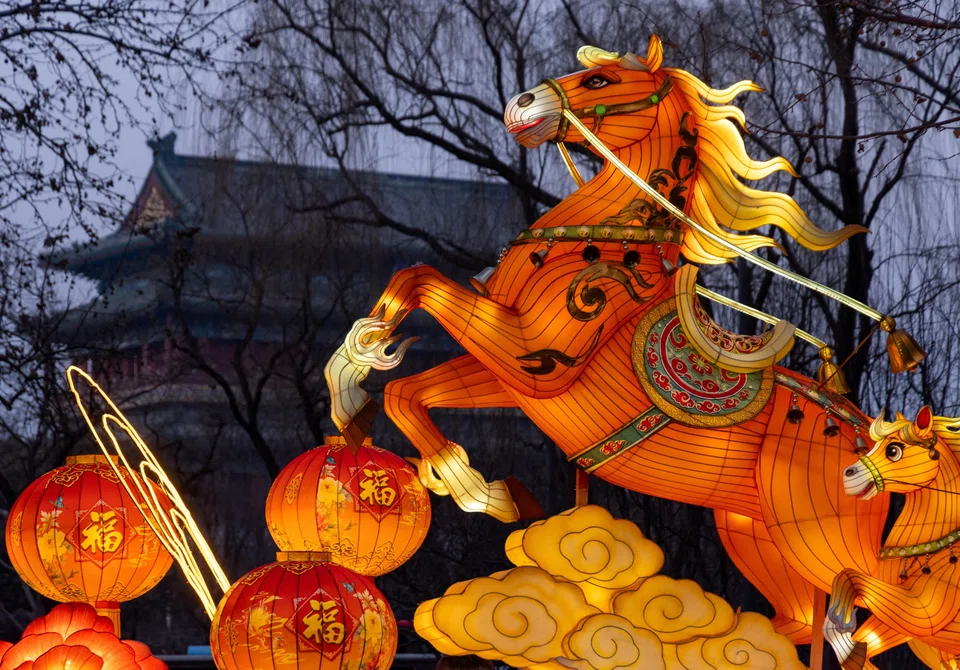
[SINGAPORE] Matters of the Chinese zodiac are not the forte of this column, but the popular narrative in the market is that the Year of the Fire Horse will embody themes such as dynamism, momentum, transformation and volatility.
For investors who endured the white-knuckle ride that was the Year of the Wood Snake, this might not be a surprise.
Over the past year, global market sentiment has been buffeted by US President Donald Trump’s trade policy chaos, a massive buildout of artificial intelligence (AI) infrastructure, and escalating geopolitical uncertainties.
Yet, the global economy has not faltered, and a number of key stock indices have repeatedly marked new all-time highs.
From the beginning of calendar 2025 to the end of last week (Feb 13), the S&P 500 climbed 16.2 per cent and the Nasdaq 100 advanced 17.7 per cent.
This was despite some mega-cap stocks – such as Amazon and Microsoft – suffering big sell-offs in recent weeks.
Some major markets around the world have performed even better. The Stoxx Europe 600 was up 21.7 per cent, while Japan’s Nikkei 225 climbed 42.7 per cent.

Even China managed to outperform the US, despite being a particular target of Trump’s trade tariffs. The CSI 300 Index was 18.4 per cent higher, the Hang Seng China Enterprises Index rose 23.9 per cent, and the Hang Seng Index was up 32.4 per cent.
Meanwhile, the spot price of gold leapt about 90 per cent during the same period, fuelled at least partly by global central banks diversifying their exposure away from US Treasury bonds.
These moves may seem confusing and even contradictory to many investors. Is the global economy really immune to Trump’s trade tariffs? What will underpin the value of gold over the longer term?
If concerns about the big AI investments failing to generate sufficiently high returns turn out to be true, wouldn’t the big technology companies that have driven the S&P 500 up take a beating?
And, if the big AI investments eventually pay off, wouldn’t that mean big white-collar layoffs?
Much like the supposed nature of the Fire Horse, markets tend not to wait for everything to become clear before reacting to new trends.
Investors should be prepared to ride the momentum wherever it unfolds in 2026, and change horses when necessary.
Sell America, buy China?
One investment theme that has demonstrated sustained momentum into the Year of the Fire Horse is “Sell America”.
Foaled in the wake of the “Liberation Day” tariffs, it has been fed and watered over the past year by the Trump administration’s attacks on the Federal Reserve’s independence, and its brusque treatment of the country’s international allies.
Its most visible manifestations are the nearly 11 per cent decline in the US dollar index since the beginning of 2025, the strong rise in the price of gold, and the relative underperformance of American stocks.
The most straightforward way for investors to ride this trend is probably to load up on non-US stocks. Among the markets in Asia that appear compelling right now is China, not least because of its burgeoning technology sector.
A year ago, China’s DeepSeek stunned the market with a high-performing AI model that it had produced cheaply, without using the most advanced chips.
“The market has yet to fully appreciate how rapidly China’s domestic AI ecosystem is innovating around constraints, such as architecture choices, open-source diffusion, and engineering pragmatism that can compound quickly when capital is directed with intent and accompanied by policy support,” said Nicholas Yeo, head of China equities at Aberdeen Investments.
The country has also shown remarkable resilience in the face of Trump’s tariffs.
In fact, its overall exports grew last year, as its shipments to other parts of the world expanded, resulting in a record trade surplus of US$1.2 trillion.
This was a reflection of China’s excess manufacturing capacity and weak domestic demand, of course.
Yet, the policies required to correct this deep-seated imbalance – such as consumption stimulus, housing stabilisation measures and some currency strengthening – are likely to be viewed positively by investors.
“While the near-term environment remains uneven, the combination of targeted fiscal easing, monetary loosening and industrial upgrading initiatives continues to boost confidence in the medium term,” said Stuart Rumble, head of investment directing for the Asia-Pacific at Fidelity International. “Equity valuations have re-rated modestly, but remain reasonable relative to historical averages and global peers.”
Reform momentum in Singapore
Back in Singapore, some Fire Horse energy could be useful in maintaining the momentum of local market reforms.
From the beginning of calendar 2025 up to the end of last week, the Straits Times Index was up 30.4 per cent and the iEdge Singapore Next 50 Index rose by an almost identical 30.5 per cent.
Much of these gains were driven by anticipation of billions of dollars being distributed to fund managers under the Equity Market Development Programme (EQDP), and a handful of the largest companies in the market having taken steps to unlock value and reposition their core businesses.
This may have been the “easy money”. Earlier this month, additional measures were announced to enable more promising companies to obtain funding for growth.
These included an expansion of the EQDP from S$5 billion to S$6.5 billion, and the launch of a second S$1.5 billion tranche of the Anchor Fund.
A new workgroup headed by Minister for National Development Chee Hong Tat will also be convened to recommend measures to strengthen Singapore’s position in fields such as venture capital, private equity, private credit and securitised assets.
Meanwhile, under the Value Unlock programme announced in November, S$30 million of grants will be provided to help listed companies build competencies in corporate strategy, capital optimisation and investor relations.
Singapore’s companies should move fast to take advantage of these initiatives, even if they do not feel they are entirely ready.
Gaining the attention of eager investors and garnering a higher market valuation should not be viewed as a final goal, but a first step towards seizing new opportunities to expand in interesting new directions.